China's mass testing mantra is building a waste mountain / Photo: © AFP

 Swiss voters expected to shun stricter neutrality
 Rapper-turned-PM faces first big test after Nepal disaster
 Tuchel seeks tonic to England World Cup 'scar' in Spain showdown
 'Helps me cope': Catholic baptisms rise among French youth

 Colombians in Santa Marta stay inside after violence wracks the city
 Iran airlines cancel flights as US sanctions hit
 Meta launches camera-free AI glasses amid privacy pushback
 Australian PM says OpenAI hacked government health website

 Xi arrives in US to personal Trump welcome

 Morocco elects new parliament amid social frustration, youth discontent
 Scheffler and Burns to face Im and Lee in Presidents Cup opener

 Crushing wins for Lyon and Barca in women's Champions League
 Rio breaks record for rainiest September amid powerful El Nino
 At UN, tech chiefs urge caution in AI development
 Russian strikes kill seven in Ukraine, Zelensky vows winter campaign
 Venezuelan shot by ICE needs urgent medical care, mother tells AFP
 Zelensky says Putin using fighters from 47 countries in Ukraine war
 Klopp calls on Germany to 'rise above ourselves' as new era begins

 Russian strikes kill seven in Ukraine as Russia vows no 'pause' to war

 ArcPoint Expands Globally with Institutional Intelligence Platform for Modern Investors

 Ronaldo focussing on 'present' ahead of Wales test
 Outgoing UN chief makes final climate push at New York summit
 Grief and pain flow at hearing for Canadian suicide poison vendor
 Ireland boss Hallgrimsson says timing of Israel remarks 'not clever'
 Weinstein resentenced to 15 years in prison for 2006 sex assault
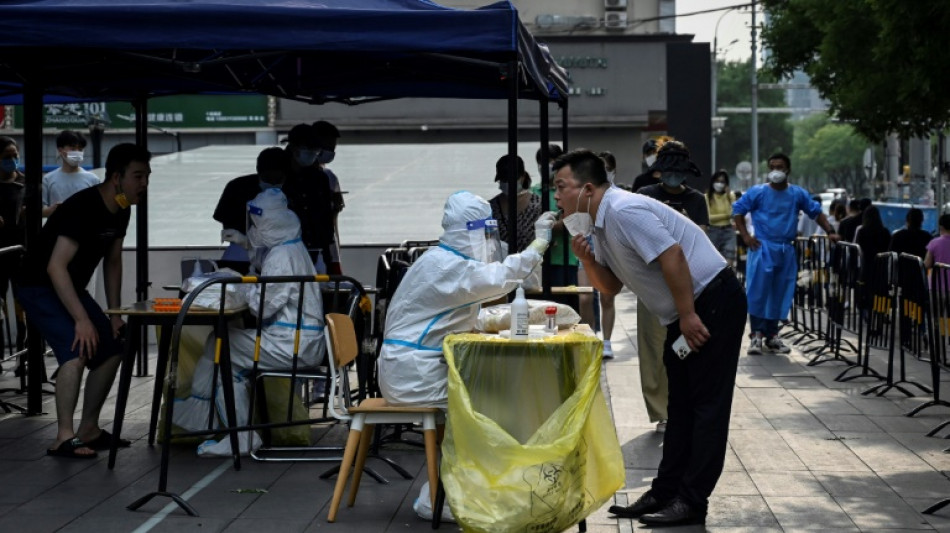
Hazmat-suited workers poke plastic swabs down millions of throats in China each day, leaving bins bursting with medical waste that has become the environmental and economic levy of a zero-Covid strategy.
China is the last major economy wedded to stamping out infections no matter the cost.
Near-daily testing is the most commonly used weapon in an anti-virus arsenal that includes snap lockdowns and forced quarantines when just a few cases are detected.
From Beijing to Shanghai, Shenzhen to Tianjin, cities are now home to an archipelago of temporary testing kiosks, while authorities order hundreds of millions of people to get swabbed every two or three days.
Mass testing appears set to stay as Chinese authorities insist zero-Covid has allowed the world's most populous nation to avoid a public health catastrophe.
But experts say the approach -- a source of political legitimacy for the ruling Communist Party -- creates a sea of hazardous waste and a mounting economic burden for local governments who must plough tens of billions of dollars into funding the system.
"The sheer amount of medical waste that is being generated on a routine basis (is) at a scale that is practically unseen in human history," said Yifei Li, an environmental studies expert at New York University Shanghai.
"The problems are already becoming astronomical, and they will continue to grow even bigger," he told AFP.
Beijing has positioned itself as an environmental leader, cracking down on air and water pollution while setting the goal of making its economy carbon-neutral by 2060, a target experts say is untenable given the current trajectory of investments in coal.
Blanket-testing is now posing a new trash challenge.
Each positive case -- typically a few dozen a day nationwide -- unspools a trail of used test kits, face masks and personal protective gear.
If not disposed of properly, biomedical waste can contaminate soil and waterways, posing threats to the environment and human health.
- Burning questions -
Cities and provinces home to a total of around 600 million people have announced some form of routine testing in recent weeks, according to an AFP analysis of government notices and Chinese media reports.
Different regions have imposed different restrictions, and some areas have suspended the policy in step with falling cases.
Nationwide data on the waste footprint has not been disclosed. But Shanghai officials said last month the city produced 68,500 tonnes of medical waste during its recent Covid lockdown, with daily output up to six times higher than normal.
Under Chinese regulations, local authorities are tasked with separating, disinfecting, transporting and storing Covid waste before finally disposing of it -- usually by incineration.
But disposal systems in the poorer rural parts of the country have long been overburdened.
"I'm not sure that... the countryside really has the capacity to deal with a significant increase in the amount of medical waste," said Yanzhong Huang, a senior fellow for global health at the Council on Foreign Relations.
The spike in waste may prompt some local governments to process it improperly or simply "dump it on the ground" in temporary landfills, said Benjamin Steuer, of the Hong Kong University of Science and Technology.
In a statement to AFP, China's health ministry said it had made "specific demands for medical waste management" as part of national Covid protocols.
- Waste of money? -
Beijing has urged provincial capitals and cities with at least 10 million people to set up a test site within 15 minutes' walk of every resident.
Top leaders also expect local governments to foot the bill for testing at a time when many are struggling to balance the books.
Expanding the model to the whole of the country could cost between 0.9 and 2.3 percent of China's gross domestic product, Nomura analysts said last month.
"The economics of that is tricky," said Li of NYU Shanghai. "You don't want to invest in permanent infrastructure to process what is perceived as a short-term surge of medical waste."
Jin Dong-yan, a professor at Hong Kong University's School of Biomedical Sciences, said "very ineffective and costly" routine testing would force governments to back away from other much-needed healthcare investments.
Authorities are also likely to miss positive cases as the Omicron variant spreads rapidly and is harder to detect than other strains, he told AFP.
"This will not work," he said. "It will just wash down millions of dollars into the sea."
M.Ouellet--BTB