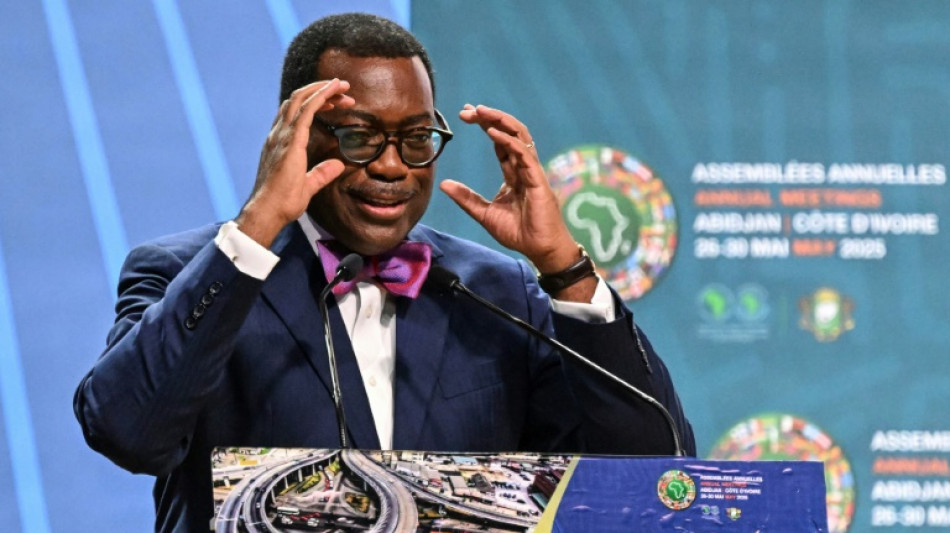
Mauritanian candidate on track to become Africa's next 'super banker' / Photo: © AFP

 Most equities rise after oil price plunge, US data in focus
 Polar oceans transformed as warming melts ice habitats: research

 Lost shark becomes viral star in South Korea
 Dangote to launch $16bn refinery in Kenya
 North Korean leader 'extremely obese': Seoul spy agency
 Yankees and pope-backed White Sox start MLB playoffs with wins

 Malaysia's ex-PM Mahathir in hospital for observation

 'No limits': Marathon world record holder Sawe chasing history
 Countdown begins to biggest-ever Rugby World Cup
 Bangladesh women lose ground after quota reform

 Vietnam admits 'differing opinions' on Hanoi development
 Stocks temper gains as oil pares heavy losses, US data in focus
 New Zealand denies breaching climate commitments to EU

 Albert becomes youngest US scorer in 4-2 win over Chile
 Pirate island's plunging population shows Greece's demographic decline
 With elections ahead, Latvia's Russian-speakers reject Moscow's help

 Brazil football clubs face massive sponsorship blow from betting ban
 ChatGPT maker wants to be the App Store for AI as safety concerns grow
 Women fight fires and sexism in Indonesian Borneo

 Forsling's OT blast lifts Florida over Carolina in NHL opener

 Hurricane Polo sweeps over Mexico's Pacific coast, heads inland
 Grynspan pulls ahead in race to lead UN: diplomat

 Trump touts AI boss pledge to self-regulate
 Oil down, but stocks lower as bond yields rise
 England break down stubborn Czechs to claim first Nations League win
Mauritania's former economy minister Sidi Ould Tah was on Thursday heading the race to become Africa's next "super banker", succeeding Nigeria's Akinwumi Adesina as head of the African Development Bank.
Five candidates began the contest in Ivory Coast's economic capital Abidjan but after two rounds of voting, Tah was out in front and close to securing overall victory, with 48.41 percent of the ballot.
In second place was the Zambian economist Samuel Munzele Maimbo, who saw his tally reduce from the first round to 36.68 percent.
Senegal's Amadou Hott was in third with 9.02 percent, followed by South African former AfDB vice president Bajabulile Swazi Tshabalala, who dropped out after getting 5.90 percent.
The winner has to secure both a majority of votes from all member countries and a majority of votes from African nations.
Tah has already secured 68.42 percent of African votes compared to only 18.77 percent for his Zambian rival and could be elected to the prestigious post in the next round, to be held later on Thursday.
In 2015 it took six rounds of voting to elect Adesina as president of the AfDB, which was founded in 1964 and now has 81 members, including 54 African nations.
The weight of each shareholder state is determined by the extent of its capital contribution to the bank.
As such, the five largest African contributors -- Nigeria, Egypt, Algeria, South Africa and Morocco -- will be especially courted, with the United States and Japan the largest non-regional contributors.
As such, alliance-building is seen as key to secure the prestigious post.
- Five priorities -
The AfDB is one of the world's largest multilateral development banks and is funded by member subscriptions, loans raised on global markets as well as repayments and income from loans.
But Adesina's successor will immediately face a disrupted international economic environment, notably due to announcements from the US Trump administration.
Beyond tariffs, the AfDB is also facing the threat of losing 500 million dollars in US funding for its projects to support low income countries on the continent.
All candidates are promising to make the AfDB even more effective to transform Africa, continuing Adesina's five priorities to light up, feed, industrialise, integrate and improve quality of life.
"I am proud of the legacy we are leaving behind for... my successor, for the bank and for Africa," the outgoing president said in a speech on Tuesday.
"We have built a world-class financial institution that will continue to advance Africa's position within a rapidly changing global development and geopolitical environment," he added.
Adesina said 565 million people had benefited from AfDB projects during his decade in charge.
Major projects include support for the construction of the Gabal El Asfar wastewater treatment plant in Egypt -- the largest in Africa.
The bank also helped finance a bridge connecting Senegal and the Gambia, expanded the port of Lome in Togo and supported sanitation projects in Lesotho and access to electricity in Kenya, he said.
From 2015 to this year, the bank's capital more than tripled from $93 billion to $318 billion, he added.
D.Schlegel--VB