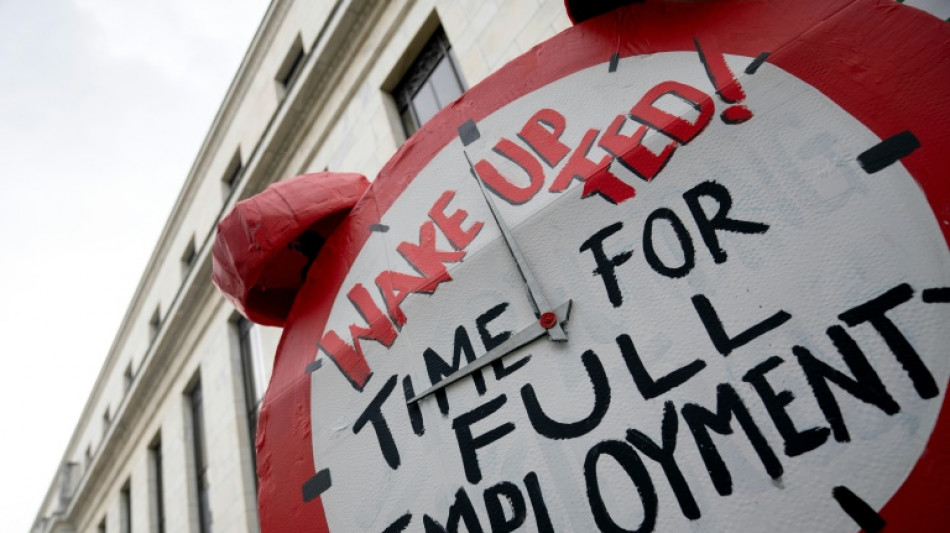
Is recession the only way out of US inflation scourge? / Photo: © AFP/File

 Devan Ekambaram and Susha’s 'Varuvaaiy' Makes History as First Tamil Song Nominated for a Grammy

 Miranda Lambert Leads North Texans with Seven Grammy Nominations for 2027

 DiDi Advances Robotaxi Operations in China with New R2 Vehicle and Expanded Safety Infrastructure

 Smart Car Seats Tested: Do Sensors and Apps Actually Improve Safety?

 5 Strategies for Fort Worth Households to Reduce Summer Electricity Costs
 Central Bank of Malta Links Energy Subsidies to Middle East Conflict and Price Volatility

 Shomari Figures Defies Redistricting in Alabama Amid Disaster Relief Crisis

 BYD Dolphin G Leasing Deal: Plug-in Hybrid Supermini Available from £174 a Month

A massive interest rate hike by the US Federal Reserve and promises of more to come are fueling warnings that the only offramp from the searing price hikes engulfing American families is a full-blown recession.
The Fed remains hopeful it can slow activity and demand, cooling the blistering pace of inflation, without derailing the world's largest economy. But skepticism is growing about the chances of success.
The central bank hiked the benchmark borrowing rate on Wednesday by three-quarters of a point, the biggest increase in nearly 30 years, and indicated a similar move is possible in July.
The super-sized rate increase came as the Fed faces intense pressure to curb soaring gas, food and housing prices that have left millions of Americans struggling to make ends meet and sent President Joe Biden's approval ratings plunging.
The central bank has raised the key rate 1.5 points since March, as the Russian invasion of Ukraine and ongoing Covid-related supply chain issues combine to send prices up at the fastest pace in more than four decades.
Fed Chair Jerome Powell said recession is not the goal, but bringing down inflation "expeditiously" is "essential" since that is vital to a healthy economy.
But Kathy Bostjancic, chief US economist at Oxford Economics, warned that "it becomes very difficult to thread that needle."
The Fed will need a Goldilocks scenario where "a number of things fall into place and at the right time," she told AFP.
The healthy US labor market and strong consumer demand, helped by a beefy stockpile of savings, are working in the Fed's favor and could support activity even as the economy cools.
In the wake of the Fed decision, mortgage rates rocketed to their highest level in 13 years, with the average for a 30-year, fixed rate home loan reaching 5.78 percent.
Drivers still face gas prices at the pump of more than $5 a gallon, although for the first time in days, the national average fell on Wednesday, down from Tuesday's record.
"My colleagues and I are acutely aware that high inflation imposes significant hardship, especially on those least able to meet the higher costs of essentials like food, housing and transportation," Powell told reporters after the rate hike was announced.
- Higher unemployment -
With the shift towards prioritizing the aggressive tightening of lending conditions -- which policymakers see rising to 3.8 percent next year -- the best the Fed might be able to hope for now is a "softish" landing, which would include higher joblessness.
The economy has continued to create jobs: the unemployment rate in May was 3.6 percent, just a tick above its pre-pandemic level, and there are nearly two job openings for every unemployment person, compared to 1.3 pre-Covid.
The Fed chief said "a 4.1 percent unemployment rate with inflation of well on its way to two percent, I think that would be a successful outcome."
But he stressed that "events of the last few months have raised the degree of difficulty" in achieving the soft landing, and it likely will "depend on factors that we don't control."
But a half-point increase in the jobless rate can signal the start of a recession.
Diane Swonk of Grant Thornton, a long-time Fed watcher, called the central bank's outlook "fanciful."
- Rising risks -
Steve Englander of Standard Chartered Bank and a former Fed economist does not expect a recession -- usually defined as two quarters of negative growth -- and said unemployment may not have to increase by that much to achieve the Fed's goals.
But the central bank will have to shrink demand, and "it'll be painful, even if it's not a technical recession."
"The risk of a recession is rising and it's rising sharply," he told AFP.
But it is a risk the Fed is willing to take since it has made fighting inflation the priority.
Bostjancic said a softish landing is still possible, but without tough action to contain prices, the US could face stagflation -- lower or negative growth with high inflation -- last seen in the 1970s and 80s.
"The Fed is worried that if they don't take care of inflation, now, it's going to linger and be a problem many years into the future," she said.
hsto
N.Fournier--BTB