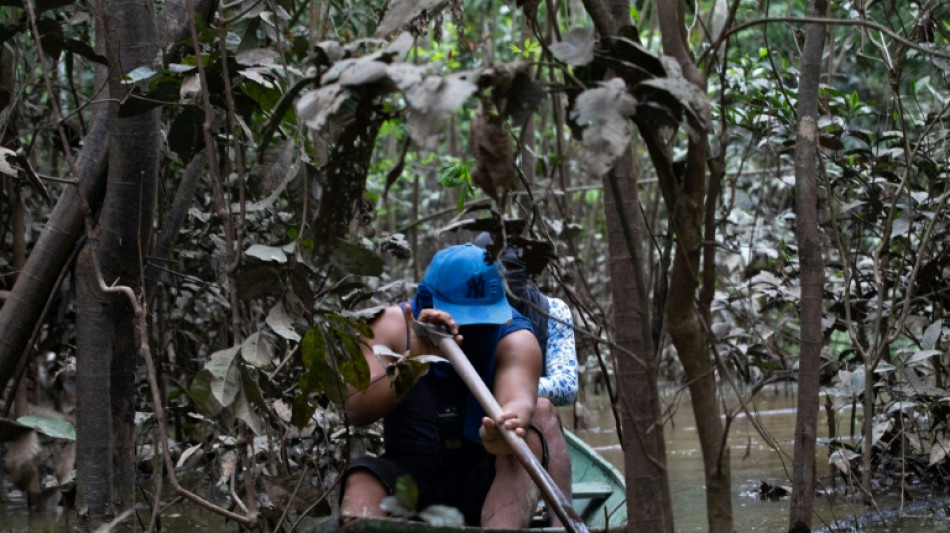
Indigenous team scours remote Amazon for missing Phillips and Pereira / Photo: © AFP

 Devan Ekambaram and Susha’s 'Varuvaaiy' Makes History as First Tamil Song Nominated for a Grammy

 Miranda Lambert Leads North Texans with Seven Grammy Nominations for 2027

 DiDi Advances Robotaxi Operations in China with New R2 Vehicle and Expanded Safety Infrastructure

 Smart Car Seats Tested: Do Sensors and Apps Actually Improve Safety?

 5 Strategies for Fort Worth Households to Reduce Summer Electricity Costs
 Central Bank of Malta Links Energy Subsidies to Middle East Conflict and Price Volatility

 Shomari Figures Defies Redistricting in Alabama Amid Disaster Relief Crisis
Wooden canoes slice soundlessly through the flooded jungles of Javari Valley in Brazil's Amazon region, steered by a team of Indigenous people scouring for clues to the whereabouts of British journalist Dom Phillips and his colleague Bruno Pereira.
Since the pair's disappearance on June 5, about 20 members of the Union of Indigenous Peoples of the Javari Valley (UNIVAJA) have relentlessly searched the area in Atalaia do Norte, one of the world's most remote places.
Phillips, 57, a regular contributor to Guardian, and Bruno Pereira, a 41-year-old expert on Brazil Indigenous communities, were last seen aboard a boat on the Itaquai River -- a snaking muddy-brown channel in the upper Amazon Basin.
"We have been working from 6 am to 6 pm," Orlando de Moraes Possuelo, a consultant with UNIVAJA, told AFP.
He has been coordinating the search across the valley, which is now joined by the federal police and army as international attention grows over the fate of the two missing men.
The men use wooden oars to navigate their way through the flooded jungles, maneuvering around trees and vines.
"They are not motorized canoes," Possuelo said. "And the search is being carried out in the igapos, which is what we call the forest area that floods during the monsoon season."
In the non-flooded areas, the searchers -- who are Indigenous people belonging to five ethnic groups -- trek on foot through muddy terrain, hacking with machetes through thick vegetation and keeping on alert for any signs of Phillips and Pereira.
The British journalist was working on a book on sustainable ways to protect the world's largest rainforest, while Pereira -- who was on leave from his job with the Brazilian government's Indigenous affairs agency, or Funai -- was accompanying him as a guide.
- Little hope -
The site of their disappearance borders Peru and Colombia, and is home to about 20 isolated Indigenous groups where drug traffickers, loggers, miners and illegal fishermen operate.
On Sunday, they made a discovery -- a health card, black pants, a black sandal and a pair of boots belonging to Pereira; a pair of boots and a backpack containing Phillips' personal clothing.
"It was the Indigenous people who found them," Possuelo said. "After we found this place with their belongings, the movement in the region increased."
The items were found submerged near the house of a fisherman, Amarildo da Costa Oliveira, who witnesses said they saw pass at high speed onboard a boat going in the same direction as Phillips and Pereira before their disappearance.
He was arrested on June 7 and has denied any involvement. Traces of blood on his boat are currently being analyzed.
A second man, Oseney da Costa Oliveira, was also arrested as he was "suspected of participating in the affair," police said Tuesday. Brazilian media said he was Amarildo's brother.
Possuelo says he thinks Phillips and Pereira's disappearance could be related to the illegal fishing of large Amazonian fish, such as the pirarucu -- which is native to the bio-diverse basin and fetches a hefty price at the markets.
He appears to have given up hope of finding the two men alive.
"We believe that in the next few days or in the next few hours, we can find the rest of their equipment, maybe the boat, and probably the bodies," he tells AFP.
R.Adler--BTB
