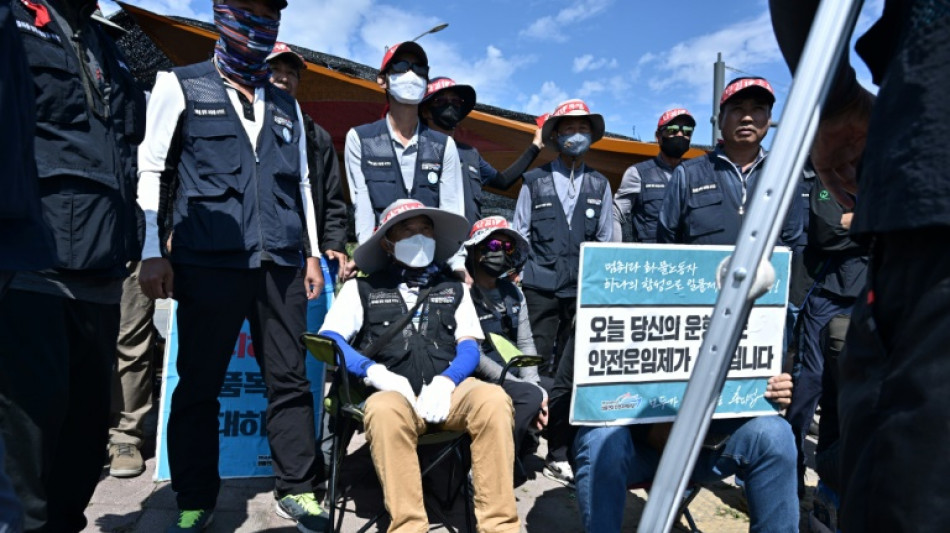
South Korean truckers end week-long strike / Photo: © AFP

 Devan Ekambaram and Susha’s 'Varuvaaiy' Makes History as First Tamil Song Nominated for a Grammy

 Miranda Lambert Leads North Texans with Seven Grammy Nominations for 2027

 DiDi Advances Robotaxi Operations in China with New R2 Vehicle and Expanded Safety Infrastructure
 Smart Car Seats Tested: Do Sensors and Apps Actually Improve Safety?

 5 Strategies for Fort Worth Households to Reduce Summer Electricity Costs
 Central Bank of Malta Links Energy Subsidies to Middle East Conflict and Price Volatility

 Shomari Figures Defies Redistricting in Alabama Amid Disaster Relief Crisis
South Korean truck drivers will return to work Wednesday after reaching an agreement with Seoul to end an eight-day protest over wages and fuel costs that had snarled global supply chains.
The truckers' industrial action had disrupted production and shipments for the crucial steel, petrochemical and automobile sectors, in an early test for new President Yoon Suk-yeol who has vowed to deal with labour disputes "strictly".
The Cargo Truckers Solidarity Union reached an agreement with the transport ministry late Tuesday and truckers will return to work from Wednesday, the ministry said in a statement.
The ministry said is "relieved" that the union decided to end their strike, adding "we are very sorry for causing concern for the people due to discruptions in logistics and production".
The truckers called the strike to protest over sharp rises in fuel prices -- with inflation at its highest level in more than a decade -- and the ending of a minimum wage guarantee.
The Safe Trucking Freight Rates System was due to expire later this year but the two sides reportedly agreed to keep it in place.
The policy was designed to help prevent dangerous driving by truckers and guarantee minimum freight rates.
"All we are asking for is to remove the uncertainty in our lives," union member Cho Jeong-jae told AFP Tuesday at a protest in Incheon, a city bordering Seoul.
"Our livelihood is at stake."
Cho said the rising cost of fuel had not been reflected in the fees businesses pay to transport their goods.
"When fuel prices drop, it's reflected very quickly by lowering freight fees," Cho said. "But that's not the case when fuel prices rise."
The strike in Asia's fourth-largest economy was the latest blow to international supply chains that are already strained by Covid-19 lockdowns in China, and Russia's invasion of Ukraine.
South Korea is the world's largest memory chip exporter and home to global chip powerhouse Samsung Electronics, as well as large car companies including Kia and Hyundai Motors.
The country's trade ministry said Tuesday that the action had resulted in losses for businesses of about 1.6 trillion won ($1.2 billion).
Prime Minister Han Duck-soo had called for an end to the strike at a cabinet meeting on Tuesday, saying "it's causing a major setback to the logistics network."
On the campaign trail, President Yoon -- a political novice -- had vowed to be strict on labour disputes and indicated he was more pro-business on issues such as minimum working hours.
At least 23 members of the Cargo Truckers Solidarity Union have been arrested for "illegal activities" at the protests, according to the transport ministry.
N.Fournier--BTB
