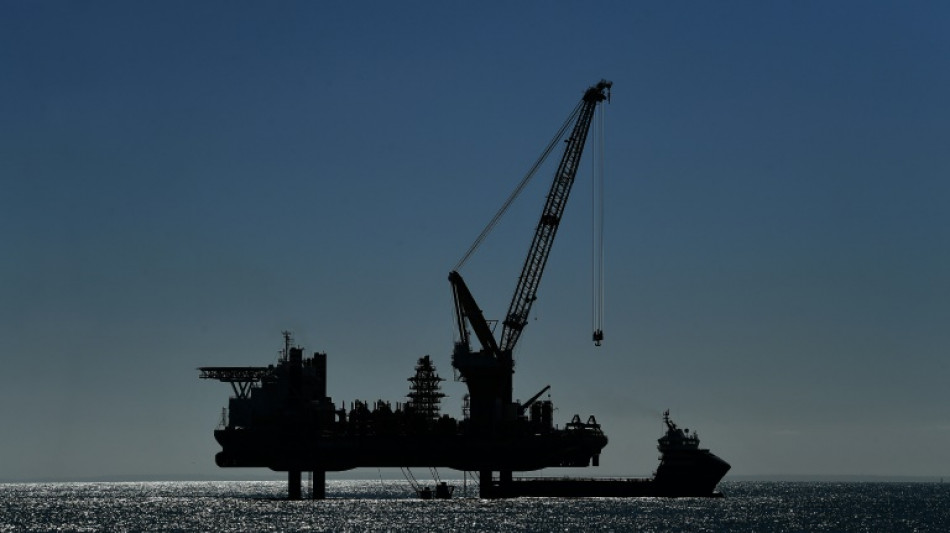
Climate: offshore methane gas leak spotted from space / Photo: © AFP/File

 Iran airlines cancel flights as US sanctions hit

 Meta launches camera-free AI glasses amid privacy pushback

 Australian PM says OpenAI hacked government health website

 Xi arrives in US to personal Trump welcome

 Morocco elects new parliament amid social frustration, youth discontent

 Scheffler and Burns to face Im and Lee in Presidents Cup opener

 Crushing wins for Lyon and Barca in women's Champions League

 Rio breaks record for rainiest September amid powerful El Nino

 At UN, tech chiefs urge caution in AI development

 Russian strikes kill seven in Ukraine, Zelensky vows winter campaign

 Venezuelan shot by ICE needs urgent medical care, mother tells AFP

 Zelensky says Putin using fighters from 47 countries in Ukraine war

 Klopp calls on Germany to 'rise above ourselves' as new era begins

 Russian strikes kill seven in Ukraine as Russia vows no 'pause' to war

 ArcPoint Expands Globally with Institutional Intelligence Platform for Modern Investors

 Ronaldo focussing on 'present' ahead of Wales test

 Outgoing UN chief makes final climate push at New York summit

 Grief and pain flow at hearing for Canadian suicide poison vendor

 Ireland boss Hallgrimsson says timing of Israel remarks 'not clever'

 Weinstein resentenced to 15 years in prison for 2006 sex assault

 Fendi brings disco bling, Italian style, to Milan Fashion Week

 French court confirms rape trial for PSG and Morocco star Hakimi

 President tells Trump that Iran will never 'bend at the knee'

 أليكس بودي والبروفيسور الدكتور شتيفان هاوبت يتفقان على التعاون من أجل مجموعة فنية أسطورية في رومانيا

 U2 at 50: Irish rockers reveal anniversary album

Scientists have for the first time used satellite data to detect a major offshore leak of the potent greenhouse gas methane, according to peer-reviewed research.
The findings add a crucial tool to an expanding space-based arsenal for pinpointing previously invisible methane plumes from the oil and gas industry.
Fossil fuel operations globally emitted about 120 million tonnes of the planet-warming gas in 2020, nearly one-third of all methane emissions from human activity, according to the International Energy Agency (IEA).
The new study in the journal Environmental Science and Technology Letters identified a plume from an oil and gas production platform in the Gulf of Mexico that spewed some 40,000 tonnes over a 17-day period in December.
The platform, near Campeche in southern Mexico, is in one of the country's biggest oil producing fields.
"Our results demonstrate how satellites can detect methane plumes from offshore infrastructure," senior author Luis Guanter, a professor at Valencia Polytechnic University, said in a statement.
"It opens the door to systematic monitoring of industrial emissions from individual offshore platforms."
Satellite-based methods for spotting methane leaks over land have developed rapidly in the last few years, training an uncomfortable spotlight on regulators and industry.
But equivalent techniques have been lacking for leaks from offshore oil and gas operations, which account for about 30 percent of global production.
- Huge short-term potential -
Up to now, ocean water's capacity to absorb short-wave infrared radiation has limited the amount of reflected light reaching space-based sensors.
Guanter and colleagues overcame this problem with a new method for measuring solar radiation bouncing off the water's surface, called Sun-glint observation mode.
Methane is responsible for roughly 30 percent of the global rise in temperatures to date.
While far less abundant in the atmosphere than CO2, it is about 28 times more powerful as a greenhouse gas on a century-long timescale. Over a 20-year time frame, it is 80 times more potent.
Methane lingers in the atmosphere for only a decade, compared to hundreds or thousands of years for CO2.
This means a sharp reduction in emissions could shave several tenths of a degree Celsius off of projected global warming by mid-century, helping keep alive the Paris Agreement goal of capping Earth's average temperature increase to 1.5C, according to the UN Environment Programme (UNEP).
Last year saw a record jump in the atmospheric concentration of methane, US government scientists reported in April.
Methane is generated by the production, transport and use of fossil fuels, but also from the decay of organic matter in wetlands, and as a by-product of livestock digestion in agriculture.
At last year's COP26 climate summit in Glasgow, more than 100 nations agreed under the Global Methane Pledge to reduce emissions 30 percent by 2030. But several major methane emitters -- including China, Russia, Iran and India -- failed to sign.
F.Pavlenko--BTB