Trump's trade math baffles economists / Photo: © AFP

 Indiana River Otters Make Comeback After Decades of Conservation Efforts

 Shruti Haasan Reveals Kamal Haasan’s Defense of Her Film Career

 Penrith Panthers Face Backlash Over Decision to Disband Pantherettes Cheerleading Squad

 Make-A-Wish Announces 2026 Starblazer Award Honorees; Allied World Becomes First Corporate Founder

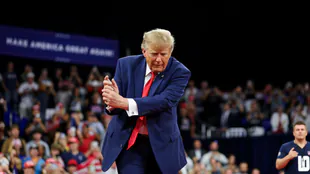 Lee-Trump Golf Diplomacy Faces Diplomatic Dilemma Ahead of G20 Summit

 Mavericks Defeat Jazz 112-100 Behind Washington’s 26 Points and Second-Half Surge

 BingX: Major Announcement of Far-Reaching Significance

Trade economists were scratching their heads on Thursday at the formula used by the White House to measure trade imbalances and inflict punishment on all its global trading partners.
Handed a chart in the White House Rose Garden, US President Donald Trump presented the rationale for how his administration would impose reciprocal tariffs on partners ranging from major powers like China and Europe to the smallest nations.
The figures presented bear little resemblance to actual tariff levels, however.
While Trump's chart claims China imposes a 67 percent tariff on American products, World Trade Organization data shows China's average tariff in 2024 was just 4.9 percent.
Similar discrepancies exist for the European Union (39 percent versus 1.7 percent) and India (52 percent versus 6.2 percent).
Administration officials explained they incorporated factors beyond tariffs, including environmental standards and "currency manipulation and trade barriers."
The US trade representative published a formula with Greek letters to provide some academic credibility to the calculations -- and one that actually did not include tariff levels as a factor.
Following Trump's trade philosophy, the formula takes a country's trade deficit with the US as evidence of unfairness.
Officials then divided this deficit by the value of goods imported from that country to determine what they call "the tariff rate necessary" to balance the bilateral deficits.
Two other variables were included -- price elasticity of import demand and elasticity of import prices -- but were set such that they cancelled each other out.
Trump said the administration then halved the resulting figure because "we're nice," while imposing a flat 10 percent tax on countries with which the US maintains a trade surplus.
"There's so much wrong with this approach that it's hard to know where to start," Nobel laureate Paul Krugman, a trade economist and frequent Trump critic, wrote on his blog.
Trump's focus on trade deficits reflects his view that they represent American job losses to foreign production -- a zero-sum standpoint that contradicts established international economic principles since World War II.
To most economists, Trump's deficit-obsessed beliefs dismiss the intricacies of the US economy, the world’s biggest, where a company like Apple manufactures 90 percent of its products abroad, but delivers huge wealth domestically.
H.Kuenzler--VB