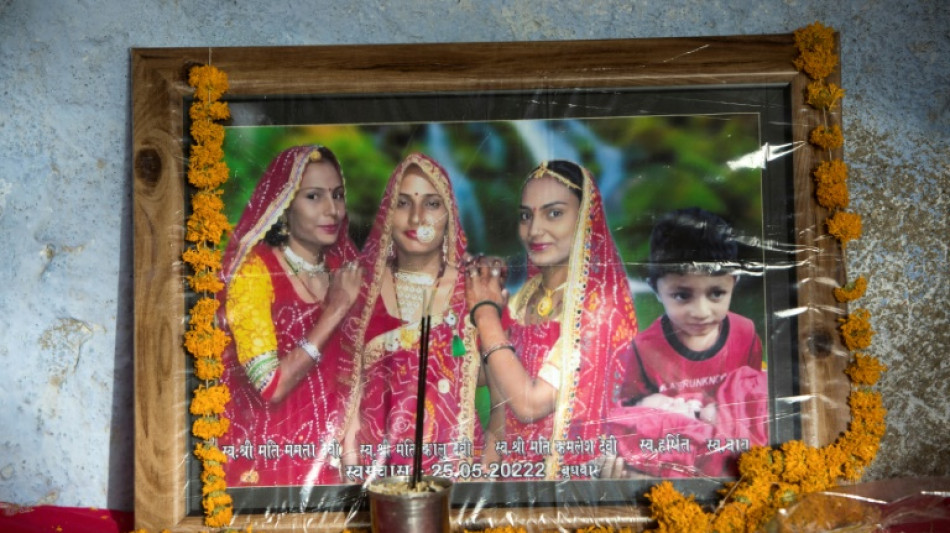
Death of three sisters spotlights India dowry violence / Photo: © AFP

 Xi arrives in US to personal Trump welcome

 Morocco elects new parliament amid social frustration, youth discontent

 Scheffler and Burns to face Im and Lee in Presidents Cup opener

 Crushing wins for Lyon and Barca in women's Champions League

 Rio breaks record for rainiest September amid powerful El Nino

 At UN, tech chiefs urge caution in AI development

 Russian strikes kill seven in Ukraine, Zelensky vows winter campaign

 Venezuelan shot by ICE needs urgent medical care, mother tells AFP

 Zelensky says Putin using fighters from 47 countries in Ukraine war

 Klopp calls on Germany to 'rise above ourselves' as new era begins

 Russian strikes kill seven in Ukraine as Russia vows no 'pause' to war

 ArcPoint Expands Globally with Institutional Intelligence Platform for Modern Investors

 Ronaldo focussing on 'present' ahead of Wales test

 Outgoing UN chief makes final climate push at New York summit

 Grief and pain flow at hearing for Canadian suicide poison vendor

 Ireland boss Hallgrimsson says timing of Israel remarks 'not clever'

 Weinstein resentenced to 15 years in prison for 2006 sex assault

 Fendi brings disco bling, Italian style, to Milan Fashion Week

 French court confirms rape trial for PSG and Morocco star Hakimi

 President tells Trump that Iran will never 'bend at the knee'

 أليكس بودي والبروفيسور الدكتور شتيفان هاوبت يتفقان على التعاون من أجل مجموعة فنية أسطورية في رومانيا

 U2 at 50: Irish rockers reveal anniversary album

 Алекс Боді та проф. д-р Стефан Гаупт домовилися про співпрацю щодо легендарної колекції мистецтва в Румунії

 Alex Bodi și prof. dr. Stefan Haupt încheie un acord de cooperare pentru o colecție de artă legendară în România

 Alex Bodi and Prof. Dr Stefan Haupt agree to collaborate on a legendary art collection in Romania

Before the three sisters and their children were found dead in a well, they left a message blaming the family they had married into.
Kalu, Kamlesh and Mamta Meena were victims of a dispute over dowries, the often hefty sums Indian parents pay to marry off their daughters.
The sisters had wed brothers from the same household and lived under the same roof, but suffered constant violence from their husbands and in-laws, according to the trio's grieving relatives.
They were abused constantly, they say, including when their father failed to meet demands for more money.
All three were found dead last month near their marital home, a village on the outskirts of Jaipur, along with Kalu's four-year-old son and infant child. Both Kamlesh and Mamta were pregnant.
"We don't wish to die but death is better than their abuse," read a message on WhatsApp left by one of the sisters after their disappearance, a cousin said.
"Our in-laws are the reason behind our deaths. We are dying together because it's better than dying every day."
Authorities are investigating and currently treating the deaths as suicides, a senior police officer in Jaipur told AFP.
The sisters' distraught father, Sardar Meena, said life had been a living hell for his daughters, whose husbands banned them from pursuing their education and constantly harassed them for more payments.
"We had already given them so many things, you can see them in their home," he told AFP, counting off the beds, television sets and refrigerator he provided to the family.
"I am the father of six girls, there is a limit to how much I can give," added Sardar, who earns a meagre income as a farmer.
"I had educated them and just doing that was difficult."
Police have arrested the three husbands, their mother and a sister-in-law on charges of dowry harassment and spousal abuse.
AFP's attempts to contact the men's family were unsuccessful.
- 'Dignity of the family' -
India outlawed the practice of paying dowries more than 60 years ago, and harassment or extortion over the payments is a criminal offence.
But the custom persists, particularly in rural areas, undergirded by social conventions that treat women as an economic burden and demand compensation for accepting them as brides.
Local news outlets regularly report on marital property disputes that end in murder.
Last year, a man in the southern state of Kerala was jailed for life after using venomous snakes to murder his wife and take sole control of their property, which included a new car and 500,000 rupees ($6,500) provided by her family as dowry.
Courts have also been punitive in their treatment of dowry harassment, last month jailing a man in Kerala for 10 years after his payment demands were blamed for driving his wife to suicide.
A pervasive taboo around divorce -- only one in 100 Indian marriages end in dissolution -- has kept married women from contemplating escape from abusive situations.
For the Meena sisters, leaving was never seen as an option, even though their relatives were aware of the violence.
"Once they were married, we thought they should remain in their marital homes, to maintain the dignity of the family," Sardar said.
"If we had gotten them remarried in another home, and if that situation turned out to be worse, then what will we do? We'll lose face."
- 'End of the road' -
India's National Crime Records Bureau recorded nearly 7,000 dowry-related killings in 2020 -- around 19 women every day.
The same agency reported that more than 1,700 women killed themselves that year over "dowry-related issues".
Both figures are dependent on reports to police, and experts say the actual number of cases is much higher, as with other data on family violence.
"In an hour, some 30 to 40 women are victims of domestic violence... and these are just documented (cases), so it must be much more than that," Kavita Srivastava, an activist with India's People's Union for Civil Liberties, told AFP.
Srivastava said the dowry dispute involving the Meena sisters was just one part of their tormentors' efforts to control their lives and restrict their independence.
The fundamental cause, she added, was a widespread social acceptance of domestic violence in India that leaves women feeling trapped in oppressive and violent relationships.
"If even one woman has to kill herself because her marital life seems like the end of the road," she said, "I feel the Indian state has failed for those women."
N.Fournier--BTB