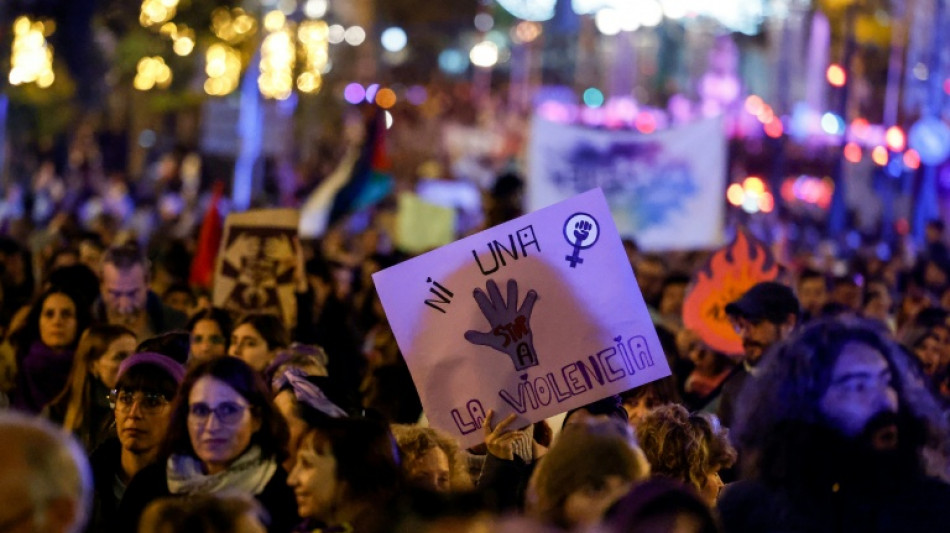
Spain targets men's 'deafening silence' in gender violence battle / Photo: © AFP

 Barca sign Croatia goalkeeper Livakovic
 Rain delays England's bid to put off-field incidents behind them
 World record holder Sawe withdraws from Berlin Marathon

 Driven by faith, activists stand up to fellow Jews to protect Palestinians
 Therapy Culture Performance: How the Lindsay Clancy Trial Sparked a Trend of Viral Maternal Distress
 Norway's King Harald, 89, in 'extremely serious' condition

 How a glacier collapse may have caused Nepal-Tibet disaster

 Harmovest Capital Strengthens Global Financial Services Through Technology and Compliance

 Nvidia to buy AI platform Hugging Face for $12.9 bn: report

 Palace intrigue in Uganda as succession battle heats up

 'Housing First' approach gets Swedish city's homeless off streets

 Czech duo Muchova and Mensik win US Open mixed doubles title
 Japan's 'polka dot queen' artist Yayoi Kusama dies aged 97

 Nepal-Tibet disaster: what we know

 China deploys record number of ships around Taiwan as pressure grows

 Ruthless Bayern target treble as rivals reboot on Bundesliga return

 What experts know so far about Nepal's deadly floods

 UEFA set to withdraw FIFA boycott threat ahead of Champions League draw

 Sumo moves to beat Japan summer heat as temperatures rise

 'Be more honest': Markets crave clarity from cryptic Fed chair

 Climate change leaves its mark on America's largest reservoir

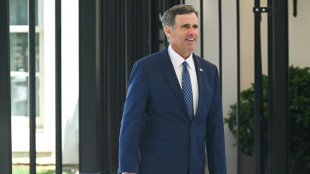 CIA director warned Russia not to attack NATO members: US media

 Search for missing after Nepal-Tibet floods kills at least 160
 Meta, US states agree $18 bn settlement in landmark teen safety case

 What scientists know so far about Nepal's deadly floods

Feminist activists in Spain say inaction and men's silence are hindering the eradication of abuse, as the country celebrates 20 years of a pioneering law against gender-based violence.
The murder of Ana Orantes, a 60-year-old woman who had reported violence against her to the authorities and on television before being burned alive by her ex-husband in 1997, shocked the nation into action.
Parliament ended up adopting a law that entered into force in 2005 and recognised gender-based violence as a human rights violation for the first time, inspiring other countries.
The legislation laid the ground for a range of new support measures for women, including specialised courts, free legal assistance, emergency housing, prosecution even if the victim did not submit a complaint and tags keeping abusers away from the victim.
It was the first law in Spain to be conceived with an explicit gender-based perspective, punishing abuse perpetrated by males against their partners or ex-partners.
For lawyer and activist Altamira Gonzalo, the law stood out by aiming to "undermine the patriarchal structure of society, which is what allows and perpetuates inequality and therefore violence".
It was the first European law which sought to change different areas including the health system, media, advertising and "all those aspects of life in which inequality between men and women is reflected", Gonzalo added.
The measures helped bring down the number of femicides, which in 2024 dropped to a low of 48 since such records began in 2008, when 76 women were killed by their partner or ex-partner.
But "there is still lots of work to do with men, and especially with young males" and "macho attitudes", said Manuela Carmena, a former judge and mayor of Madrid from 2015 to 2019.
Equality Minister Ana Redondo said the scale of the problem was "enormous" and "inoculated like a virus in society" that spread on social networks.
- 'Deafening silence' -
Socialist Prime Minister Pedro Sanchez recently called out fellow men for their inaction, speaking of "a silence that covers macho culture's most subtle manifestations, but also the most extreme ones".
"Everywhere, this silence must end, because today it remains a deafening silence," he said at an event marking the 20th anniversary of Spain's gender-violence law.
This week, the Spanish bar awarded an equality prize to Gonzalo and French lawyers Stephane Babonneau and Antoine Camus, who represented Gisele Pelicot in her notorious mass rape trial that generated much soul-searching in Spain.
Pelicot was raped for years by her husband and dozens of men recruited by him online while sedated, and her insistence that the trial in France be made public made her a global feminist icon.
"Under how much silence was the continual rape of Gisele Pelicot maintained for years? How many men knew and kept quiet?" said Sanchez.
Sexual violence is "under-reported in Spain", agreed Gonzalo, a member of the national observatory against gender-based violence.
Nonetheless, the ground-breaking 2005 law has allowed more than three million women to report their suffering and escape from their ordeal, the lawyer added.
Spanish authorities are now widening the law's scope to include newer offences such as online and economic violence as well as "vicarious violence" -- abuse meted out to children with the aim of making the mother suffer.
R.Buehler--VB