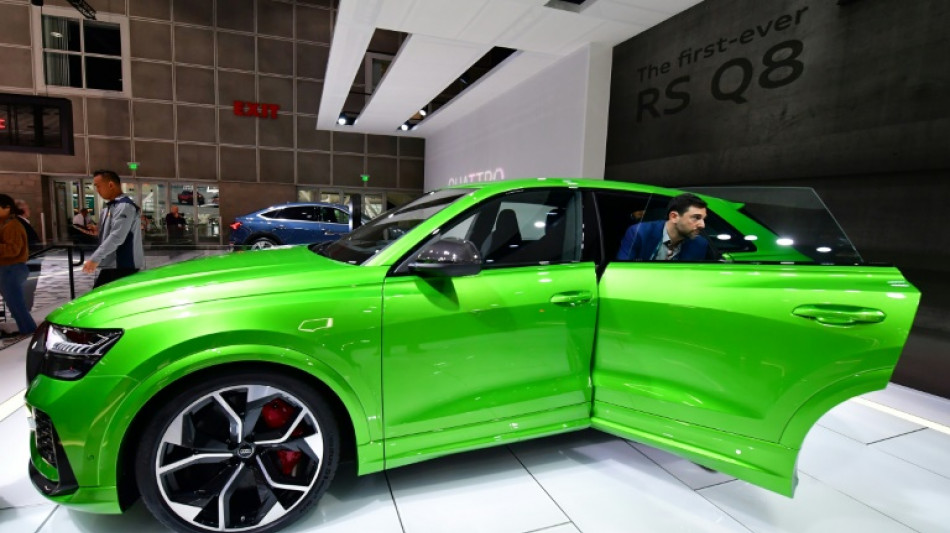
Trump tariffs fuel US auto anxiety / Photo: © AFP

 Killing of Palestinian children and teens by Israel surges in West Bank
 Educators keep 9/11 memory alive for next generation, 25 years on
 Venezuelans view US oil deal with doubt, hope

 Gobena and Jepchirchir power to Sydney Marathon victories

 Iceland in suspense after close EU vote

 Wallabies hold on for victory in Argentina

 Juve notch second straight win, Fiorentina's centenary party falls flat

 Rybakina eases injury fears ahead of US Open
 Djokovic kicks off latest Grand Slam quest under US Open lights

 'Sorry' De Zerbi won't panic after Spurs shambles

 UN, Nepal warn of climate threat after deadly floods

 USTA boss says structure of new player council not yet set

 Tiny Elversberg stun Leverkusen on Bundesliga debut, Dortmund beat Hamburg

 Chinchpoklicha Chintamani begins 2026 arrival procession in Parel

 Editorial questions Letitia James’ record as New York attorney general

 Los Angeles triplets weigh 19.3 pounds in unusually heavy birth

 Matt Leinart assesses Arch Manning and the leading names in college football

 Rural Tamil Nadu students present 64 technology projects at IIT-M research park

 Tamil Nadu goalball team’s national silver highlights need for wider support

 Tamil Nadu and NUS agree to expand postgraduate and research links

 India and China have not named two new border meeting sites

 French campaign sharpens as far right accuses left over civil disobedience calls

 Baladi Map app turns Lebanon’s local problems into a public record

 Thirty-seven Mumbai pilgrims return after Nepal flood disruption

 Ankle ligament tear ends Neeraj Chopra’s 2026 season

A flood of presidential trade policy announcements has kept US automakers on edge since Donald Trump returned to the White House last month.
While some signature threats –- like 25 percent tariffs on Mexico and Canada -- have been wielded and then paused, Trump’s multipronged assault on the international trade order is building up incremental cost pressures, according to auto industry experts.
An additional 10 percent tariff on imports from China -- a major auto parts supplier -- has already been imposed, and a 25 percent tariff on steel and aluminum imports that takes effect March 12 is likely to add another layer to supply and manufacturing costs.
"It's like, a little here, a little there," Ford CEO Jim Farley said this week. "They won't be small together."
And there has been no letup in the stream of trade directives emanating from the Oval Office.
On Thursday, when Trump signed plans for sweeping "reciprocal tariffs" with trading partners, he highlighted an imbalance between US and European Union levies on car imports as a prime example of what he was targeting.
And the following day, the president said he planned to unveil tariffs on foreign cars in early April, though he did not specify how large the levies would be or which countries would be initially earmarked.
If the paused Mexico and Canada tariffs are eventually imposed, Farley said they would "blow a hole" in the US auto industry, which has been integrated with its neighbors since the 1990s North American Free Trade Agreement (NAFTA).
"Most folks recognize the threat, but they don't believe he's going to drop the bomb," said Cox Automotive economist Charlie Chesbrough.
Besides the Detroit giants, foreign automakers also have extensive investments in Mexico and Canada. Honda has factories in the United States, Canada and Mexico and none of the cars it sold in the US market in 2024 were imported from Japan, according to figures from the consultancy GlobalData.
- New US investment? -
Trump administration officials have characterized tariffs as a potential revenue source as well as an incentive for global companies to add manufacturing capacity in the United States.
Trump has placed tariffs at the center of his "America First" approach, describing the levies as a way to right past "unfair" treatment from trade allies.
A White House fact sheet released Thursday pointed out that the European Union imposes a 10 percent tariff on imported cars, while the United States levy stands at 2.5 percent.
Within the EU, German automakers are the biggest source of direct US car imports from Europe. This group includes luxury brands like BMW, Mercedes-Benz and Audi that either have or are part of companies that also operate manufacturing facilities in the United States.
Placating the Trump administration on the EU auto tariff could be relatively painless for Brussels, said Jeff Schuster, vice president of global research at GlobalData.
"US vehicles, especially the vehicles that are popular here, would not be popular in Europe," said Schuster, who expects eliminating the EU tariff would have little impact.
Auto analysts believe foreign automakers may in the coming months unveil plans to expand or build new factories in the United States. However, they face a dilemma about what kind of vehicles to manufacture due to the shifting winds of US politics.
At the same time the Trump administration is pursuing a shake-up to international trade, it is signaling a reversal on efforts to boost electric vehicle capacity, placing the United States out of step with Europe, China and other major markets.
The long lead-time in the auto industry means the cars resulting from current investment decisions may not hit the market for four or five years.
As global companies, "it's not efficient to have different strategies in every market," Schuster said.
A.Kunz--VB