Late trains, old bridges, no signal: Germany's infrastructure woes / Photo: © AFP

 Killing of Palestinian children and teens by Israel surges in West Bank

 Educators keep 9/11 memory alive for next generation, 25 years on
 Venezuelans view US oil deal with doubt, hope

 Gobena and Jepchirchir power to Sydney Marathon victories

 Iceland in suspense after close EU vote

 Wallabies hold on for victory in Argentina

 Juve notch second straight win, Fiorentina's centenary party falls flat

 Rybakina eases injury fears ahead of US Open
 Djokovic kicks off latest Grand Slam quest under US Open lights

 'Sorry' De Zerbi won't panic after Spurs shambles

 UN, Nepal warn of climate threat after deadly floods

 USTA boss says structure of new player council not yet set

 Tiny Elversberg stun Leverkusen on Bundesliga debut, Dortmund beat Hamburg

 Chinchpoklicha Chintamani begins 2026 arrival procession in Parel

 Editorial questions Letitia James’ record as New York attorney general

 Los Angeles triplets weigh 19.3 pounds in unusually heavy birth

 Matt Leinart assesses Arch Manning and the leading names in college football

 Rural Tamil Nadu students present 64 technology projects at IIT-M research park

 Tamil Nadu goalball team’s national silver highlights need for wider support
 Tamil Nadu and NUS agree to expand postgraduate and research links

 India and China have not named two new border meeting sites

 French campaign sharpens as far right accuses left over civil disobedience calls
 Baladi Map app turns Lebanon’s local problems into a public record

 Thirty-seven Mumbai pilgrims return after Nepal flood disruption

 Ankle ligament tear ends Neeraj Chopra’s 2026 season

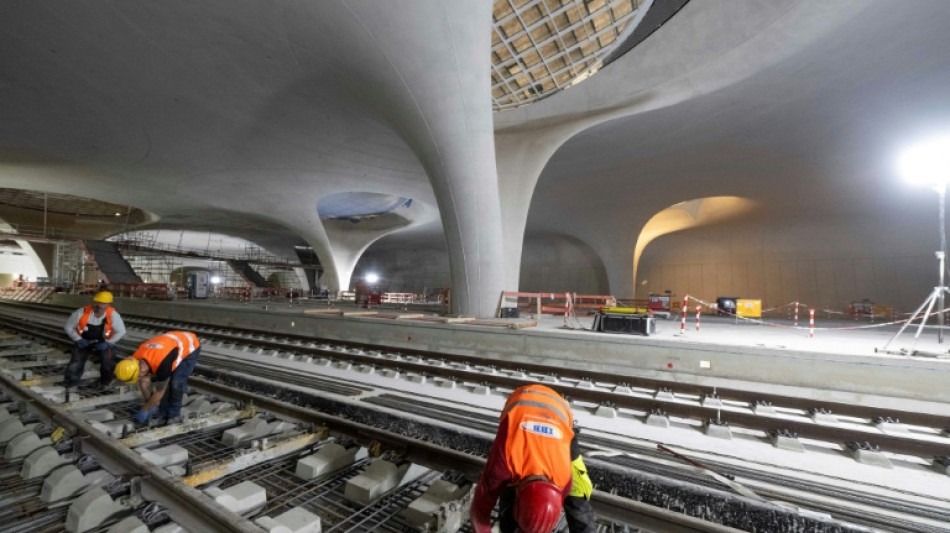
Running late and vastly over budget, a mammoth rail project stands as a monument to what critics say is Germany's glaring failure to tackle long-standing infrastructure woes.
"Stuttgart 21" is envisaged as a major, futuristic rail hub in the southwestern city, a fitting gateway to a region home to the headquarters of corporate heavyweights such as Bosch and Mercedes-Benz.
But 15 years after work began, the project -- which involves replacing the current station with a major underground site -- is not yet complete.
Parts of the city centre remain a vast building site and costs have more than doubled to around 11 billion euros ($11.4 billion).
"Money is just being thrown out of the window," Dieter Reicherter, spokesman for protest group Action Alliance Against Stuttgart 21, told AFP.
"It would be much better if the money had just been used to improve and modernise the existing infrastructure."
Ageing, clapped-out infrastructure and badly planned projects are among some of the most visible problems facing Europe's top economy, whose malaise has become a key issue in the February 23 parliamentary election.
Germany's reputation for efficiency no longer holds true, critics contend -- trains do not run on time, internet and mobile phone coverage is often patchy, and roads and bridges are in a state of disrepair.
- Digital doldrums -
Observers blame years of underinvestment, cumbersome planning and approval procedures and political paralysis caused in recent years by the feuding ruling coalition, whose November collapse precipitated the polls.
A catalogue of problems meant it took 14 years to build a new international airport in the capital Berlin, which finally opened in 2020.
The parlous condition of the railways, run by state-owned operator Deutsche Bahn, is a frequent target of criticism, with passengers complaining of breakdowns, cancelled services and shuttered restaurant carriages.
In 2023 a total of 36 percent of long-distance trains were not punctual, defined as six minutes or more past their scheduled arrival time, according to data from the operator, a rate unthinkable in the past.
The problems sparked international headlines when Germany hosted the Euro 2024 football tournament last summer, with stories of fans facing arduous journeys, frequent delays and being left stranded on platforms.
Elsewhere there are concerns about the state of the country's bridges -- in a 2022 paper, the transport ministry identified 4,000 of them in need of modernisation.
Last September a bridge in Dresden collapsed into the Elbe river in the early hours, causing no injuries but snarling traffic in the eastern city.
It is not just physical infrastructure problems holding the country back, with critics also pointing to a slow rollout of new technologies and digitalisation.
Just 11 percent of Germany's fixed broadband connections are of the faster fiber-optic variety, one of the lowest rates among countries of the Organisation for Economic Co-operation and Development, according to OECD data.
- 'Invest, invest, invest' -
The infrastructure woes have been partly blamed on Germany's constitutionally enshrined "debt brake", which limits annual public deficits to 0.35 percent of GDP, hampering borrowing and keeping spending low.
"The overarching reason is too little investment," ING bank analyst Carsten Brzeski told AFP.
He urged the next government to "invest, invest, invest", and suggested setting up an infrastructure fund and coming up with a 10-year plan.
Both the centre-right CDU, likely to take power after the vote, and Chancellor Olaf Scholz's SPD have voiced openness to easing the debt brake.
Berenberg bank economist Salomon Fiedler said there was a good chance of "helpful reforms" under the country's new leaders.
"I do expect that the next government will try to streamline bureaucratic procedures to speed up investment projects," he told AFP.
But that may be little comfort to residents of Stuttgart whose city centre has faced long-running disruption due to the monster rail project.
"When you come to Stuttgart by train, you have to walk around the construction site," said protest activist Reicherter. "It is like a long-distance hiking trail."
The alliance opposes the project on numerous grounds, including that its main aim is not to improve rail traffic but rather to free up space above ground for new real estate projects.
There is light at the end of the tunnel -- Deutsche Bahn believes the project will be mostly up and running at the end of next year, seven years late.
It insists there will be benefits to travellers, such as significant reductions in journey times and a better link to the airport.
But Reicherter dismisses the claims as "fairy tales", and fears follow-up construction will continue for years to come.
"Unfortunately it never stops," he said.
U.Maertens--VB