'What would you have us do?': the plastic credits problem / Photo: © AFP

 Trump says AI data center opponents want to be 'backwards and poor'

 Pakistan ditch coaches, send seven players home after England defeats

 Galliano pulls Met Gala exhibit after antisemitism backlash

 Afghan people should 'not be abandoned': top Red Cross official

 Six defining moments of Lionel Messi's Argentina career

 Trump blasts US backlash against data centers
 It 'hurts' says Messi of decision to retire from international football
 Benzema ends brief stint with Al Hilal in Saudi league

 Djokovic's Grand Slam future uncertain after brutal US Open defeat

 Turkey says regional defence pact not against any country

 US vows to keep economic pressure on Iran as G20 finance talks begin

 Shein valued at $26.3 bn in Hong Kong market debut

 Crude prices rise above $90 per barrel on US-Iran strikes

 Liverpool sign Barcola from PSG for reported £124 million

 Putin, Xi, Iran's Pezeshkian in Kyrgyzstan for summit

 Fully Permitted Tanzanian Gold Project Clears Path to Construction as Financing, EPCM Fall in Place (LVGLF)

 EdWealth Announces MoneyBench Benchmark Comparing AI Money Answers From Ed, ChatGPT and Gemini

 Root says new balls behind batsmen's struggles in England

 Swollen rivers, washed-out roads hamper Nepal rescue effort

 In France's north, winegrowers bet on a warmer future

 Deadly virus stalks South Africa's sardines
 South Korea women's football body probes 'period' insult

 Transitional Fashion Essentials for Autumn: Key Pieces from M&S and Joe Browns

 China's Xi and Iran's Pezeshkian in Kyrgyzstan, Putin expected

 Rescuers hunt for missing after deadly N.Cyprus ferry accident
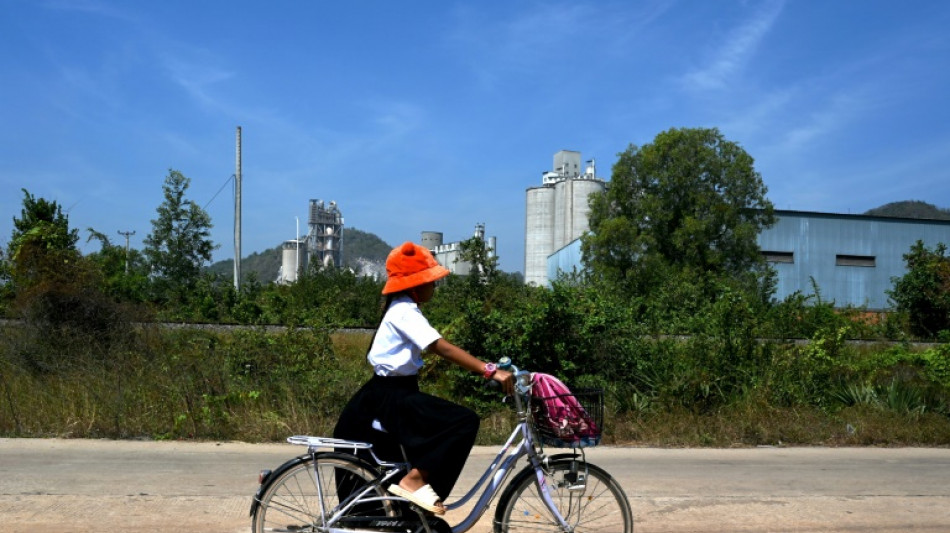
Twice a day, sirens sound at Cambodia's Chip Mong Insee cement kiln, warning limestone will soon be blasted from the karst mountain that overlooks the sprawling industrial site.
White smoke billows from its silver chimney, visible only at night against the dark sky, and dust coats much of the surrounding area, where residents complain of persistent respiratory illnesses that arrived along with the kiln.
The plant might seem an unlikely poster child for the fight against plastic pollution, but cement kilns are central to the burgeoning plastic credits sector, where buyers pay for the collection and disposal of plastic waste.
Credits are meant to tackle the scourge of plastic pollution and boost the supply of recycled plastic.
But they place no obligations on buyers to stop producing or using unrecyclable plastic that ends up in the environment.
And an investigation by AFP and SourceMaterial shows the sector relies heavily on the polluting cement industry to burn collected plastic waste as alternative fuel, despite concerns about health risks and carbon emissions.
This technique, known as co-processing, may send toxic chemicals into surrounding communities, often in countries least equipped to monitor and deal with the problem.
"The burden... is borne by the community, and the benefit is borne by those companies," said Miriam Rotkin-Ellman, a public health scientist.
"You have a complete divorce of who benefits and who's harmed."
Around the Chip Mong Insee kiln, half a dozen local residents all describe the same health problems.
"We're often coughing," said Pheara, who like all those in the area asked to be identified only by a first name.
"Before when we got sick, we'd take a bit of medicine, but now we have to take multiple rounds and even change doctors to get better."
The kiln has brought jobs to the area, but it has not improved her life.
"I don't want to live here because it's so dusty," she said.
"But I don't know who would buy my house."
- 'Lazy solution' -
There is little debate about the problem of plastic pollution -- at least 22 million tonnes flowed into the environment in 2019, according to the OECD.
Worst affected are developing countries with limited waste management, like Cambodia, where plastic clogs streets, fields and streams.
Plastic credits aim to drive funds to this problem.
They are generated by projects that collect and process waste, usually one tonne per credit.
Buyers might then claim that tonne to "offset" or cancel out part of their plastic footprint, or to demonstrate environmental action.
But the sector, concentrated mostly in Asia, Latin America and Africa, has no universal rules.
Self-appointed auditors certify credits based on various standards with little government oversight.
Buyers include subsidiaries of Colgate-Palmolive, PepsiCo and Mondelez, and while the market is still small, BloombergNEF projects revenue could reach $4.2 billion by 2050.
For some, that is no good thing.
It's a "lazy, lazy solution," said Piotr Barczak, circular economy programme manager for ACEN Foundation.
"It enables the plastic-producing companies to further continue their business model."
Companies that offer and certify credits acknowledge that buyers aren't obligated to change.
But they say buying credits, priced around $140-670 each, raises the cost of business-as-usual.
"You start to hit a break-even point, where the economic incentive (is) to take more action," said Sebastian DiGrande, CEO of leading credit registry PCX Markets.
- 'Nobody's testing' -
The sector relies heavily on co-processing, where plastic replaces coal in cement kilns and some leftover ash is used in cement production.
An analysis by AFP and SourceMaterial of four major credit marketplaces found only around a quarter of credits issued were for projects that recycle.
More than two thirds were for co-processing and other forms of incineration.
That is partly because so much plastic waste is unrecyclable.
However, co-processing also offers the cement industry, which accounts for around eight percent of global emissions, the rare chance to boast of "circular" credentials.
While co-processing is regulated and monitored in developed countries, oversight elsewhere is often limited, according to Jorge Emmanuel, a specialist on environmental and health issues at Silliman University in the Philippines.
"Often you might even have laws in the books, but they can be completely meaningless since they are not enforced," he said.
"Nobody is really monitoring emissions," he added, and testing for dioxins at co-processing plants is vanishingly rare because of cost.
- Bottled water -
Cement kilns operate at high temperatures that should avoid releasing persistent organic pollutants like cancer-linked dioxins and PFAS or "forever chemicals."
However, Emmanuel warned that there are windows when dioxins are produced, including when temperatures fluctuate during start-up or cool-down, or as mixed fuel is fed in.
Even in wealthy countries, systems generally do not continuously monitor for these pollutants.
"When you introduce waste... you're bringing in a whole new cocktail of contaminants," explained Lee Bell, policy advisor for the International Pollutants Elimination Network NGO.
These are "ending up in the cement kilns that are not designed to filter (them) out".
Even without co-processing, cement production is linked to pollution and health risks, according to the US Environmental Protection Agency.
Local communities face risks ranging from cancer to heart and lung problems and adverse birth outcomes, said Rotkin-Ellman.
Just outside the kiln wall, Kongthy, 56, said the smell of burning plastic regularly drifts towards her roadside cafe.
Like her neighbours, she has stopped collecting rainwater, gesturing to the dust that settles on surfaces around the plant.
"We don't dare to collect it. We have to drink bottled water instead."
- 'Something perfect' -
Several kiln workers said they were not worried about safety, citing annual health checks and protective equipment offered by the company.
They said the kiln burns everything from used oil and clothes, to plastic bags and even water bottles, which are generally recyclable.
"They have filters," said Vork, who operates machinery at the kiln.
"It's not like they're burning it in a field."
Chip Mong Insee did not respond to requests for comment.
It receives plastic from Tontoton, a company that generates credits bought by companies including Celebrity Cruises and EY, formerly known as Ernst & Young.
Neither firm replied to requests for comment while Tontoton declined to answer questions about its operations.
Its credits are sold on an exchange operated by Zero Plastic Oceans, whose co-founder Vincent Decap said co-processing is simply the best option for plastic waste in many countries.
"We're trying to do something better," he said.
"We're not trying to do something perfect. If you try to do something perfect, you do nothing."
- Invisible pollutants -
Cambodia has one of the world's highest levels of plastic along its coastlines, a study found last year, and waste including plastic is regularly burned openly.
AFP and SourceMaterial placed air quality monitors around the Chip Mong Insee kiln and at a baseline location away from industry and roads.
The monitors showed levels of PM2.5 -- fine particles that can penetrate the lungs -- were higher at the baseline site, most likely due to seasonal crop burning.
Experts caution however that air quality monitors cannot detect the most harmful pollutants caused by burning plastic, and testing for them is both expensive and not widely available.
Cambodia's environment ministry said burning plastic in kilns is regulated and monitored.
It also said open burning of plastic is banned.
- Coal calculations -
Co-processing is often described as reducing emissions by displacing coal, but some experts consider that calculation simplistic.
Emissions from burning coal and plastic are roughly equal, but any comparison must consider the full lifecycle of both materials.
That includes the production process for plastic and transportation emissions if coal is imported.
"Combusting plastic waste will displace further coal extraction," said Ed Cook, research fellow in circular economy systems for waste plastic at the University of Leeds.
But it is not recycling, and "we should avoid, and look for alternatives to, combusting fossil fuels whatever their source," he added.
DiGrande said plastic credit critics often overlook the realities of plastic pollution.
He acknowledged fears about co-processing, and said credits using the technique are declining over time on PCX Markets as money flows to recycling facilities.
But he urged critics to "hold up the health concerns associated with co-processing against the health concerns associated with open burning."
"In an ideal world, we have none of those single-use plastics, we have none of that legacy waste," he said.
"Until then, my question is always, what would you have us do with it otherwise?"
That presents a "false binary," according to Neil Tangri, a senior fellow at the Center for Environmental Public Policy at UC Berkeley's Goldman School.
For him, co-processing is "mismanagement of waste that poses as a waste management system" while failing to address the real issue: reducing production.
Plastic waste is expected to triple by 2060, the OECD says, with less than a fifth recycled.
Negotiations last year to reach the world's first agreement on plastic pollution ended without a deal.
B.Baumann--VB