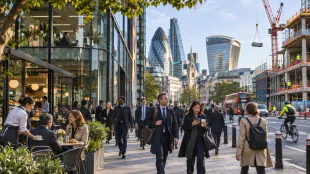
Bank of England set to cut interest rate / Photo: © AFP/File

 Euro-Area Growth Slows to 0.4% While Employment Stalls
 US Wholesale Inflation Eases Monthly but Hits a Four-Year Annual High

 India's Wholesale Inflation Jumps to 12.29% as Fuel Costs Surge

 Japan's Economy Edges Into Contraction as Costly Oil Weighs on Demand

 Colin Farrell and Emma Fogarty on Friendship, Disability, and 'The Slightest Touch'

 Knicks Coach Mike Brown Unfazed by Josh Hart's Offensive Struggles

 River Medway Reveals Financial Struggles Before 'Drag Race' Windfall

The Bank of England was widely expected to cut its key interest rate on Thursday to help support weak British growth even if UK inflation stays elevated.
At its first rate meeting of the year, the BoE is forecast to reduce borrowing costs by a quarter point to 4.50 percent according to analysts' consensus forecast.
"The BoE is likely to justify the move, even though inflation remains above (bank) target, due to a sluggish economy and a softening in the labour market in recent months," said Kathleen Brooks, research director at XTB trading group.
The central bank will also provide its latest growth and inflation forecasts, which could be altered amid US President Donald Trump's tariff war.
Trump has stated that Britain might not escape levies on its exports to the United States, having already imposed tariffs on imports from China and threatened similar action against the European Union. However, he has delayed measures against Mexico and Canada pending talks.
There is widespread concern that such tariffs will cause a renewed spike in inflation that risks hikes to interest rates.
The US Federal Reserve last week left US borrowing costs unchanged but the European Central Bank cut eurozone rates.
Should the BoE reduce its rate Thursday, aiding mortgage holders but hurting savers as retail banks in turn pass on similar cuts to customers, it will be the central bank's third reduction in six months.
The Bank of England cut in August for the first time since early 2020, from a 16-year high of 5.25 percent after UK inflation fell sharply.
It cut further in November.
Britain's annual inflation rate fell to 2.5 percent in December but remains above the BoE target of 2.0 percent.
Britain's economic growth has meanwhile stalled, heaping pressure on the country's Labour government which won power in July thanks in part to its pledge to drive output.
Major central banks last year began to cut interest rates that had been hiked in efforts to tame inflation.
UK inflation had soared to above 11 percent in October 2022, the highest level in more than four decades, as the Russia-Ukraine war cut energy and food supplies, sending prices soaring.
Companies faced supply constraints also as they struggled to return to the pre-Covid rhythm of working.
F.Fehr--VB