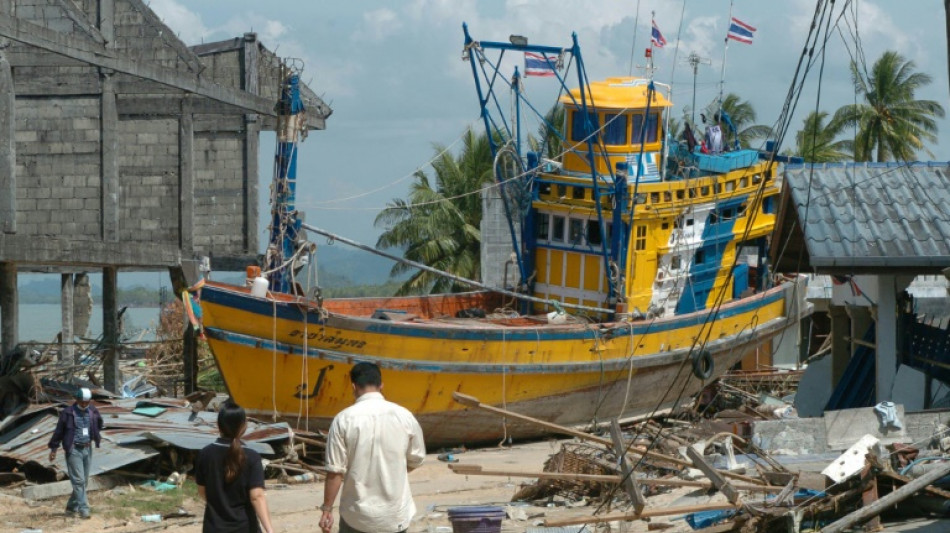
2004 Indian Ocean tsunami: what to know 20 years on / Photo: © AFP

 Sabalenka edges Noskova, keeps US Open treble bid alive

 Real Madrid win Champions League opener as Haaland stars for Man City
 Gambian leader vows power boost after violent blackout protests

 Newcastle battle past Millwall to reach League Cup fourth round
 Mourinho's Real Madrid make winning start against Inter Milan

 Villa take 'big step forward' with win over Brugge

 Yaya Toure hails 'new era' for African coaches ahead of Champions League bow

 Lawes and Marchant told to prove themselves in quest for England recalls

 Smithsonian secretary to retire as Trump exerts control over institution
 Atletico have work to do to reach home Champions League final: Simeone

 Villa end goal drought to beat Brugge in Champions League opener

 McIlroy says 'we'll keep our heads down and play' in event of Trump golf visit

 Sabalenka holds of Noskova to reach US Open semi-finals

 Netanyahu under fire over report UAE warned of October 7 attack

 Wasim Akram urges 'fair treatment' for jailed Imran Khan

 No. 1 in reach as Rybakina battles for US Open semi-final spot
 Putin and Trump discuss Ukraine in 'extremely frank' call

 French police hunt Renoir thieves after lightning museum heist
 World Cup final scorer Torres leads Ballon d'Or nominees
 Carney touts Canada 'pivot' away from US as tariffs rise

 Spanish stars Cruz, Bardem play strained on-screen couple in new film
 The "Everlasting Battery" Inside Your Joints:UConn Professor's Self-Powered Healing Material just Got Acquired

 Visionary or conman? Elon Musk enigmatic star of Venice documentary

 Trial opens in France over deadliest Channel migrant crossing disaster

 England skipper Root says it's wrong to accuse Pakistan of lacking fight
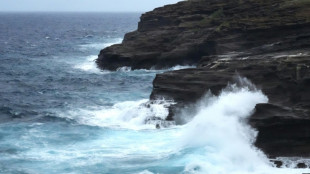
Survivors and victims' relatives will next week mark the 20th anniversary of the 2004 Indian Ocean earthquake and tsunami, which killed more than 220,000 people across more than a dozen countries.
A 9.1-magnitude earthquake off the western coast of Indonesia's Sumatra island triggered huge waves that swept into coastal areas of Indonesia, Sri Lanka, India, Thailand and nine other nations around the Indian Ocean basin.
Here is a look back at the impact of the deadliest tsunami in history.
- Faultline rupture -
The tsunami was triggered by the longest faultline rupture from an earthquake ever observed, seconds before 7:59 am on December 26, 2004.
The ocean floor opened at least 1,200 kilometres (750 miles) in length between the India plate and Burma microplate.
It created waves more than 30 metres (100 feet) high, releasing energy equivalent to 23,000 Hiroshima atomic bombs and causing widespread destruction.
The magnitude was initially recorded at 8.8, before the United States Geological Survey gave its official magnitude of 9.1 and depth as 30 kilometres (18.6 miles).
The epicentre was located 150 miles from Sumatra's coast.
Indonesia is a vast archipelago nation on the Pacific "Ring of Fire", an arc of intense seismic activity stretching from Japan through Southeast Asia and across the Pacific basin.
- Huge death toll -
A total of 226,408 people died as a result of the tsunami, according to EM-DAT, a recognised global disaster database.
The worst affected area was northern Sumatra, where more than 120,000 people were killed out of a total of 165,708 dead in Indonesia.
The huge waves travelled around the Indian Ocean, hitting Sri Lanka, India and Thailand hours later.
At their fastest the waves travelled at over 800 kilometres an hour (500 mph), more than twice the speed of a bullet train.
More than 35,000 were killed in Sri Lanka, with 16,389 killed in India and 8,345 in Thailand, according to EM-DAT.
Nearly 300 were killed in Somalia, more than 100 in the Maldives, as well as dozens in Malaysia and Myanmar.
- Displaced, reconstruction -
The tsunami displaced more than 1.5 million people and sparked disaster relief of around $14 billion pledged from the international community, according to the United Nations.
Hundreds of thousands of buildings were destroyed, leaving in some cases entire communities homeless.
A splurge in reconstruction has transformed the worst-hit city Banda Aceh.
More than 100,000 houses were rebuilt in the westernmost Indonesian province of Aceh alone, according to the Indonesian government.
- Warning systems -
The tsunami also forced a reckoning about the preparedness of coastal communities around the Indian Ocean basin.
At the time of the earthquake, there was no warning system in place in the Indian Ocean.
But now, 1,400 stations globally cut warning times to just minutes after a tsunami wave forms.
Experts said the lack of a properly coordinated warning system in 2004 had made the disaster's impact worse.
Ocean scientists say we are more prepared than ever thanks to millions of dollars being invested into tsunami warning systems, but warn that the impact of a catastrophic tsunami can never be completely prevented.
S.Gantenbein--VB