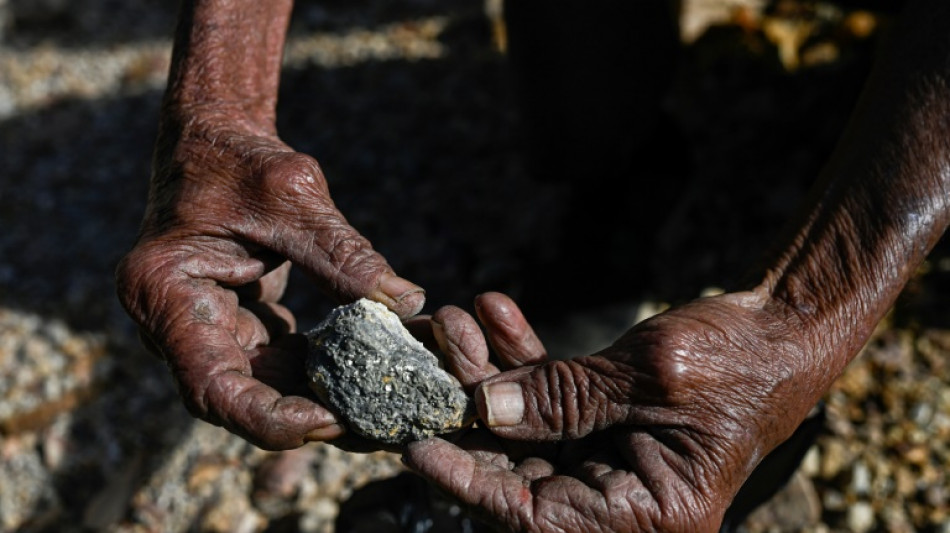
El Salvador Congress votes to end ban on metal mining / Photo: © AFP/File

 Norway bids farewell to King Harald V, 'grandfather' of the nation
 NFL breaks new ground as 100,000 set to pack MCG in Australia

 EU faces revolt over social media ban for children
 Canada eyes researchers looking to leave 'hostile' US

 Tiafoe escapes Michelsen to reach US Open semi-finals

 Carney touts Canada 'pivot' away from US as Trump levels new threat

 Pounding waves open up sinkhole in swanky Malibu
 LIV Golf files for bankruptcy protection

 Argentina launches legal action against oil firms for Falklands drilling

 Haaland double powers Man City to victory over Porto

 Sabalenka survives Noskova to return to US Open semi-finals

 'South Park' changes name in dig at Trump

 OpenAI says AI solved one of math's hardest problems in days
 Nearly 1,100 flights cancelled after UK air traffic control glitch
 Sabalenka holds off Noskova to keep US Open three-peat bid alive

 Rein in social media not children, say over 130 groups, experts
 Hong Kong's first post-colonial leader Tung Chee-hwa dies aged 89

 Rangers captain Shankland sidelined for up to four months
 NY failed to disclose what it knew on 'toxic air' after 9/11
 What we learned from 'lacerating' four-hour Musk documentary

 UK, France, Canada to ban imports from Israeli settlements

 Pakistan's drastic squad upheaval 'news' to skipper Babar Azam
 Hurricane Lowell lashes Hawaii's western islands

 Argentina files lawsuit against oil firms operating off Falklands

 Root wants Pietersen to pull no punches on England return

El Salvador's Congress on Monday approved a bill promoted by President Nayib Bukele to roll back a ban on the mining of gold and other metals, dismaying environmentalists.
The small Central American nation became the world's first country to outlaw metal mining in 2017, warning of the harmful effects of the chemicals used, like cyanide and mercury.
The move by Bukele's predecessor, former left-wing rebel Salvador Sanchez Ceren, reflected a growing rejection of mining by rural communities in the region.
But last month, Bukele, who is popular at home for his crackdown on street gangs, signaled that he wanted to change course.
The bill to bring back metal mining was approved by 57 deputies out of a total of 60, said Ernesto Castro, head of the legislature -- which is dominated by the ruling party -- as environmental campaigners protested nearby.
Critics fear that mining will pollute the Lempa River, which runs through a potential mining zone proposed by Bukele and supplies water to 70 percent of the inhabitants of the capital and surrounding areas.
"This wretched mining will punish the people, it will contaminate our waters and rivers and that's an attack on life," activist Vidalina Morales told reporters.
Bukele said last month that El Salvador, a country of 6.6 million people, had "potentially" the largest gold deposits per square kilometer in the world.
"God placed a gigantic treasure underneath our feet," he wrote on social media, arguing that the mining ban was "absurd."
"If we make responsible use of our natural resources, we can change the economy of El Salvador overnight," he said.
The new law stipulates that the state will be the only entity authorized to search for, extract and process mined metals.
However, the government may do so through companies in which it is a shareholder.
The bill prohibits the use of mercury in mining operations, which may not be carried out in protected natural areas or places with important water sources.
A survey by Central American University published on Monday revealed that 59 percent of respondents do not consider El Salvador "an appropriate country for metal mining."
Since El Salvador dollarized its remittances-reliant economy in 2001, it has registered average annual growth of 2.1 percent.
Twenty-seven percent of Salvadorans live in poverty, according to the United Nations Economic Commission for Latin America and the Caribbean, and 70 percent of the workforce operates in the informal sector.
Elsewhere in the region, Costa Rica and Honduras have banned open-pit mining, and Panama declared a moratorium on new mining concessions last year after mass protests over plans for a huge copper mine.
L.Wyss--VB