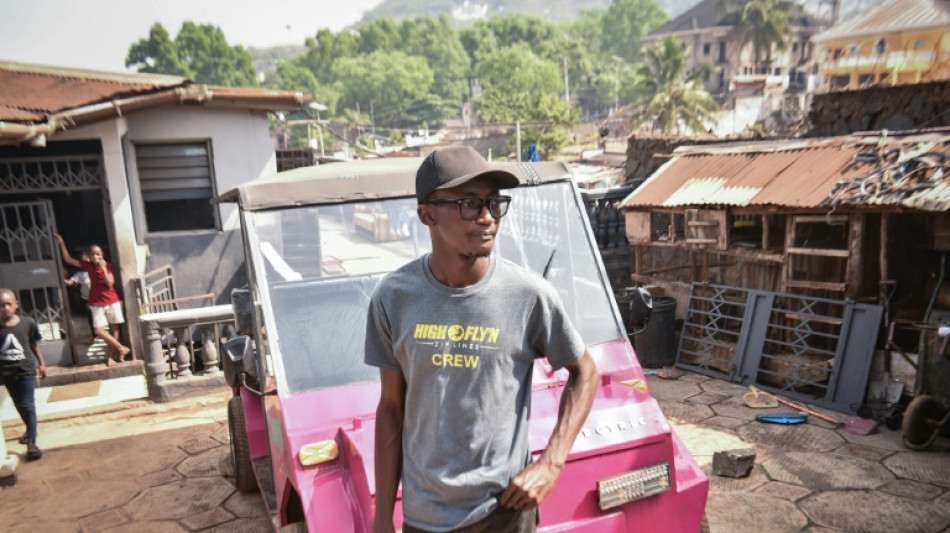
Sierra Leone student tackles toxic air pollution / Photo: © AFP

 'Long live Chairman Mao': Supporters pay respects to founder of Communist China
 Sweden immigration restrictions spark healthcare concerns
 EU to help cities tighten screws on Airbnb, holiday rentals
 'Our year': Kane and Bayern primed for Champions League tilt
 Australian World Cup star Volpato fined over positive cocaine test
 Sabalenka edges Noskova to keep US Open treble bid alive
 Pegula outlasts Navarro to set US Open semi with Sabalenka
 From trenches to catwalk: Ukraine's amputee soldiers hit the runway

 UK airports face more disruption after air traffic control glitch

 ECB meets, weighing a tricky balance between savers and spenders
 Pakistan police counter drone attacks with Ukraine-style nets

 Russia torments Kyiv with new 'horror' jet drones

 Iran attacks US base in Jordan as Hormuz impasse deepens
 New Apple CEO to face first test with foldable iPhone launch

 Sabalenka edges Noskova, keeps US Open treble bid alive
 Real Madrid win Champions League opener as Haaland stars for Man City
 Gambian leader vows power boost after violent blackout protests

 Newcastle battle past Millwall to reach League Cup fourth round
 Mourinho's Real Madrid make winning start against Inter Milan

 Villa take 'big step forward' with win over Brugge

 Yaya Toure hails 'new era' for African coaches ahead of Champions League bow
 Lawes and Marchant told to prove themselves in quest for England recalls

 Smithsonian secretary to retire as Trump exerts control over institution
 Atletico have work to do to reach home Champions League final: Simeone

 Villa end goal drought to beat Brugge in Champions League opener

In his small Freetown workshop, engineering student James Samba tinkered with batteries and electrical parts he hoped could help clean up Sierra Leone's polluting public transport system.
Rush hour in the West African country's major cities is a frenetic medley of minibuses, mopeds, shared taxis and three-wheeled vehicles known as "kekehs" –- each spluttering toxic emissions into the atmosphere.
Samba said that his uncle died from a respiratory illness after years of inhaling roadside exhaust fumes, spurring the 23-year-old to develop his own model for an electric kekeh.
Assembled from recycled scrap metal and powered by batteries, the pink four-wheeled vehicle now roams the streets of the capital.
Although the project is still in its infancy, Samba aims to offer an eco-friendly alternative to traditional fuel-run models.
"I wanted to save others from dying of lung and respiratory disease due to air pollution... by manufacturing a prototype electric vehicle," Samba said.
Worldwide, an estimated 4.2 million premature deaths per year are attributed to outdoor air pollution, the World Health Organization (WHO) says, with low- and middle-income countries overwhelmingly impacted.
Vehicle emissions are also a leading contributor to climate change.
Like in much of West Africa, lengthy traffic jams in Sierra Leone's major cities and poorly maintained vehicles with inefficient exhausts exacerbate the emissions problem.
The United Nations Environment Programme (UNEP) says that in 2021, fine particle air pollution killed 1,200 people in Sierra Leone, a country of 8.5 million people.
- 'Good for business, environment' -
Samba first ventured into engineering when he built an electric wheelchair for his uncle, who had long struggled to access public transport.
He has since set up his own company, Sierra Electric, with the aim of eventually manufacturing a fleet of solar-powered kekehs and disability-friendly electric vehicles.
Lacking the immediate means to cover production costs, Samba has partnered with start-up NEEV Salone to develop a kekeh powered by a rooftop solar panel.
The Freetown-based firm already has a fleet of more than 100 solar tricycles, three charging stations and battery swapping cabinets for customers, according to co-founder and operations officer Emmanuella Sandy.
"Our e-kekeh products are thriving. We swap batteries to reduce waiting time for commercial riders and we have trained 60 university students from the mechanical engineering department on electric vehicle assembly and maintenance," she said.
The development of electric vehicles faces numerous hurdles in Sierra Leone, where the national grid suffers from chronic underperformance and frequent outages, and a six-month rainy season hampers the functioning of solar panels.
Just over 20 percent of households have access to electricity via the national grid or mini-grids, according to a 2024 World Bank report.
NEEV Salone alternates between solar power, off-grid generators and the national grid to maintain supply to their charging points.
Samba says solar kekehs are cheaper to run than fuel-powered alternatives, as drivers face lower maintenance costs and no fuel bill.
The smallest of NEEV Salone's solar kekehs sells for 120,000 new leones (around $5,270), a high price for those living in one of the world's poorest countries.
Despite the cost, some drivers have already converted to renewables in the face of rising fuel prices.
"The solar tricycle is comfortable and a profitable business. I no longer worry about fuel scarcity in the country," said 25-year-old driver Thomas Kanu.
"The solar kekeh is good for business and our environment."
B.Wyler--VB