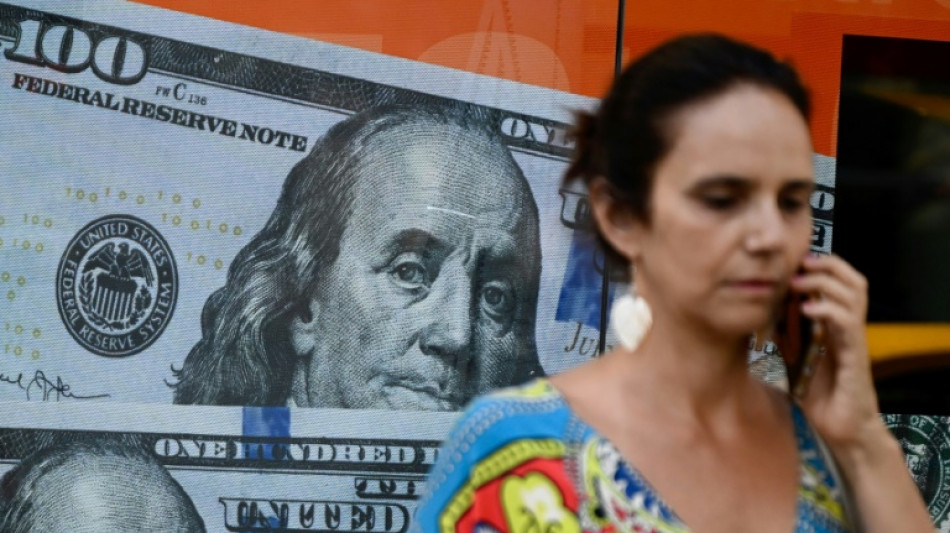
Argentina's dollar craze cools under greenback-loving Milei / Photo: © AFP/File

 Alcaraz falls to Shelton in epic latest-ever US Open finish

 South Korea video game tycoon to pay record $1.5 bn in divorce
 'Long live Chairman Mao': Supporters pay respects to founder of Communist China
 Sweden immigration restrictions spark healthcare concerns
 EU to help cities tighten screws on Airbnb, holiday rentals

 'Our year': Kane and Bayern primed for Champions League tilt
 Australian World Cup star Volpato fined over positive cocaine test

 Sabalenka edges Noskova to keep US Open treble bid alive
 Pegula outlasts Navarro to set US Open semi with Sabalenka

 From trenches to catwalk: Ukraine's amputee soldiers hit the runway
 UK airports face more disruption after air traffic control glitch

 ECB meets, weighing a tricky balance between savers and spenders
 Pakistan police counter drone attacks with Ukraine-style nets
 Russia torments Kyiv with new 'horror' jet drones
 Iran attacks US base in Jordan as Hormuz impasse deepens

 New Apple CEO to face first test with foldable iPhone launch

 Sabalenka edges Noskova, keeps US Open treble bid alive

 Real Madrid win Champions League opener as Haaland stars for Man City
 Gambian leader vows power boost after violent blackout protests

 Newcastle battle past Millwall to reach League Cup fourth round

 Mourinho's Real Madrid make winning start against Inter Milan

 Villa take 'big step forward' with win over Brugge

 Yaya Toure hails 'new era' for African coaches ahead of Champions League bow

 Lawes and Marchant told to prove themselves in quest for England recalls

 Smithsonian secretary to retire as Trump exerts control over institution
"Dollars, selling dollars!" a money changer shouts to people streaming past in Buenos Aires' financial district.
But there are no takers as Argentina's decades-long dollar craze finally shows signs of cooling.
Over years of high inflation and currency controls, Argentines lined up to trade their increasingly worthless pesos for dollars, propelling the US currency to a record 1,500 pesos on the black market on July 12.
But as the inflation rate slows under cost-cutting President Javier Milei -- from 25.5 percent in December 2023 to 2.4 percent in November 2024 -- the clamor for dollars has quieted, even after Milei pledged on the campaign trail last year to swap the peso for the greenback.
- Amnesty brings in billions -
Experts cite several reasons for the fall in demand for dollars. Milei's biting austerity measures have cratered Argentines' purchasing power, shattering their ability to save in hard American cash -- the preferred way to create a nest egg.
The experts also point to a tax amnesty launched by the government in July to encourage Argentines to deposit dollars that have been stashed under mattresses and floorboards, or tucked in safety-deposit boxes and offshore accounts.
The scheme has brought in $20 billion in deposits so far, helping ease a dollar shortage.
Meanwhile, the central bank has taken advantage of a stronger peso to build up its dollar reserves from $21 billion when Milei took power a year ago to $32 billion.
In a sign of how times have changed, the black market dollar rate, which at one point was double the official rate, is now nearly aligned with the official rate, at a little over 1,000 pesos to the greenback.
- Under the mattress -
Oscar, one of Buenos Aires' many black-market money changers -- they are dubbed "arbolitos,"or little trees, because they plant themselves in the street offering green notes -- told AFP that business has slowed dramatically.
"Up to a year ago I was conducting around 40 transactions in a six-hour period; now I have four, at most, in 10 hours," said Oscar, who works openly near the presidential palace but declined to give his full name due to the illegal nature of his work.
These days, his only customers for dollars are Bolivian and Peruvian migrant workers, who change small amounts to send home.
In scenes unthinkable just months ago, most of his Argentine customers are now offloading dollars -- because they need more pesos to pay bills that have soared since Milei took office and slashed energy and transport subsidies.
Retirees "walk the whole city center looking for the best deal" for pesos, Oscar said.
In the back room of her estate agency in the middle-class Caballito neighborhood, where she trades dollars on the black market, Fabiana is also struggling.
To compete, she offers home delivery service for well-off Argentines buying dollars to go on holiday abroad or for people cashing in savings in dollars, some of them "stained from having been kept under the mattress."
Money-changing is merely a source of "petty cash" these days, Fabiana said.
Most of her business comes from property sales, which are booming thanks to the amnesty, which also covers investments in real estate projects and certain property purchases.
- Impact on exports -
Experts warn the peso's strengthening against the dollar may be temporary if, as expected, the effects of the tax amnesty soon wear off or if Milei fails to secure a new cash injection from the International Monetary Fund.
The IMF said Thursday it was in talks with Argentina on a new program to replace a $44 billion loan agreement set to expire on December 31.
Economist Hernan Letcher credited the tax amnesty with helping stabilize demand for dollars, but said that program and any new IMF cash injection are one-off measures that do not resolve Argentina's currency woes.
"The amnesty dollars aren't yours (don't belong to the state) and you have to pay back the IMF dollars," he said.
Meanwhile, the strengthening of the peso risks hurting exports to Brazil, Argentina's biggest trading partner.
Brazil's currency, the real, fell to a record low against the dollar last week over concerns about its economy.
O.Schlaepfer--VB