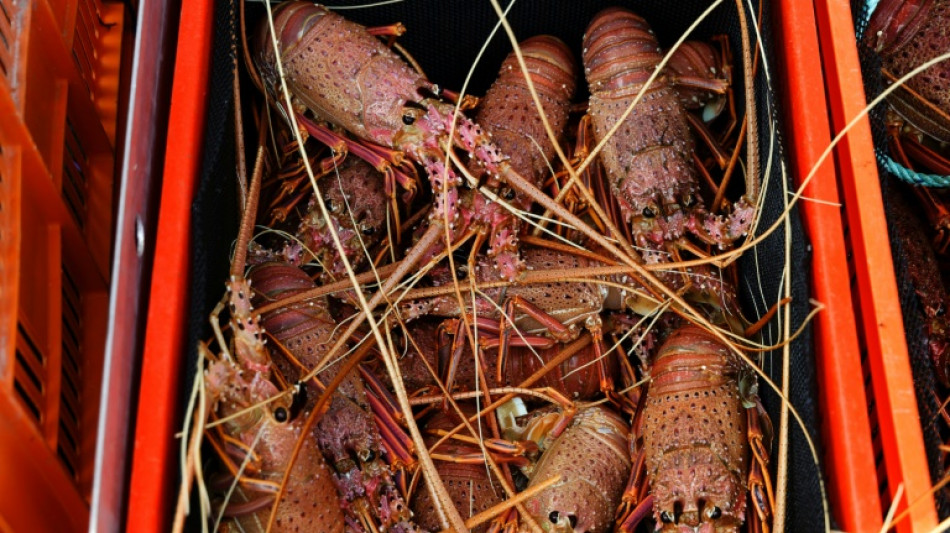
China lifts rock lobster ban, bringing end to Australian trade barriers / Photo: © AFP

 Cyberattack ruled out in UK air traffic glitch as more flights axed

 Ekiden Launches Canton Network’s First Order Book-Based Derivatives Exchange

 Germany's Merz accuses AfD of promoting 'ethnic cleansing'

 Japanese director Kore-eda's manga film charms critics in Venice

 As African space race heats up, Senegal pursues homemade satellites

 UK's little-known Bayeux Tapestry replica steps into spotlight
 Shelton stuns Alcaraz in 3:34 am US Open finish, Sabalenka battles on

 Alcaraz falls to Shelton in epic latest-ever US Open finish

 Tradition Announces Partnership With Affin Moneybrokers to Support Malaysian Market Data

 Protesters urge South Korea to stay out of Iran war
 Africa's informal economy: a burden and lifeline

 Kenyan start-up makes robotic limbs to sign for deaf kids

 Iran, US trade blows as Hormuz impasse deepens

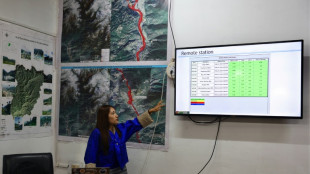 The round-the-clock monitors protecting Bhutan from glacier risk

 'Hell': Father of surfers killed in Mexico testifies at trial

 Travellers in UK face more chaos after air traffic control glitch

 Crude pushes towards $100 on Mideast flare-up, fanning inflation fears

 Record rain forces Asian Games athletes to evacuate accommodation
 Amusing or addictive? The algorithms powering our social feeds

 Norway bids farewell to King Harald V, 'grandfather' of the nation

 NFL breaks new ground as 100,000 set to pack MCG in Australia

 EU faces revolt over social media ban for children

 Canada eyes researchers looking to leave 'hostile' US

 Tiafoe escapes Michelsen to reach US Open semi-finals

 Carney touts Canada 'pivot' away from US as Trump levels new threat

China has lifted a ban on imports of Australian live rock lobsters, Canberra said Friday, demolishing the final barrier in a broader, multibillion-dollar trade war between the countries.
Beijing has banned or slapped retaliatory tariffs on more than US$12 billion worth of Australian exports, from wine to timber, during years of soured ties with Canberra.
The lobster trade, worth US$500,000 a year, was the last of a number of major Australian exports to remain under sanctions after months of Australian diplomatic efforts.
"China has confirmed that our live rock lobster exports can recommence into China," Agriculture Minister Julie Collins told reporters.
"This is great news for our live rock lobster producers and fishers here in Australia, and importantly, it means that they can now apply for import permits to go back into this market."
Lobsters were the "last of those trade impediments" imposed by China, she added.
China introduced a de facto ban on live rock lobster in 2020 while denying the move -- and a raft of other punitive tariffs -- were linked to the worst crisis in relations in decades.
Beijing was enraged by Canberra's crackdown on Chinese foreign influence operations, the decision to block tech giant Huawei from running Australia's 5G network, and a call for an investigation into the origins of the Covid-19 pandemic.
Australian Prime Minister Anthony Albanese said in October that Beijing would let the lobsters back in after a meeting with Chinese Premier Li Qiang in Laos.
Albanese said the confirmation of that reopening was the result of his government's "calm and consistent" approach with China since his Labor Party came to power in May 2022.
- End of trade 'impediments -
At the low point in relations, Australian exporters faced impediments on exporting wine, barley, coal, cotton, timber logs, oaten hay, copper ores and concentrates and red meat, the government said.
"The removal of restrictions on lobster marks the resolution of all outstanding impediments to trade from that period," it said in a statement.
The reopening to lobster may also give Albanese a political boon.
The prime minister must call an election in the first half of 2025, and many lobster producers come from Western Australia, a key battleground state.
The centre-left leader has spent much of his time in office trying to improve the trade relationship with China, Australia's biggest trade partner.
At the same time, Australia is part of a loose US-led alliance that has aggressively pushed back against China's bid for primacy in the Pacific region.
Before the ban, an estimated 97.7 percent of Australia's rock lobster exports were sold to China, more than 1,600 tonnes a year.
Some Australian producers have since found new markets in the United States, Europe, Asia and the Middle East.
Many more skirted sanctions by creating a "grey market" of exports to China via Hong Kong, Hanoi and other Asian cities.
The volume of exports to Hong Kong alone shot up more than 6,100 percent after the ban, according to researchers at the University of Technology Sydney.
Exporters are hoping they can resume exports in time for Chinese New Year, when delicacies such as rock lobster are in hot demand.
A.Zbinden--VB