Sweden sees red over Germany's energy policy / Photo: © AFP/File

 Cyberattack ruled out in UK air traffic glitch as more flights axed
 Ekiden Launches Canton Network’s First Order Book-Based Derivatives Exchange

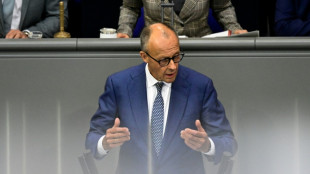 Germany's Merz accuses AfD of promoting 'ethnic cleansing'

 Japanese director Kore-eda's manga film charms critics in Venice

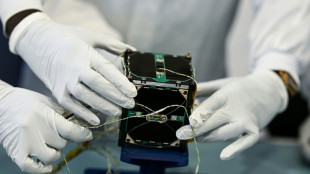 As African space race heats up, Senegal pursues homemade satellites
 UK's little-known Bayeux Tapestry replica steps into spotlight
 Shelton stuns Alcaraz in 3:34 am US Open finish, Sabalenka battles on

 Alcaraz falls to Shelton in epic latest-ever US Open finish
 Tradition Announces Partnership With Affin Moneybrokers to Support Malaysian Market Data
 Protesters urge South Korea to stay out of Iran war
 Africa's informal economy: a burden and lifeline
 Kenyan start-up makes robotic limbs to sign for deaf kids
 Iran, US trade blows as Hormuz impasse deepens

 The round-the-clock monitors protecting Bhutan from glacier risk

 'Hell': Father of surfers killed in Mexico testifies at trial

 Travellers in UK face more chaos after air traffic control glitch

 Crude pushes towards $100 on Mideast flare-up, fanning inflation fears

 Record rain forces Asian Games athletes to evacuate accommodation
 Amusing or addictive? The algorithms powering our social feeds
 Norway bids farewell to King Harald V, 'grandfather' of the nation
 NFL breaks new ground as 100,000 set to pack MCG in Australia
 EU faces revolt over social media ban for children
 Canada eyes researchers looking to leave 'hostile' US
 Tiafoe escapes Michelsen to reach US Open semi-finals

 Carney touts Canada 'pivot' away from US as Trump levels new threat

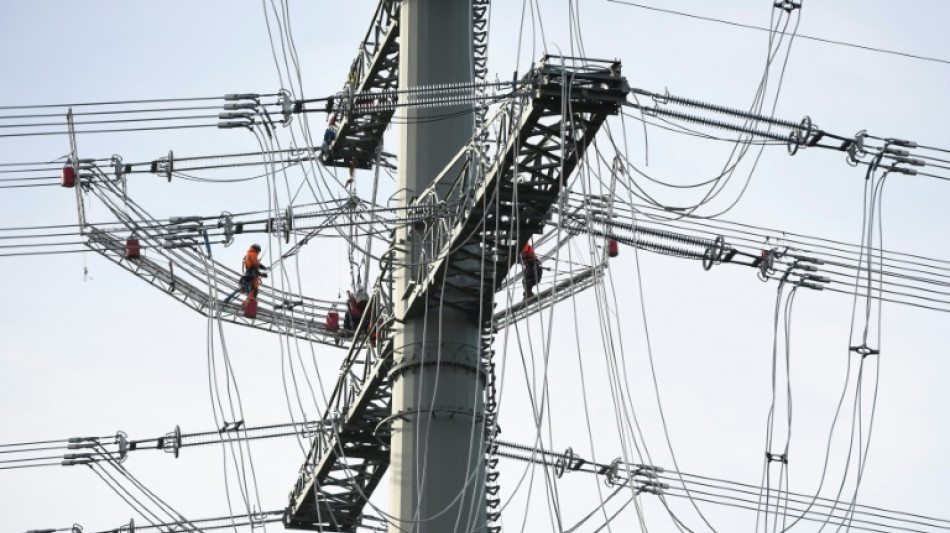
As one of Europe's biggest suppliers of electricity, Sweden is seeing red over Germany's energy policy, which it says ends up punishing Swedish consumers.
Putting diplomatic manners aside, Sweden's energy minister Ebba Busch has not minced words over what she thinks of Berlin's "irresponsible" energy policy.
"I'm furious with the Germans," Busch told a press conference last week.
Germany, then ruled by chancellor Angela Merkel, decided to close its last nuclear power stations in the wake of the Fukushima disaster in 2011 -- a withdrawal completed in the spring of 2023.
Having largely converted to renewable energies, Europe's largest economy is now dependent on the elements and importing energy from abroad.
That includes imports from Sweden, which was Europe's second biggest net exporter of electricity last year -- behind France -- according to energy market website Montel.
- 'Rules of physics' -
But while cross-border grid connections facilitate the balancing of electricity supply and demand across the continent, they also mean that demand in one country can affect prices in another.
The willingness of Germans to dig deep into their pockets to meet their considerable energy needs is therefore also reflected in the electricity bills of Swedish businesses and households.
Sweden has a system with four electricity zones which at times has led to vast price differences between the country's north -- which has vast hydropower facilities -- and the south.
Last week, the price of electricity in the southern regions -- which are more affected by German prices -- was during certain hours when there was a lack of wind on the continent roughly 190 times the price in the north.
Busch on Monday said that "no willpower in the world can override the basic rules of physics, not even Dr Robert Habeck", taking aim at Germany's economy minister and vice chancellor.
"Germany can take whatever decision they want but they need to see it affects their neighbours a lot and it is not fair that Swedes should pay German prices for German decisions," she said on the sidelines of a meeting in Brussels.
Busch and Swedish analysts concede, however, that Germany is not entirely to blame.
Electricity production in southern Sweden was greatly reduced with the closure of several nuclear reactors in recent years.
"Southern Sweden has a great need to increase electricity production," Lotta Medelius-Bredhe, director of the Swedish authority managing electricity transmission Svenska Kraftnat, told Swedish radio this week.
Unlike Berlin, Stockholm has reversed course and decided to build new nuclear power facilities.
- Cable held 'hostage' -
In order to limit the contagion of volatile prices, Sweden wants Germany to follow its example and introduce a system with price zones for electricity.
In the meantime, the Nordic country has said no to the construction of a new 700-MW subsea connection, the Hansa PowerBridge, between the two countries.
"To be clear, we are holding a gigantic cable to Germany hostage, because Germany does not have its energy system in order," Busch told reporters last week.
Berlin is so far ruling out the introduction of variable pricing zones.
"We are in a situation where we produce our electricity from renewable energies mainly in the north and our industry is often in the south," German government spokesman Stefan Hebestreit told AFP.
"We are currently in the process of creating the necessary additional connections, i.e. building the transmission lines. When this is done, the problem will be less significant," he added.
In Norway, Europe's third largest net exporter of electricity last year, there is also a temptation to insulate itself from the continent.
There, the government is advocating not to renew two undersea cables linking the country to Denmark which will reach the end of their life cycle in 2026.
"I have been clear that we will not extend the Skagerrak cables to Denmark if it turns out that they contribute to the high prices we are seeing now... and harm the Norwegian power system," Norway's Energy Minister Terje Aasland told AFP in an email.
Although no formal decision has been taken yet, his announcement has already stoked some tensions between Norway and once again Sweden.
As the neighbouring countries' electricity markets are closely linked, Busch told Norwegian agency NTB that not renewing the Skagerrak 1 and 2 cables would be a "complete catastrophe".
To which Aasland replied, according to NTB: "I must remind Ebba Busch that I am Norway's energy minister."
M.Betschart--VB