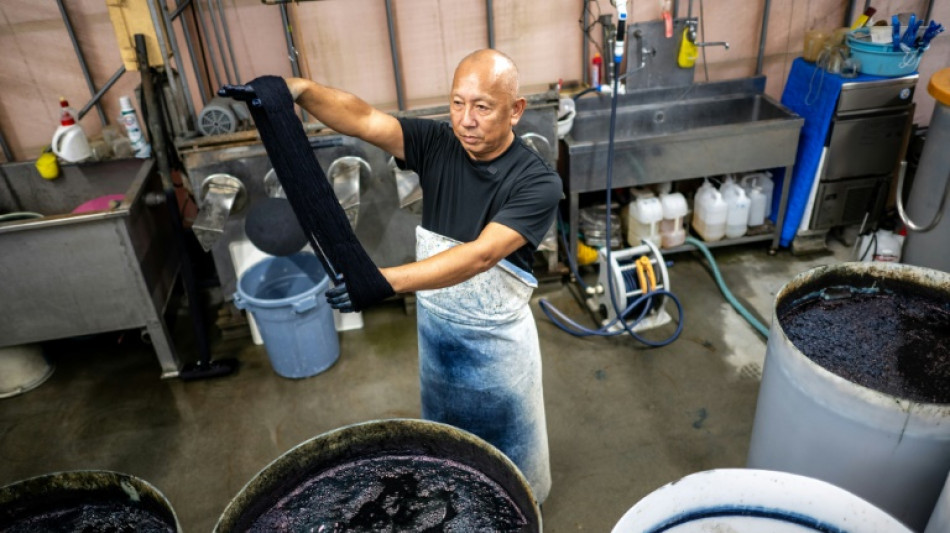
True blue tradition: how Japan's coveted jeans are made / Photo: © AFP

 England edge ahead in third Test after latest Pakistan collapse

 'Alarm bells ringing': US summer heat shatters record

 IAEA board refers Iran to UN Security Council

 Rubio pushes extraditions, anti-drug fight in Ecuador
 Amboss and Aureo Connect the Lightning Network to Mexico's Banking System

 Brent oil passes $100 on Mideast flare-up, stoking inflation fears

 Israeli settlement winemaker defiant after UK-led trade sanctions

 Josh Kerr: I pick my races and never get 'greedy'

 Carrick confident Man Utd can go far in 'magical' Champions League

 France far right expels policeman member over racist remarks

 Pakistan collapse to 133 all out against England in 3rd Test

 Heat forces French champagne makers to stiffen their drink

 Iran war drives oil prices to $100 per barrel as Tehran strikes ships
 Pakistan collapse to 100-7 against England in 3rd Test
 Workers, migrants focus of documentaries by Oscar winners at Venice

 Nepal seeks survivors two weeks after deadly floods

 Bangladesh measles crisis kills more than 1,000 children

 Pakistan collapse to 26-4 against England in 3rd Test
 EU helps cities tighten screws on Airbnb, holiday rentals

 Courtois to put Belgium career on hold

 RavenDB Launches Quill to Bring Production AI Agents to Enterprise SQL Systems, No Migration Required

 Affleck family affair at Venice for Casey's latest film 'Company'

 Yemen rebels report fresh Saudi strikes as conflict deepens

 'They're playing with our lives': AI researcher quits Anthropic
 Series finale of 'Babylon Berlin' offers dark mirror for today's Germany

Call it an antidote to fast fashion: Japanese jeans hand-dyed with natural indigo and weaved on a clackety vintage loom, then sold at a premium to global denim connoisseurs.
Unlike their mass-produced cousins, the tough garments crafted at the small Momotaro Jeans factory in southwest Japan are designed to be worn for decades, and come with a lifetime repair warranty.
On site, Yoshiharu Okamoto gently dips cotton strings into a tub of deep blue liquid, which stains his hands and nails as he repeats the process.
The cotton is imported from Zimbabwe, but the natural indigo they use is harvested in Japan -- its colour far richer than synthetic imitations, according to Okamoto.
He calls it a "time-consuming and costly" method, commonly used to dye kimonos in the 17th-19th century Edo period.
Momotaro Jeans was established in 2006 by Japan Blue, one of a few dozen denim producers in the seaside town of Kojima, renowned for their artisan quality.
"We're very strict about all aspects of manufacturing," Japan Blue's president Masataka Suzuki told AFP.
That includes "whether the sewing is done properly, and whether the dye is beautiful," making local craftspeople with traditional manufacturing skills indispensable.
Their efforts do not come cheap, however. A standard pair of Momotaro Jeans retails for around 30,000 yen ($200) while a silk-blend pair costs 60,000 yen.
The brand's most expensive offering, woven by hand on a wooden machine converted from a luxury kimono loom, has a price tag of over 200,000 yen.
Following in the footsteps of popular high-end Japanese denim brands such as Osaka-based Evisu and Sugar Cane in Tokyo, interest in Japan Blue is growing among overseas shoppers.
They now account for 40 percent of retail sales, and the company recently opened its sixth Kyoto store targeting deep-pocketed tourists.
- 'Niche' reputation -
Denim-making flourished from the 1960s in Kojima, which has a long history of cotton-growing and textile-making.
In the Edo period, the town produced woven cords for samurai to bind sword handles. It then switched to producing split-toe "tabi" socks and, later, school uniforms.
Now denim from Kojima is used by international luxury fashion brands.
The market for Japanese jeans "has grown in the last 10 to 15 years", said Michael Pendlebury, a tailor operating a repair shop in Britain called The Denim Doctor.
Although revered by denim aficionados in Western countries, they remain "not quite affordable for most" with something of a "niche" reputation, Pendlebury said.
"Mass-produced denim brands like Levis, Diesel and Wrangler are the largest, and more worn, but the highest quality is still Japanese in my opinion," he said, adding that the weak yen and a tourism boom could boost sales of made-in-Japan jeans.
Momotaro Jeans is named after a folklore hero in Okayama, where Kojima is located. It's part of the wider denim-producing Sanbi area, which also includes Hiroshima.
Another factor that makes brands like Momotaro Jeans idiosyncratic -- and expensive -- is the use of very noisy old shuttle-weaving machines, which have only a quarter of the output of the latest factory looms.
They often break down, but the only people who know how to repair the machines are in their 70s or older, according to Shigeru Uchida, a weaving craftsman at Momotaro.
The brand uses a handful of shuttle looms made in the 1980s by a company owned by Toyota.
"There are only a few of them in Japan now" because they are no longer made, the 78-year-old Uchida said, walking back and forth between the machines to detect unusual sounds that could signal a breakdown.
Despite the complexities, he says their fabric makes it worth it.
"The texture is very smooth to the touch... and when made into jeans, it lasts quite a long time," Uchida said.
Suzuki says Momotaro Jeans is a "sustainable" choice because "no matter when you bring it to us, we will take responsibility for fixing it".
"When people spend a lot of time in their jeans, the path of their life is left on the clothes," depending on how they wear or wash them and even where they live, Suzuki said.
"We want to preserve such a mark as long as possible."
R.Fischer--VB