
ECB cuts rates again, Lagarde says eurozone 'losing momentum' / Photo: © AFP

 Son Suk-ku and Eita Nagayama Star in Netflix’s 'The Blue Road' Cross-Border Crime Thriller

 Moving to a New State? Your Healthcare Might Get More Complicated

 South Africa’s Economic Shift: Why Services Must Lead Job Creation Beyond Manufacturing

 Lethbridge Council to Vote on $80 Million Capital Improvement Program

 Redmi Note 18 5G Battery Specs Leaked: Larger Capacity in Chinese Variant

 COP31 Presidency Publishes First Draft Cover Decision on Climate Action

 EU Club Group Files Antitrust Complaint Against UEFA Over Prize Money

 Heat and El Niño Drive Surge in Preterm Births Across Southern Africa

 China's Factory Activity Contracts as Export Orders Weaken

 US Retail Sales and Fed Minutes Set Up a Critical Test for Consumers

 Oil Heads for Second Weekly Loss as Supply Surplus Emerges

 Brazil Faces Debt and Inflation Test as Lula Prepares Fourth Term

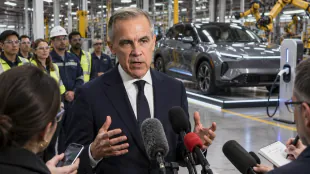 Canada Signals Openness to Chinese Automakers if US Trade Talks Fail

 US Mortgage Rate Falls for Fourth Week but Remains Above 7%

 13 Native American-Owned Restaurants in Arizona to Experience Indigenous Culinary Traditions

 Best Digital Photo Frames 2026: Aura, Skylight, and Amazon Compared

 UK Economy Grows 0.7% in Third Quarter as Services Lead Expansion

The European Central Bank cut interest rates again Thursday and hinted at more to come, with President Christine Lagarde saying the beleaguered eurozone economy was "losing momentum" as EU and US politics fuelled uncertainty.
The central bank for the 20 countries that use the euro reduced its key deposit rate by a quarter point to three percent, as widely expected.
It was the ECB's third cut in a row and fourth since June, when it kicked off its current easing cycle.
After hiking borrowing costs from mid-2022 to combat runaway energy and food costs, policymakers have turned their attention to lowering rates as inflation eases and the eurozone economic outlook darkens.
While there had been speculation the ECB could opt for a bigger move, particularly after a surprise bumper cut by the Swiss central bank hours earlier, it decided to continue at the same pace, with a quarter-point reduction.
But Lagarde was clear that the Frankfurt-based institution's concerns now centred on the weakening outlook in the eurozone, following a string of worse-than-expected data.
"The latest information suggests (the eurozone) is losing momentum," she told a press conference after the rate decision.
The ECB's updated forecasts highlighted the problem, with the central bank cutting its growth estimates slightly for 2024 and the following two years -- to 0.7 percent, 1.1 percent and 1.4 percent respectively.
- 'Door open' for more cuts -
Observers seized on the ECB dropping language from its statement on keeping rates "sufficiently restrictive for as long as necessary", saying it showed policymakers laying the ground for further cuts.
When pressed on the change, Lagarde would not be confirm future reductions, although she did add that "the direction of travel currently is very clear".
Analysts were confident more rate cuts were coming.
"The door has been opened more clearly to further cuts," said Mark Wall, chief European economist at Deutsche Bank, adding the statement signalled an "easing bias".
As well as cutting growth forecasts, the ECB trimmed its inflation estimates for 2024 to 2.4 percent and to 2.1 percent in 2025.
Eurozone inflation peaked at 10.6 percent in late 2022 after surging in the wake of Russia's full-scale invasion of Ukraine and amid post-pandemic supply chain woes.
It fell back under the ECB's two-percent target in September but rebounded in subsequent months, reaching 2.3 percent in November.
- Geopolitical headaches -
Political headwinds have added to the tricky terrain for rate-setters.
Germany is heading for elections in February, seven months earlier than scheduled, after the collapse of Chancellor Olaf Scholz's long-troubled coalition last month.
Even before the latest turbulence, the eurozone's biggest economy was struggling with a manufacturing slowdown, and its anaemic growth rates are weighing down the broader single currency area.
Meanwhile in France, the eurozone's second-biggest economy, the government of Michel Barnier was ousted last week in a historic no-confidence vote, deepening the country's growing political and financial chaos.
Donald Trump's impending return to the White House is another source of worry as he has vowed to hike tariffs.
Lagarde said the challenging geopolitical backdrop had come up in discussions at the meeting of the 26-member ECB governing council.
"If there is one thing that we discussed in the last two days it's the level of uncertainty that we are facing," she said, mentioning "political situations in some of the member states" and the US election.
Without referring openly to US politics, she also expressed concern that the "risk of greater friction in global trade" could hit eurozone growth.
Trump's threats to impose tariffs on all imports are causing jitters in the eurozone, as the United States is a major destination for EU exports.
The ECB's decision comes a week ahead of the US Federal Reserve's next rate-setting meeting on December 17 and 18, with markets betting on another cut in borrowing costs there too.
P.Keller--VB