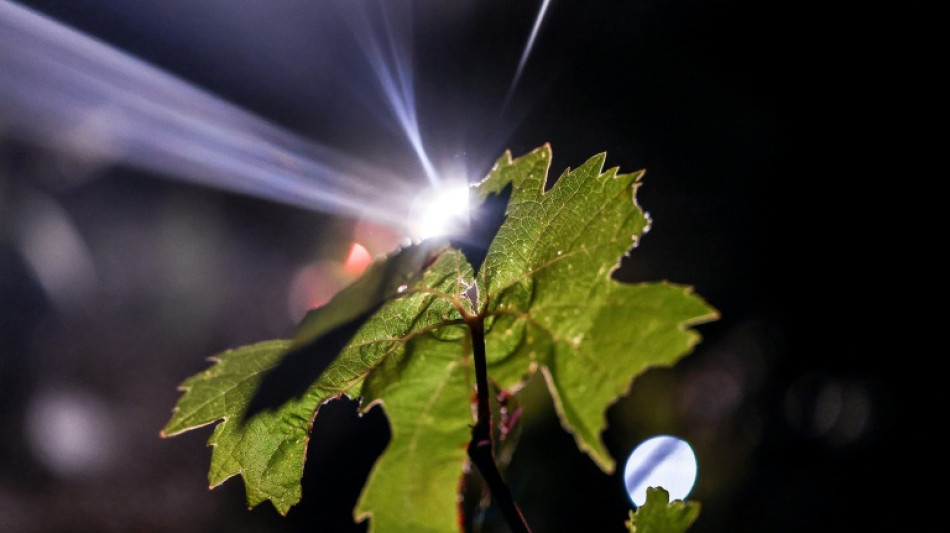
Portugal harvests grapes at night to beat the heat / Photo: © AFP

 Brewers rout Rays to reach brink of World Series sweep

 Mbappe dropped by Chinese brands for 'offending national sentiments'

 Kuwait exhibition presents Ukraine’s Islamic heritage and cultural ties

 Tech firms track Wall St rally on mixed day for Asian markets

 Jay-Z to perform at Super Bowl LXI halftime show: NFL

 Climate-threatened Fijian utopia rejects calls to relocate

 Israel to give verdict on Netanyahu in pivotal election

 $1m bounties, dawn arrests: Trump presses voter fraud campaign

 Gasping for air: Borneo residents struggle as island burns

 Doha exhibition charts a millennium of Chinese maritime ceramics trade

 New Zealand ex-PM Ardern to teach leadership in Sydney

 Ballon d'Or 'beyond wildest dreams' but Kane has plenty more to prove

 No envy, no secrets: How Spain's Gipuzkoa became football coaching hotbed

 South Korea economy grows three times faster than expected in Q3

 Al-Thawadi urges technology to deepen human connection through shared experiences

 Ballon d'Or: Harry Kane's crowning moment

 Harry Kane wins men's Ballon d'Or

 Lula win rattles Brazil markets over spending spree fears

 De la Fuente wins men's Ballon d'Or coach of year

 Trump slams 'rigged' Brazil election after ally loses to leftist Lula

 Nadal returns for Vegas hardcourt event

 Fainga'anuku named as loose forward for All Blacks northern tour

 Anthropic points to AI dangers, soaring sales in IPO filing

 Sinner to play rescheduled Saudi Six Kings in December
 Brazilian lawmaker Andre Janones, Lula's social media 'general'

Equipped with headlamps and pruning shears, a team of farm workers navigate pitch-black darkness during a nocturnal grape harvest that shields them from Portugal's increasingly oppressive summer heat.
"At night, it's much cooler, and with this light we see the bunches of grapes better," Maria Jeronima Mendes, 70, told AFP on a rural estate lined with lush vines.
Climate change is intensifying and lengthening spells of extreme heat and drought across Europe, with EU's climate monitor reporting on Thursday that western Europe sweltered through its warmest summer this year, while August was the hottest single month ever recorded globally.
The heat has forced adaptations in the continent's wine-making south that includes Portugal, Spain, Italy and Greece.
At Herdade das Servas, an estate of around 350 hectares (865 acres) located some 150 kilometres (93 miles) east of Lisbon, nighttime grape harvests were fully adopted last year after a successful test in 2024.
At first, the shift came up against the reluctance of its around 20 workers from Portugal, Romania and Southeast Asia, in a sector already struggling to recruit.
But the harvesters have now come to terms with working at night in cooler temperatures that make the manual work more bearable.
"Working at night isn't more tiring, it's just a matter of habit," said Mendes, who has worked in the fields since she was 12 and is the oldest member of the team.
Under a clear sky illuminated only by the stars and the Moon, it was still 28C at midnight at the estate in southern Portugal's Alentejo region.
But the temperature was much lower than the daytime peak of 40C, with such highs creeping into September as well as baking the country during the summer months.
The nighttime harvests "have become a necessity" to spare the workers from "temperatures of more than 40 degrees", said Renato Neves, director of production at Herdade das Servas.
- 'Response to climate change' -
As in other European regions struck by an exceptionally warm and dry summer, the grape harvest in Alentejo started in early August -- two weeks earlier than usual.
The new working conditions also offer an advantage for the wine-making process at the estate, which produced some 277,000 litres of red, white and rose wine in 2025.
"At night, the grapes arrive fresher, which delays the start of fermentation," making it possible to "obtain better decanting" and a better "extraction of aromas", explained Neves.
As well as adapting the working hours, Neves's estate no longer removes the weeds that grow at the base of the vines to try to retain soil humidity and thwart the increasingly hot, dry conditions.
At daybreak, the workers leave the vines and the harvest is taken to vats, where the grapes are washed and sorted before being crushed.
The night harvest then provides another advantage, as the cellar works at full capacity during the day, when the estate's solar panels are at their most productive.
The spread of harvesting at night across several European countries "is a response to climate change, and in Mediterranean climates I think this practice is here to stay", said oenologist Rui Reguinga.
The wine expert believes the new method is "another step in the transition towards a more sustainable viticulture".
But fellow oenologist Tiago Macena, a specialist in grape varieties native to Portugal, said the adaptation had its limits as it requires a specific organisation and a workforce prepared to work at night.
The practice is for now "limited to large wine estates" that characterise the country's south, but is yet to find an uptake among the smaller producers in the north, he said.
P.Staeheli--VB