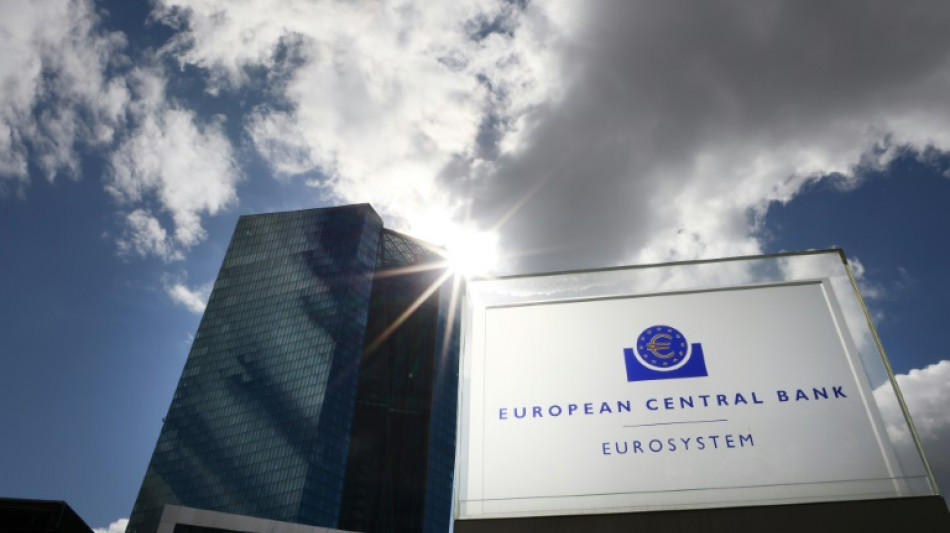
ECB cuts rates again as eurozone hit by economic, political woes / Photo: © AFP

 Macron urges Europe to develop 'crewed spaceflight' programme

 Deals worth billions to be signed as UAE leader visits Germany

 Zamanat Targets GCC’s $250 Billion SME Financing Gap With Up to $100 Million Tokenized Private Credit Fund

 Sri Lanka court revokes monk's pardon, orders return to prison

 'Hopeless, stuck, afraid': US deportees in limbo in Cameroon

 Mount Fuji ends hiking season with landslide, two rescues

 Seahawks beat Patriots again in NFL opener

 Asian Games begin with Qatar basketball win, nine days before opening ceremony

 Stocks sink as oil rally fans inflation and rate hike fears

 Argentine industry reels from Milei's free-market revolution

 Women quit South Korea's grind for diving tradition

 Bayeux Tapestry 'mania' sweeps UK as sold-out exhibition opens

 August hottest month ever recorded globally: EU monitor

 Duplantis leads creme de la creme at 'game-changing' Ultimate Championship

 Sjobo, cradle of Sweden's now-mainstream anti-migrant sentiment

 Israeli-made film about Gaza civilian deaths to debut in Venice

 Stars ready for busy Toronto International Film Festival

 Rubio defends anti-drug boat strikes, warns of cartel 'cancer'

 Rybakina books US Open semi against Gauff, secures No.1 ranking

 Pegula aiming to thwart Sabalenka three-peat in US Open semis

 'Not normal' US Open scheduling under-fire after late-night finishes

 Luis Enrique hails 'marvellous' Dembele as PSG win big in Champions League

 Liverpool's Iraola 'lucky' after first taste of Champions League

 Resurgent Zheng takes positives from storming US Open run

 Odegaard gives Arsenal winning Champions League start at Napoli

The European Central Bank cut interest rates again Thursday, citing a worsening growth outlook and slowing inflation, with political turmoil in the eurozone adding to the troubled picture.
The central bank for the 20 countries that use the euro reduced its key deposit rate a quarter point to three percent, as widely expected.
It was the ECB's third cut in a row and fourth since June, when it kicked off its current easing cycle.
After hiking borrowing costs from mid-2022 to combat runaway energy and food costs, policymakers have turned their attention to lowering rates as inflation eases and the eurozone economic outlook darkens.
Worse-than-expected data, as well as the Swiss central bank making an unexpectedly large rate reduction earlier Thursday, had fuelled speculation the ECB could deliver a hefty, half-percentage-point cut for the first time in the easing cycle.
But rate-setters opted to continue cutting at the same pace, with a quarter-point reduction, as inflation remains stubborn, having rebounded back above the ECB's two-percent target in November.
The slowdown in inflation is "well on track", the ECB said in a statement announcing its decision.
It cut its inflation forecasts for 2024 to 2.4 percent and to 2.1 percent in 2025 -- down 0.1 percentage point in each case.
"Most measures of underlying inflation suggest that inflation will settle at around the governing council's two-percent medium-term target on a sustained basis," it said.
But the central bank added that it now expects a "slower economic recovery" than several months ago, and cut its growth forecasts slightly for 2024 and the following two years -- to 0.7 percent, 1.1 percent and 1.4 percent respectively.
The statement dropped previous language on keeping rates "sufficiently restrictive for as long as necessary", saying instead that it was "determined to ensure that inflation stabilises sustainably" around the ECB target.
Investors are now set to follow ECB President Christine Lagarde's press conference for clues about the pace going forward, with analysts predicting she may offers hints of cuts in the months ahead.
- Trump jitters -
The move by the Swiss National Bank earlier Thursday, which brought its main rate down to 0.5 percent, reflected "uncertainty" about the economic outlook between political upheaval in the United States and Europe.
ECB officials have likewise raised concerns about the weakening growth outlook in the single-currency area, signalling a shift away from being laser-focused on bringing down inflation.
Eurozone inflation peaked at 10.6 percent in late 2022 after surging in the wake of Russia's full-scale invasion of Ukraine and amid post-pandemic supply chain woes.
It fell back under the ECB's two-percent target in September but rebounded in subsequent months, reaching 2.3 percent in November.
Political headwinds are adding to the tricky terrain that rate-setters will have to navigate.
Germany is heading for elections in February, seven months earlier than scheduled, after the collapse of Chancellor Olaf Scholz's long-troubled coalition last month.
Even before the latest turbulence, the eurozone's biggest economy was struggling with a manufacturing slowdown, and its anaemic growth rates are weighing down the broader single currency area.
Meanwhile in France, the eurozone's second-biggest economy, the government of Michel Barnier was ousted last week in a historic no-confidence vote, deepening the country's growing political and financial chaos.
Adding to the troubled picture is Donald Trump's impending return to the White House.
He has threatened to slap hefty new tariffs on all imports to the United States, and has previously singled out the EU as the bloc runs a sizeable trade surplus with the world's biggest economy.
The ECB's decision comes a week ahead of the US Federal Reserve's next rate-setting meeting on December 17 and 18, with markets betting on another cut in borrowing costs.
D.Schaer--VB