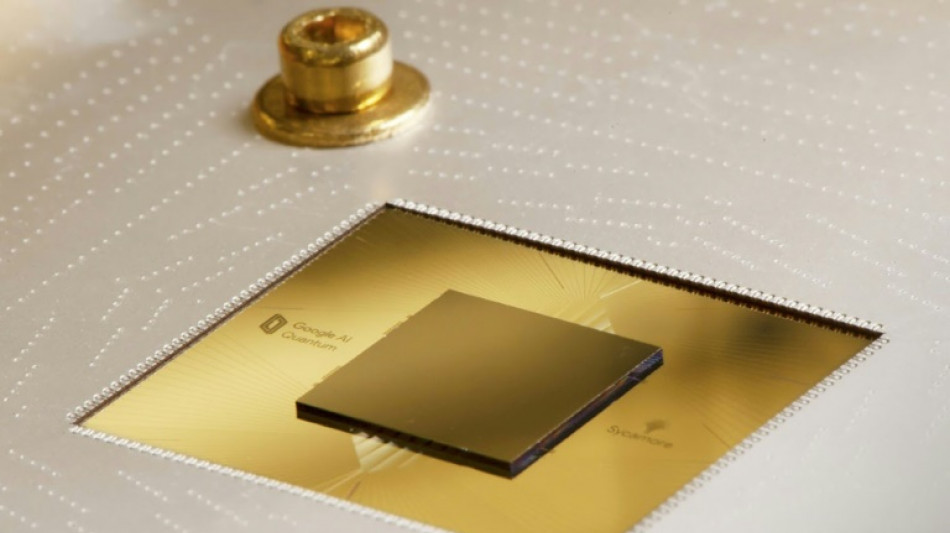
Google announces quantum computing chip breakthrough / Photo: © GOOGLE/AFP

 Nursing Leaders Warn HSE Recruitment Controls Are Unsafe

 Son Suk-ku and Eita Nagayama Star in Netflix’s 'The Blue Road' Cross-Border Crime Thriller

 Moving to a New State? Your Healthcare Might Get More Complicated

 South Africa’s Economic Shift: Why Services Must Lead Job Creation Beyond Manufacturing

 Lethbridge Council to Vote on $80 Million Capital Improvement Program

 Redmi Note 18 5G Battery Specs Leaked: Larger Capacity in Chinese Variant

 COP31 Presidency Publishes First Draft Cover Decision on Climate Action
 EU Club Group Files Antitrust Complaint Against UEFA Over Prize Money

 Heat and El Niño Drive Surge in Preterm Births Across Southern Africa

 China's Factory Activity Contracts as Export Orders Weaken

 US Retail Sales and Fed Minutes Set Up a Critical Test for Consumers

 Oil Heads for Second Weekly Loss as Supply Surplus Emerges

 Brazil Faces Debt and Inflation Test as Lula Prepares Fourth Term

 Canada Signals Openness to Chinese Automakers if US Trade Talks Fail

 US Mortgage Rate Falls for Fourth Week but Remains Above 7%

 13 Native American-Owned Restaurants in Arizona to Experience Indigenous Culinary Traditions

 Best Digital Photo Frames 2026: Aura, Skylight, and Amazon Compared
Google on Monday showed off a new quantum computing chip that it said was a major breakthrough that could bring practical quantum computing closer to reality.
A custom chip called "Willow" does in minutes what it would take leading supercomputers 10 septillion years to complete, according to Google Quantum AI founder Hartmut Neven.
"Written out, there is a 1 with 25 zeros," Neven said of the time span while briefing journalists. "A mind-boggling number."
Neven's team of about 300 people at Google is on a mission to build quantum computing capable of handling otherwise unsolvable problems like safe fusion power and stopping climate change.
"We see Willow as an important step in our journey to build a useful quantum computer with practical applications in areas like drug discovery, fusion energy, battery design and more," said Google CEO Sundar Pichai on X.
A quantum computer that can tackle these challenges is still years away, but Willow marks a significant step in that direction, according to Neven and members of his team.
While still in its early stages, scientists believe that superfast quantum computing will eventually be able to power innovation in a range of fields.
Quantum research is seen as a critical field and both the United States and China have been investing heavily in the area, while Washington has also placed restrictions on the export of the sensitive technology.
Olivier Ezratty, an independent expert in quantum technologies, told AFP in October that private and public investment in the field has totaled around $20 billion worldwide over the past five years.
Regular computers function in binary fashion: they carry out tasks using tiny fragments of data known as bits that are only ever either expressed as 1 or 0.
But fragments of data on a quantum computer, known as qubits, can be both 1 and 0 at the same time -- allowing them to crunch an enormous number of potential outcomes simultaneously.
Crucially, Google's chip demonstrated the ability to reduce computational errors exponentially as it scales up -- a feat that has eluded researchers for nearly 30 years.
The breakthrough in error correction, published in leading science journal Nature, showed that adding more qubits to the system actually reduced errors rather than increasing them -- a fundamental requirement for building practical quantum computers.
Error correction is the "end game" in quantum computing and Google is "confidently progressing" along the path, according to Google director of quantum hardware Julian Kelly.
G.Frei--VB