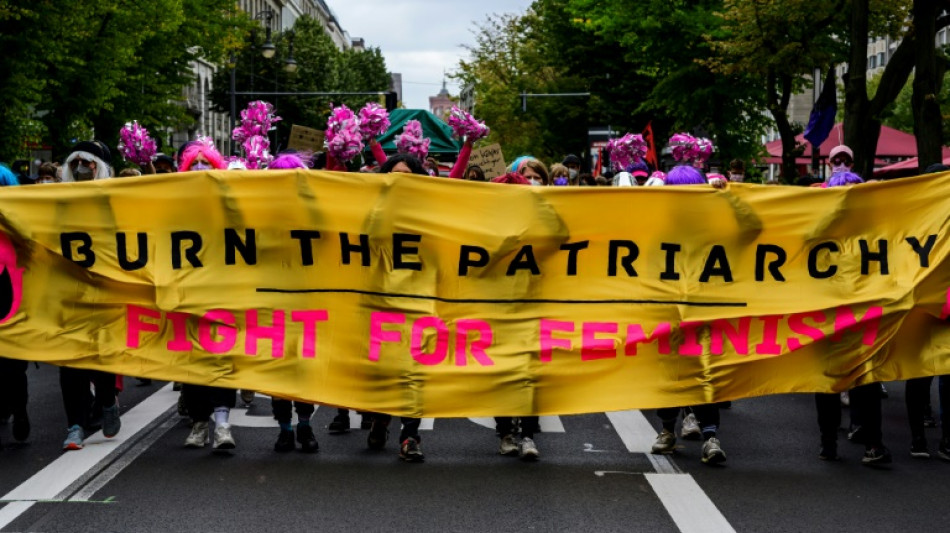
German campaigners demand abortion be fully legalised / Photo: © AFP/File

 Man United, Bayern cruise as Como make dream Champions League start

 Musiala returns to help Bayern sink Bodo in Champions League

 Surging oil prices, higher bond yields weigh on stocks

 Russell admits he needs luck as Antonelli focuses on the job

 Canada pledges support for Ukraine air defense as Zelensky visits

 Latin America fact-check group asks Meta not to replace verification practice

 Seahawks' Darnold gets good news on hip injury: coach

 Evasive Alonso teases reporters on his F1 future

 What to know about Trump's $5,000 'dividend' pledge

 Leclerc concedes he 'went too far' in Hamilton Monza incident
 Shelton, Tiafoe in spotlight as Zverev aims to build on Grand Slam success

 England close in on Test series sweep against sorry Pakistan

 England dominate sorry Pakistan, close in on Test series sweep

 Kung wins Vuelta time-trial as Mas retains lead

 DR Congo school fire leaves at least 14 children dead

 USA and France ease into women's Basketball World Cup semis

 ECB lifts borrowing costs amid energy shock, opens door for more hikes

 France defeat China to reach women's basketball World Cup semis

 Tribal Launches Campfire, Letting Business and Technical Teams Build on Salesforce Together

 Yemen's Houthis seize key city on Red Sea

 US producer inflation tops expectations as diesel costs jump

 Rubio ends South America swing with Peru security talks

 Defiant Iran seeks to bruise Trump ahead of midterms

 France withdraws support for Infantino in FIFA presidential election

 Evolution Metals & Technologies Provides Initial Revenue Guidance of $400-460mm for Fiscal Year 2027

German campaigners are pushing for reform to remove legal hurdles for women seeking an abortion, with emotions running high on the issue as the country heads for early elections.
Under current German law, abortion is illegal but tolerated in practice for women who are up to 12 weeks pregnant.
However, a woman seeking to terminate a pregnancy must first receive compulsory counselling, followed by a three-day waiting period before the procedure.
Critics say the law, known as paragraph 218, stigmatises women by branding abortion as a crime and deters some medical doctors from carrying out the procedure, especially in conservative regions.
The issue was debated in parliament this week and demonstrators will take to the streets of Berlin and the western city of Karlsruhe on Saturday to demand full legalisation.
"Members of the Bundestag have a historic opportunity to legalise abortion before the next election," said Leonie Weber from campaign group "Legalise Abortion -- Now!".
"We cannot allow conservative and right-wing forces to prevent this... We are the majority and we want legalisation."
Reforming the law had been a flagship pledge of Chancellor Olaf Scholz's former three-way coalition between his centre-left Social Democrats, the Greens and the liberal FDP.
But Scholz's coalition collapsed in early November, with the FDP jumping ship and leaving him in charge of a minority government ahead of fresh elections on February 23.
- 'Life is life' -
With the conservative opposition CDU/CSU alliance ahead in the polls, a group of mostly centrist and left-leaning MPs are now seeking to speedily push through the reform.
A total of 327 MPs -- mostly from the SPD and Greens -- have put their names to a bill in parliament on the issue and are hoping for enough votes from other parties for a majority in the 733-seat chamber.
But as Germany enters full campaign mode ahead of February's election, the proposal has sparked strong pushback from anti-abortion groups.
CDU leader Friedrich Merz, Germany's likely next chancellor, said the bill was "likely to trigger a completely unnecessary major conflict in Germany".
His party's more right-wing allies the CSU, who rule the predominantly Catholic southern state of Bavaria, are also strongly opposed to changing the law.
Dorothee Baer, a CSU lawmaker, said her party saw "no need to question the social consensus on the regulation of abortion".
"From a Catholic perspective" the change is unacceptable, said the head of the Central Committee of German Catholics, Irme Stetter-Karp. "Life is life from the beginning."
The far-right Alternative for Germany (AfD), currently in second place in the polls, has also seized on the debate with a proposal to massively restrict abortions.
In its draft election manifesto, it argues abortions should only be permitted "in cases of criminological or medical indication" -- for example after rape or where the mother's health is at risk.
- Nazi-era law -
Abortions must "remain the absolute exception", it argues, proposing that women seeking an abortion be shown ultrasound images of the foetus to dissuade them.
The party -- which strongly rejected what past German governments labelled a "welcome culture" toward migrants -- instead advocated a "welcoming culture for children".
According to a survey commissioned by the families ministry, 80 percent of Germans believe it is wrong that abortion is formally illegal.
In a reform in 2022, parliament voted to remove a Nazi-era law that limited the information doctors and clinics are allowed to provide about abortions.
But the subject still carries a stigma in Germany, according to a number of gynaecologists, and can feel like an obstacle course for patients, particularly in Bavaria.
In large parts of the southern state, no hospitals offer the procedure and many women seeking an abortion opt to cross the border to Austria instead.
In April, a commission set up by Scholz's government recommended making abortion fully legal up to 12 weeks.
Liane Woerner, a law professor and member of the commission, said the current situation was "untenable" and urged the government to "take action to make abortion legal and unpunishable".
Adriana Lamackova of the non-government Centre for Reproductive Rights argued that "German abortion law is rooted in an outdated legal framework that fails to meet the health needs and respect the fundamental rights of women".
"We hope that German lawmakers will seize this opportunity to safeguard women's health, autonomy and dignity," she said.
L.Maurer--VB

