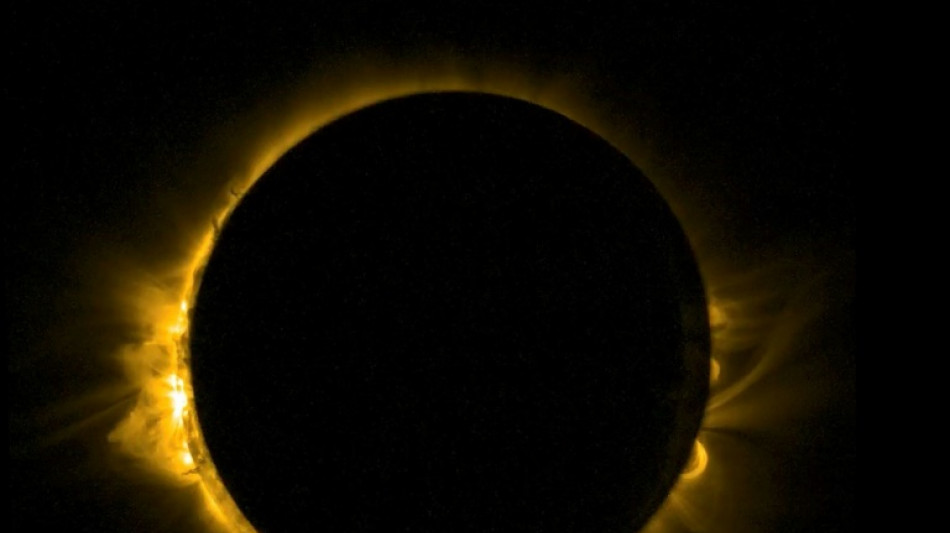
European mission to imitate solar eclipse launches from India / Photo: © ESA/AFP/File

 Nursing Leaders Warn HSE Recruitment Controls Are Unsafe

 Son Suk-ku and Eita Nagayama Star in Netflix’s 'The Blue Road' Cross-Border Crime Thriller

 Moving to a New State? Your Healthcare Might Get More Complicated

 South Africa’s Economic Shift: Why Services Must Lead Job Creation Beyond Manufacturing

 Lethbridge Council to Vote on $80 Million Capital Improvement Program

 Redmi Note 18 5G Battery Specs Leaked: Larger Capacity in Chinese Variant

 COP31 Presidency Publishes First Draft Cover Decision on Climate Action

 EU Club Group Files Antitrust Complaint Against UEFA Over Prize Money

 Heat and El Niño Drive Surge in Preterm Births Across Southern Africa

 China's Factory Activity Contracts as Export Orders Weaken

 US Retail Sales and Fed Minutes Set Up a Critical Test for Consumers

 Oil Heads for Second Weekly Loss as Supply Surplus Emerges

 Brazil Faces Debt and Inflation Test as Lula Prepares Fourth Term

 Canada Signals Openness to Chinese Automakers if US Trade Talks Fail

A European mission launched from India on Thursday, aiming to catch a rare glimpse of the Sun's mysterious atmosphere by imitating a solar eclipse using two satellites flying with millimetre-level precision.
The European Space Agency's Proba-3 mission blasted off on an Indian rocket from a launchpad on the island of Sriharikota at around 4:04 pm (1034 GMT), an online broadcast showed.
The separation of the rocket's third stage was met with applause at mission control, according to the ESA broadcast.
The Indian Space Research Organisation wrote on X that the PSLV-C59 rocket had "successfully soared into the skies", hailing the "proud moment" for India's space efforts.
The mission's aim is to find out more about the Sun's corona, the outermost part of its atmosphere, which is not visible on Earth except during a total solar eclipse when the Moon blocks out the light.
The half-ton spacecraft, which soon will enter Earth's orbit, holds two satellites that will separate from each other early next year.
They will then line up around 150 metres (500 feet) apart, so that one casts its shadow on the other.
In tandem, and without guidance from the ground, the solar-powered satellites will embark on an extremely elliptical 19-hour orbit, swinging out towards the Sun around 60,000 kilometres (37,000 miles) from Earth.
One satellite has a 1.4-metre shield that will play the role of the Moon in blocking the Sun's light.
The other satellite will then be able to observe and measure the Sun's corona from the shadow.
While total eclipses on Earth last just minutes and only occur around 60 times a century, it is hoped that Proba-3 will manage to secure 10 to 12 hours of observations a week over two years, the ESA has said.
To achieve this feat, the two satellites will need to fly in formation at a level of precision never before seen in such a mission, according to the ESA.
"We are aiming for precision on the order of a millimetre," ESA's Proba-3 project manager Damien Galano told a recent press conference.
The launch of the 200-million-euro ($210-million) mission had originally been planned for Wednesday, but was postponed by one day due to a technical issue, the ESA said.
T.Egger--VB