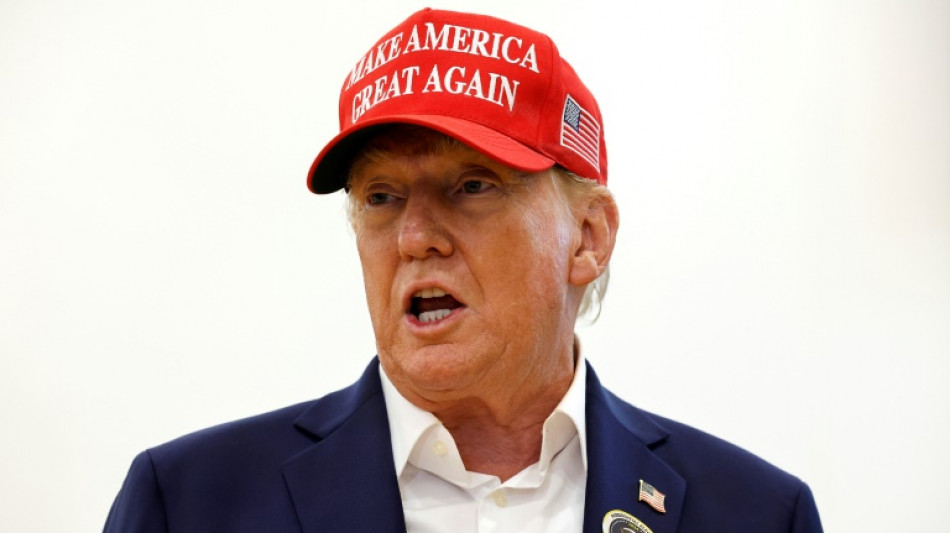
OECD warns of protectionism weeks before Trump return / Photo: © GETTY IMAGES NORTH AMERICA/AFP/File

 Inflation slows in top eurozone economies as ECB ponders next move

 Starmer boosts budget to modernise UK military before exit

 Stocks mostly higher, yen stays near 40-year low against dollar

 Data centres emitting more CO2 than thought: study

 Over 1 million migrants apply for Spain's mass regularisation

 Germany questions footballing identity after fresh World Cup failure

 MEXC Lists Ondo's Tokenized Strategy Preferred Stock on Spot Market

 Stocks climb, yen stays near 40-year low against dollar
 Swim star Marchand limps out of French nationals as Europeans loom

 UN says transport infrastructure must adapt to climate

 Sommer, Acerbi, Darmian, De Vrij leave Inter Milan

 Germany's labour market dilemma: rising unemployment despite vacancies

 Skating allows Russian, Belarussians to return as neutrals

 Russian double Olympic figure skating champion Dmitriev dies aged 58

 S. Africa deploys police as anti-migrant protests loom

 Monaco parcel bomb blast wounds Ukrainian oligarch

 Sweden face France's attacking firepower at the World Cup

 Online same-sex romance series embrace AI 'freedom'

 New Oxford academic centre symbolises UK's big-donor era

 Trump says Iran meeting set in Qatar, despite uncertainty

 Morocco down Netherlands to reach World Cup last 16

 Asian stocks unable to track Wall St higher, yen holds at 40-year low

 'We came from nothing': DR Congo dreams of England World Cup upset

 Peruvian political heir Fujimori wins presidency

 What to expect as EU small parcel levy kicks in

The OECD warned Wednesday that protectionist trade measures pose a major risk to disrupting the world economy, just weeks before Donald Trump is set to return to the White House.
The Organisation for Economic Cooperation and Development, a Paris-based body that advises industrialised nations on policy matters, never named Trump in its updated analysis of the world economy.
But with the president-elect vowing to slap tariffs on US trading partners after his return to power next month, it was abundantly clear that the OECD was warning about Trump's possible measures.
While the organisation raised its 2025 global growth forecast to 3.3 percent, it cautioned that "greater trade protectionism, particularly from the largest economies" poses a "downside risk" along with geopolitical tensions and high public debts.
On the campaign trail, Trump threatened blanket tariffs of at least 10 percent on all imports and since his election has vowed to slap 25 percent import tariffs against Canada and Mexico, top US trade partners.
"Increases in trade-restrictive measures could raise costs and prices, deter investment, weaken innovation and ultimately lower growth," the OECD warned in its economic outlook.
"Further increases in global trade restrictions would add to import prices, raise production costs for businesses and reduce living standards for consumers," it added.
During his first term in office from 2017 to 2021, Trump slapped tariffs on certain products from China and other trading partners, including the European Union, but on a smaller scale than the measures he has pledged to take upon his return to the White House.
A recent study by the Roland Berger consultancy calculated the cost of the US measures and likely countermeasures by China and the EU at more than $2.1 trillion through 2029.
- 'Major shocks' -
Trump is far from the only risk in terms of protectionist measures.
The Covid-19 pandemic and the war in Ukraine showed the dependency of many countries upon global trade, but instead of facilitating the exchange of goods and service many countries have sought to shorten certain supply chains and protect markets.
A spat has also broken out between Brussels and Beijing after the EU imposed import tariffs on Chinese electric vehicles. China has retaliated with tariffs on EU brandy, including cognac.
The OECD noted "the global economy has demonstrated remarkable resilience despite being subject to major shocks such as the pandemic and an energy crisis."
It even raised its global growth forecast for next year to 3.3 percent, an increase of 0.1 percentage points from its previous outlook in September, due in large part to the strong performance of the US economy.
- Strong US growth -
The OECD now sees the US economy expanding by 2.4 percent next year, up from its September forecast of 1.6 percent growth.
It also raised its forecast of British growth next year by 0.5 percentage points, to 1.7 percent, due to higher public spending planned by the new Labour government.
China's economy is now expected to expand by 4.7 percent next year, an increase of 0.2 percentage points, while India's growth forecast was raised 0.1 percentage points to 6.9 percent.
But both France and Germany saw to 0.3 percentage point cuts to their 2025 growth forecasts, to 0.9 percent and 0.7 percent, as both countries face political crises amid mounting fiscal pressure.
The downgraded forecast comes as France's new minority government faces being brought down Wednesday by lawmakers after it forced through the adoption of the social welfare budget.
O.Schlaepfer--VB