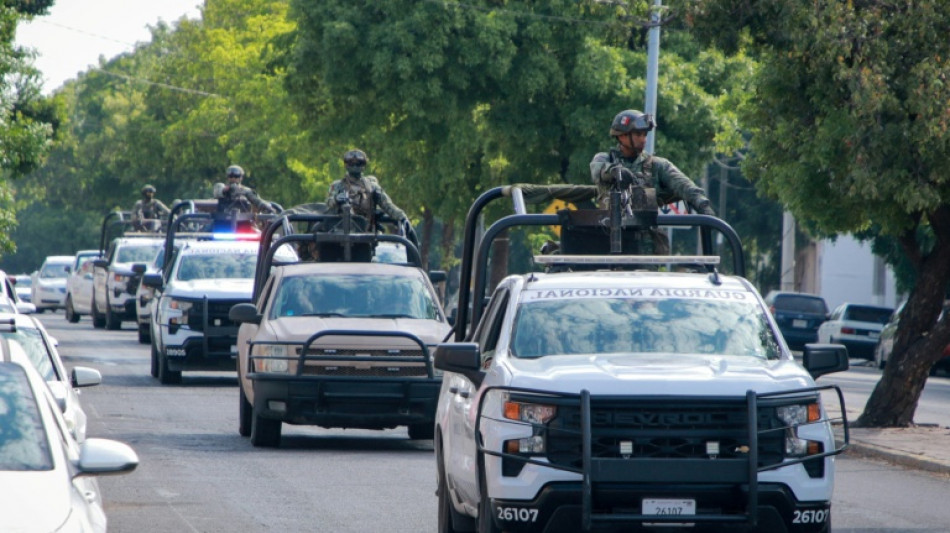
Life has 'disappeared': Mexican city reeling from cartel infighting / Photo: © AFP

 Inflation slows in top eurozone economies as ECB ponders next move

 Starmer boosts budget to modernise UK military before exit
 Stocks mostly higher, yen stays near 40-year low against dollar

 Data centres emitting more CO2 than thought: study

 Over 1 million migrants apply for Spain's mass regularisation

 Germany questions footballing identity after fresh World Cup failure
 MEXC Lists Ondo's Tokenized Strategy Preferred Stock on Spot Market

 Stocks climb, yen stays near 40-year low against dollar

 Swim star Marchand limps out of French nationals as Europeans loom

 UN says transport infrastructure must adapt to climate

 Sommer, Acerbi, Darmian, De Vrij leave Inter Milan

 Germany's labour market dilemma: rising unemployment despite vacancies

 Skating allows Russian, Belarussians to return as neutrals
 Russian double Olympic figure skating champion Dmitriev dies aged 58
 S. Africa deploys police as anti-migrant protests loom
 Monaco parcel bomb blast wounds Ukrainian oligarch
 Sweden face France's attacking firepower at the World Cup

 Online same-sex romance series embrace AI 'freedom'

 New Oxford academic centre symbolises UK's big-donor era

 Trump says Iran meeting set in Qatar, despite uncertainty

 Morocco down Netherlands to reach World Cup last 16

 Asian stocks unable to track Wall St higher, yen holds at 40-year low

 'We came from nothing': DR Congo dreams of England World Cup upset
 Peruvian political heir Fujimori wins presidency

 What to expect as EU small parcel levy kicks in
An eerie silence pervades the historic center of Culiacan, capital of the Mexican state of Sinaloa, where infighting among one of the world's biggest drug cartels has left hundreds of people dead since September.
As night falls on Paseo del Angel, the city's entertainment quarter, a popular restaurant offering Japanese-Mexican fusion cuisine that was booked out nightly just a few months ago is virtually empty.
A nail salon and a pastry shop on the same street have "for sale" signs in the window.
"Life in Culiacan has almost disappeared," Miguel Taniyama, owner of the Clan Taniyama restaurant, lamented.
Years of relative quiet in Sinaloa, a predominantly agricultural state home to the notorious cartel of the same name, were shattered in September when two rival factions of the drug gang went to war.
- Allegations of double-crossing -
Since then, each week has brought a grim litany of shootouts, abductions, bodies dumped in the street and vehicles and businesses set alight, sending Culiacan's 800,000 residents scrambling for cover.
The bloodletting began on September 9 after details emerged of how the son of the cartel's jailed founder Joaquin "El Chapo" Guzman reportedly double-crossed the cartel's other co-founder, Ismael "El Mayo" Zambada.
Zambada was arrested on US soil on July 25 after allegedly being kidnapped in Mexico and delivered to US authorities against his will.
Zambada claimed he was ambushed by Joaquin Guzman Lopez, one of "El Chapol"'s sons, who he said lured him onto a plane that was headed for the United States, where "El Chapo" himself is serving a life sentence.
The ensuing war between the cartel's "Mayos" and "Chapitos" has left more than 400 people dead and hundreds missing, according to the state prosecutor's office.
The local Noroeste newspaper said 519 people had been killed in an explosion of violence that shows no signs of abating.
At least 10 people were killed on Monday, the state prosecutor's office said.
Last week, five bodies were found outside the Autonomous University of Sinaloa, which promptly suspended classes and switched to remote learning.
- Feeding US fentanyl addiction -
The Sinaloa Cartel, one of Mexico's biggest drug trafficking organizations, was built on cocaine smuggling but over the past decade has changed focus to feeding the US opioid addiction.
The US Drug Enforcement Administration in June said the gang was "largely responsible for the massive influx of fentanyl" into the country over the past eight years.
The cartel's stranglehold on Culiacan was evident in 2019, when Mexico's security forces attempted to arrest another of El Chapo's sons, Ovidio Guzman Lopez.
The operation ended in humiliation for the government, which was forced to free the drug lord after the cartel launched a massive assault on the city.
While Culiacan recovered quickly from that episode -- and Ovidio was later recaptured -- the succession war now raging within the cartel has brought the local economy to the brink of collapse.
At least 30,000 people have lost their jobs, representing about a third of all social welfare recipients, according to the city's chamber of commerce.
The violence has affected all aspects of daily life.
With many people fearing going out into the street, some companies have reinstated pandemic-era remote working.
The second-division Dorados de Sinaloa football club, which had late Argentine legend Diego Maradona for a coach in 2018-2019, has temporarily relocated from Culiacan to Tijuana, some 1,500 kilometers (932 miles) away.
- 'Scared out of our wits' -
Around 11,000 soldiers backed with armored vehicles and planes have been deployed to Culiacan to try to quell the violence.
In October, the army said it had killed 19 suspected cartel members and arrested one local leader in its bloodiest clashes with narco-traffickers in years.
More than 450,000 people have been murdered in Mexico since the state launched a war on drugs in 2006.
Over 100,000 people are missing.
To try lure people back onto the streets, Taniyama, the chef, organized a giant festival on November 21, with live music and lashings of Sinaloa's signature dish, aguachile, a shrimp ceviche.
"We've been locked up for 70 days and scared out of our wits...Today we're starting to live again!" he told the gathering.
But there was no respite from the suffering for the families of those caught up in the violence.
Rosa Lidia Felix, 56, has not heard from her 28-year-old son Jose Tomas since he went missing on November 1.
"Please, I want my son back," she wept.
C.Bruderer--VB