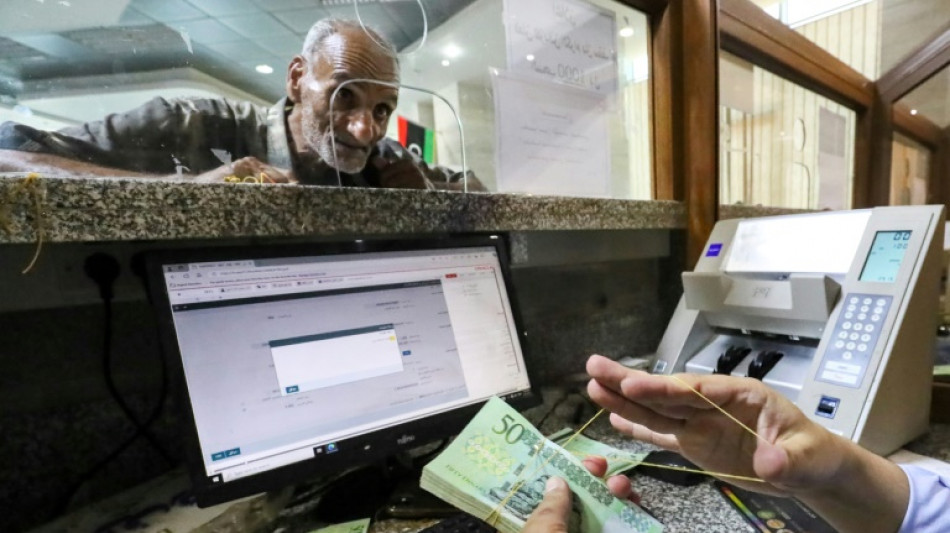
Cash crunch pushes Libyans to bank cards despite hurdles / Photo: © AFP/File

 Inflation slows in top eurozone economies as ECB ponders next move
 Starmer boosts budget to modernise UK military before exit
 Stocks mostly higher, yen stays near 40-year low against dollar

 Data centres emitting more CO2 than thought: study

 Over 1 million migrants apply for Spain's mass regularisation

 Germany questions footballing identity after fresh World Cup failure

 MEXC Lists Ondo's Tokenized Strategy Preferred Stock on Spot Market

 Stocks climb, yen stays near 40-year low against dollar
 Swim star Marchand limps out of French nationals as Europeans loom

 UN says transport infrastructure must adapt to climate
 Sommer, Acerbi, Darmian, De Vrij leave Inter Milan

 Germany's labour market dilemma: rising unemployment despite vacancies
 Skating allows Russian, Belarussians to return as neutrals

 Russian double Olympic figure skating champion Dmitriev dies aged 58
 S. Africa deploys police as anti-migrant protests loom
 Monaco parcel bomb blast wounds Ukrainian oligarch
 Sweden face France's attacking firepower at the World Cup
 Online same-sex romance series embrace AI 'freedom'

 New Oxford academic centre symbolises UK's big-donor era
 Trump says Iran meeting set in Qatar, despite uncertainty
 Morocco down Netherlands to reach World Cup last 16

 Asian stocks unable to track Wall St higher, yen holds at 40-year low

 'We came from nothing': DR Congo dreams of England World Cup upset

 Peruvian political heir Fujimori wins presidency
 What to expect as EU small parcel levy kicks in

In Libya, a shortage of cash in the banking system has pushed many to turn to cards for payments after more than a decade of war and instability has hammered the country's financial system.
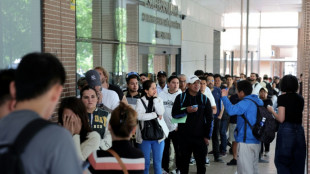
Across most Libyan cities, withdrawing money is akin to an obstacle course in which hundreds wait, often for hours, outside heavily guarded banks for a turn to take out cash.
But the money all too often runs out early due to short supply.
Mistrust in that system means money is rarely reinjected back into banks, with Libyans preferring instead to keep cash on hand.
And while cashless culture has yet to take root, "the younger generations are easily adopting it", said Abdullah al-Gatet, an employee at a bank in Misrata, the country's third largest city.
Withdrawals at bank counters are capped at 1,000 dinars ($206) each time.
This, along with the cash shortage, means civil servants who make up the bulk of Libya's working population often receive their salaries late.
There is a growing awareness among Libyans of "the importance of electronic solutions to facilitate daily transactions, especially in times of liquidity crisis", said 30-year-old Gatet, "even if the infrastructure is still insufficient".
- Shift in awareness -
Libya has been wracked by instability and conflict since the 2011 NATO-backed uprising that overthrew and killed longtime dictator Moamer Kadhafi.
It is currently divided between a United Nations-recognised government in the capital Tripoli and a rival administration in the east backed by general Khalifa Haftar.
In Misrata, a major port city and commercial hub about 200 kilometres (120 miles) from Tripoli, the population of 400,000 are increasingly signing up to receive bank cards.
But the shift towards cash-free transactions is not without stumbling blocks.
There are few ATM machines and many vendors do not accept card payments as they are not equipped with payment terminals.
Economist Khaled al-Delfaq, 42, said that while the shortages have pushed many to shift to using cards, there needs to be an accompanying shift in awareness, and work needs to be done to "make these services more accessible".
But in the seeming absence of other options, many have already been converted.
Among those are Mohamed al-Soussi, who was shopping for his family at a supermarket in Misrata.
"Transactions are more simple with the card. I don't need to carry large wads of cash with me anymore," he said.
- Divided central bank -
Libya's political upheaval has also precipitated another strange side-effect -- multiple prints of 50-dinar banknotes.
Libya's institutions have since 2014 been caught between the two camps vying for power in the oil-rich country, and its central bank is no exception.
Until last year, it had been split in two, with an internationally recognised headquarters in the capital and another in the east, with each printing bills signed off by their respective governors.
In 2012, new 50-dinar bills, the largest available denomination, were put into circulation to make life easier for consumers who often make cash payments in the thousands.
But last April, the central bank announced the withdrawal of those notes from circulation due to the proliferation of counterfeits.
"The situation became even more complicated with businesses refusing the 50-dinar bills," said Moussab al-Haddar, a 45-year-old teacher who was visiting his bank branch to request a card.
The central bank had initially set a deadline for the end of August for the notes to go out of circulation, before extending it to the end of the year.
In a bid to address the current crisis, the bank injected 15 billion dinars into the system in late October, while urging banks to facilitate the issuing of cards to clients.
R.Flueckiger--VB