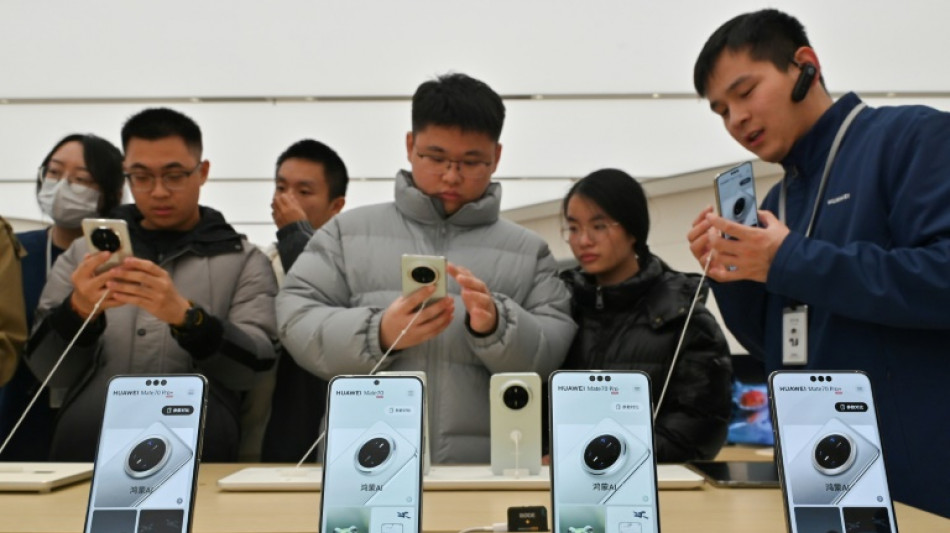
China curbs exports of key chipmaking components to US / Photo: © AFP

 German rail regulator backs Italian firm in competition spat

 Ancelotti shows Brazil his worth at World Cup but concerns remain

 Stocks rise, yen at 40-year low against dollar

 Australia hold West Indies to 125-7 in World Cup semi-final

 Defending champ Swiatek survives scare to reach Wimbledon second round

 US Supreme Court upholds state bans on transgender athletes in school

 Tourists soldier on in Rome despite heatwave

 Record number of 'new millionaires' in 2025, says UBS
 UN calls for food, shelter to help Venezuela quake survivors
 Merz faces mockery over praise of Germany's World Cup team

 Ride-share group BlaBlaCar taps AI for 20-country expansion

 Escaping heat, forgetting war: Kyiv locals hit the beach

 Thousands march to demand illegal migrants leave South Africa

 Serena set for remarkable Wimbledon return
 Outgoing UK PM Starmer announces 'record' defence spending

 Paralluelo joins Barca women's departures

 Police hunt for Monaco bomb suspect after Ukrainian-born businessman wounded

 Sommer, Acerbi, Darmian leave Inter Milan

 'Waiting like torture': Turks despair as Schengen visa delays mount

 Venezuela rescuers in final push to find survivors as families mourn

 Over 1 million migrants apply for Spain's mass regularisation: PM

 Thousands from Philippine sect protest pro-Duterte senator's graft case

 South Africa repatriations top 25,000 ahead of anti-immigrant ultimatum

 Taiwan raids tech firms in China AI chip smuggling probe

 Morocco 'unstoppable' says coach after Netherlands thriller

Beijing said Tuesday it would restrict exports to the United States of some key components in making semiconductors, after Washington announced curbs targeting China's ability to make advanced chips.
Among the materials banned from export are metals gallium, antimony and germanium, Beijing's commerce ministry said in a statement that cited "national security" concerns.
Exports of graphite, another key component, will also be subject to "stricter reviews of end-users and end-uses", the ministry said.
"To safeguard national security interests and fulfil international obligations such as non-proliferation, China has decided to strengthen export controls on relevant dual-use items to the United States," Beijing said.
"Any organisation or individual in any country or region violating the relevant regulations will be held accountable according to the law," it added.
In its own latest curbs, Washington on Monday announced restrictions on sales to 140 companies, including Chinese chip firms Piotech and SiCarrier, without additional permission.
They also impact Naura Technology Group, which makes chip production equipment, according to the US Commerce Department.
The move expands Washington's efforts to curb exports of state-of-the-art chips to China, which can be used in advanced weapons systems and artificial intelligence.
The new US rules also include controls on two dozen types of chip-making equipment and three kinds of software tools for developing or producing semiconductors.
Beijing swiftly vowed to defend its interests, saying the United States "abuses export control measures" and has "hindered normal economic and trade exchanges".
- 'Weaponised' trade -
And on Tuesday, China said Washington had "politicised and weaponised economic, trade and technological issues" as it unveiled its own export curbs.
The moves also restrict the exports of "dual-use items to United States military users or for military purposes", Beijing said.
China accounts for 94 percent of the world's production of gallium -- used in integrated circuits, LEDs and photovoltaic panels -- according to a report by the European Union published this year.
For germanium, essential for fibre optics and infrared, China makes up 83 percent of production.
Beijing last year had already tightened restrictions on exporters of the metals, requiring them to provide information on the final recipient and give details about their end use.
But the curbs unveiled Tuesday now ban them outright.
It had also previously restricted curbs on exports of certain types of graphite --also key to making batteries for electric vehicles.
"The move is clearly a retaliatory strike at the US," Chong Ja Ian, an associate professor of political science at the National University of Singapore, told AFP.
"Should these back and forth curbs affect trade for third parties, this can create some trade and supply chain disruption—as well as associated inflationary pressures," he said.
N.Schaad--VB