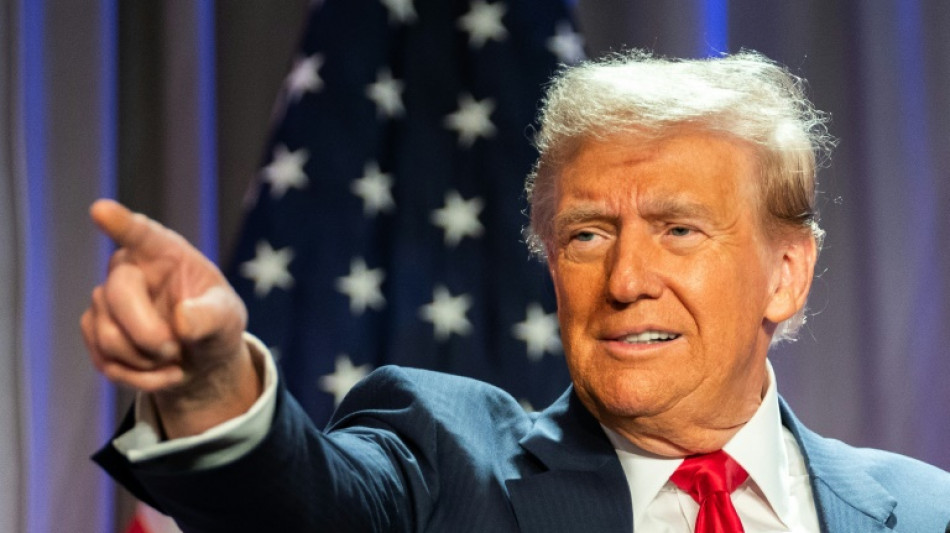
Trump vows to defend US dollar hegemony, but is it under threat? / Photo: © POOL/AFP/File

 German rail regulator backs Italian firm in competition spat
 Ancelotti shows Brazil his worth at World Cup but concerns remain

 Stocks rise, yen at 40-year low against dollar
 Australia hold West Indies to 125-7 in World Cup semi-final

 Defending champ Swiatek survives scare to reach Wimbledon second round

 US Supreme Court upholds state bans on transgender athletes in school

 Tourists soldier on in Rome despite heatwave
 Record number of 'new millionaires' in 2025, says UBS
 UN calls for food, shelter to help Venezuela quake survivors
 Merz faces mockery over praise of Germany's World Cup team

 Ride-share group BlaBlaCar taps AI for 20-country expansion

 Escaping heat, forgetting war: Kyiv locals hit the beach

 Thousands march to demand illegal migrants leave South Africa

 Serena set for remarkable Wimbledon return
 Outgoing UK PM Starmer announces 'record' defence spending

 Paralluelo joins Barca women's departures

 Police hunt for Monaco bomb suspect after Ukrainian-born businessman wounded

 Sommer, Acerbi, Darmian leave Inter Milan

 'Waiting like torture': Turks despair as Schengen visa delays mount

 Venezuela rescuers in final push to find survivors as families mourn

 Over 1 million migrants apply for Spain's mass regularisation: PM

 Thousands from Philippine sect protest pro-Duterte senator's graft case

 South Africa repatriations top 25,000 ahead of anti-immigrant ultimatum

 Taiwan raids tech firms in China AI chip smuggling probe

 Morocco 'unstoppable' says coach after Netherlands thriller

US President-elect Donald Trump has threatened retaliation against governments that challenge the US dollar, vowing "100 percent tariffs" on countries that undercut the US currency.
The Republican vowed the action on states that "create a new BRICS Currency" or otherwise "replace the mighty US dollar," according to a post on Truth Social on Monday.
BRICS refers to a grouping that includes Brazil, Russia, India, China and South Africa, and has expanded in recent years to include Iran, Egypt, Ethiopia and the United Arab Emirates.
Trump's statement, however, comes at a time when the greenback's hegemony does not appear to be facing an immediate threat, having been the world's reserve currency for decades.
- Is the dollar's influence diminishing? -
The US dollar currently comprises 58 percent of foreign exchange reserves held worldwide, according to the International Monetary Fund (IMF), down from 67 percent in 2000.
But the greenback accounts for 74 percent of export invoices in the Asia-Pacific region, which is the most active in terms of international trade, the IMF says.
The dollar has maintained its unique position globally since the 1944 Bretton Woods accords, the international agreement that established the IMF and required signatories to peg their currencies to the US currency.
The system has evolved since that time and several countries have stopped indexing their currencies to the dollar, but without challenging its status as the global reserve currency.
The United States' massive role in monetary policy also reflects the country's position as the world's largest consumer of goods and services and the source of more than $8 trillion in government debt held by foreign investors.
The dominance of the US currency has not been affected by the huge scale of its debt, nor by the shakiness of its financial system during the 2008 global financial crisis.
"The US dollar remains as dominant as ever as a global funding currency, a payment currency for international transactions, and a reserve currency," said Eswar Prasad, a professor of international trade policy at Cornell University in New York state.
"Without the dollar as the dominant international currency, the multilateral trading system would effectively cease to exist –- making the global economy much less efficient," said Benn Steil, a senior fellow at the US-based Council on Foreign Relations.
- Is the dollar being threatened? -
Trump's comments came on the heels of a BRICS summit in October in Kazan, Russia, where members discussed boosting non-dollar transactions and strengthening local currencies.
"The BRICS today might be where Europe was in the 1970s and that's optimistic in terms of integrating," said Adam Button, chief currency analyst at ForexLive.
Recent years have seen an uptick in transactions involving local currencies, especially between China and Russia, in light of international sanctions on Moscow following its invasion of Ukraine in 2022.
There has not, however, been an official effort to employ a currency throughout the group, or at forming an official monetary union.
"I don't know if there (are) any of those countries (that) would give up monetary sovereignty," Button said. "So it's a wholly fringe idea, and I'm not even sure why Trump decided to validate it."
While China and India are by far the world's two most populous states, their currencies are not widely used outside of their borders.
Trump's broadside did not mention the euro, which plays a key role in facilitating commerce within the eurozone but has not been envisioned as having global aspirations.
- Will Trump's comments impact the dollar? -
The influence of the dollar means many countries can see their fortunes affected by the fluctuations of the US currency.
When the dollar is strong -- such as currently -- other countries face pressure to raise their interest rates to counter the risk of capital flight.
"The US has wielded the dollar's dominance as a weapon against its rivals through financial sanctions and even freezing of dollar reserves," Prasad said.
Jonathan Kirshner, a political scientist at Boston College who has written extensively on currencies and international relations, sees Trump's comments as largely "irrelevant for real-world international politics."
"Despite Trump's bluster, you can't force people to use the dollar -- an international currency thrives because people *want* to hold it -- and thus such coercion will only backfire," he said in an email to AFP.
J.Sauter--VB