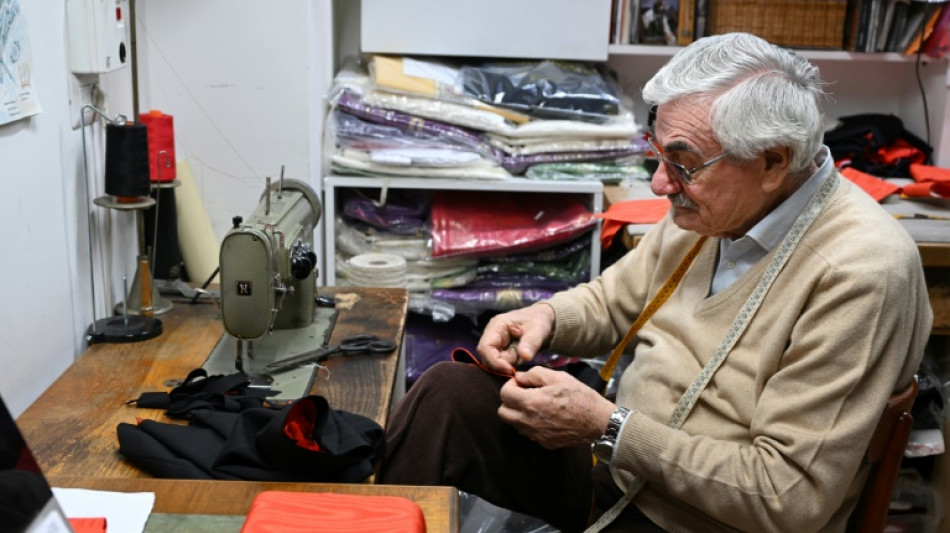
Dressing the Church: one of Rome's last clergyman tailors / Photo: © AFP

 Devan Ekambaram and Susha’s 'Varuvaaiy' Makes History as First Tamil Song Nominated for a Grammy

 Miranda Lambert Leads North Texans with Seven Grammy Nominations for 2027

 DiDi Advances Robotaxi Operations in China with New R2 Vehicle and Expanded Safety Infrastructure

 Smart Car Seats Tested: Do Sensors and Apps Actually Improve Safety?

 5 Strategies for Fort Worth Households to Reduce Summer Electricity Costs
 Central Bank of Malta Links Energy Subsidies to Middle East Conflict and Price Volatility

 Shomari Figures Defies Redistricting in Alabama Amid Disaster Relief Crisis

 BYD Dolphin G Leasing Deal: Plug-in Hybrid Supermini Available from £174 a Month

 Egypt Opens Registration for 2027 Total Solar Eclipse Viewing Packages

 French Economy Shrinks 0.1% as Consumer Confidence Slumps

 Wall Street Ends Turbulent Week Higher Despite Inflation and AI Jitters

 Kansas City Fed Chief Says Inflation Is Still Running Too Hot

With a tape measure around his neck and thimble on his finger, Raniero Mancinelli slides a needle into a black cassock with red piping destined for a Catholic cardinal.
"It takes two or three days to make an outfit: taking the measurements, cutting it out, and putting it all together," according to the 86-year-old Italian, one of the last ecclesiastical tailors in Rome.
Mancinelli has been working flat out in his historic shop on the Borgo Pio, a stone's throw from the Vatican, ahead of a ceremony this weekend to make 21 new cardinals.
A third of those being elevated by Pope Francis have placed orders with the tailor.
"They trust me and I know what I have to do, depending on where they live, the climate, their financial means," said Mancinelli, bushy black eyebrows moving animatedly above rectangular glasses, his hands stroking a tiny silver goatee.
Gold chalices, embroidered headdresses, signet rings and rosaries with gleaming crucifixes fill the shop's display cases.
Entering his workshop at the back of the shop is like stepping back in time: an olive green Necchi sewing machine sits on a wooden bench, underneath a map of the Vatican.
Large scissors and an old cast-iron iron lie on a nearby table.
- Less sumptuous -
Mancinelli, assisted by his daughter and grandson, arms himself with scissors, pins, bobbins and buttons.
Two scarlet cassocks hang ready nearby. The future cardinals will also need a "biretta" (a square cap), "mozzetta" (an elbow-length cape), and "rochet" (a white lace garment).
The tailor also makes the black habits and white collars for priests, and the violet skullcaps and belts worn by bishops.
The luxury silks once used have today been replaced by "light, cheaper wools", and cassocks now cost around 200 euros ($210) each.
Mancinelli, originally from the Marche region in central Italy, has worked under seven popes but fell into the profession "by chance".
"One day I was offered the job of making cassocks for the Vatican," he told AFP.
"I started like that, cautiously, little by little, but I immediately saw that I liked it."
After honing his skills in Rome in the late 1950s under Pius XII, Mancinelli opened his own business in 1962.
He thinks back with nostalgia of long scarlet trains "of 6-7 metres of silk" once worn by cardinals, and the clergy who used to favour very high collars.
But ecclesiastical fashions change.
After the Second Vatican Council in the 1960s brought the Church into a more modern era, outfits became more simple.
And they have become humbler still under Pope Francis, who refused to wear the furs and velvets donned by his predecessors.
Clerical clothing is now "lighter, less expensive, less sumptuous, less flashy", Mancinelli said.
- 'Maestro' -
The workshop is lined with photographs of Mancinelli and popes. He personally made cassocks for the last three, including Argentine Francis.
But it is his "exceptional" relationship with common clergymen that drives him, and gave him the strength to reopen after a difficult pandemic.
"They are the ones who give me this energy, this desire to work," he said.
Clerics from all over the world drop in on him during their visits to Rome.
Some have become friends, others have climbed the ranks of the Catholic hierarchy.
Over the decades, he has seen the number of ecclesiastical tailors dwindle as the sector industrialises.
"It's a very particular job, everything is done by hand," he said.
But one person is learning the centuries-old skills.
Mancinelli's 23-year-old grandson Lorenzo di Toro has been working alongside him for the past three years.
"I didn't think it would be so difficult," said di Toro, whose hoodie and sneakers contrast starkly with the decor.
His grandfather is "very demanding" and "attentive to the smallest details".
But di Toro said he is ready to take over the family business from Mancinelli.
"I always try to learn from him, because in the end, he is the maestro," he said.
D.Schlegel--VB