
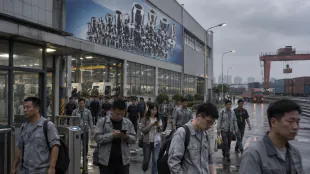
US unveils fresh export curbs targeting China's chip sector / Photo: © AFP

 Devan Ekambaram and Susha’s 'Varuvaaiy' Makes History as First Tamil Song Nominated for a Grammy

 Miranda Lambert Leads North Texans with Seven Grammy Nominations for 2027

 DiDi Advances Robotaxi Operations in China with New R2 Vehicle and Expanded Safety Infrastructure

 Smart Car Seats Tested: Do Sensors and Apps Actually Improve Safety?

 5 Strategies for Fort Worth Households to Reduce Summer Electricity Costs

 Central Bank of Malta Links Energy Subsidies to Middle East Conflict and Price Volatility

 Shomari Figures Defies Redistricting in Alabama Amid Disaster Relief Crisis

 BYD Dolphin G Leasing Deal: Plug-in Hybrid Supermini Available from £174 a Month

 Egypt Opens Registration for 2027 Total Solar Eclipse Viewing Packages

 French Economy Shrinks 0.1% as Consumer Confidence Slumps
 Wall Street Ends Turbulent Week Higher Despite Inflation and AI Jitters

 Kansas City Fed Chief Says Inflation Is Still Running Too Hot

The United States announced new export restrictions Monday taking aim at China's ability to make advanced semiconductors -- used in weapon systems and artificial intelligence -- as competition deepens between the world's two biggest economies.
"The United States has taken significant steps to protect our technology from being used by our adversaries in ways that threaten our national security," said National Security Advisor Jake Sullivan in a statement.
He added that Washington will keep working with allies and partners "to proactively and aggressively safeguard our world-leading technologies and know-how so they aren't used to undermine our national security."
The moves step up existing US efforts to tighten curbs on exports of state-of-the-art AI chips to China.
The announcement comes weeks before President-elect Donald Trump returns to the White House, where he is expected to further Washington's hawkish stance on China.
The latest rules include a restriction of exports to 140 companies, including Chinese chip firms Piotech and SiCarrier Technology.
They also impact Naura Technology Group, which makes chip production equipment, according to the Commerce Department.
The new rules also include controls on two dozen types of chipmaking equipment and three kinds of software tools for developing or producing semiconductors.
"We are constantly talking to our allies and partners as well as reassessing and updating our controls," noted Under Secretary of Commerce for industry and security Alan Estevez.
The efforts further a policy beginning under Trump's first administration, to hold back Beijing's ability to gain ground and become a leading tech economy.
On Monday, Commerce Secretary Gina Raimondo stressed that President Joe Biden's government has been especially tough in "strategically addressing China's military modernization through export controls."
"The semiconductor manufacturing equipment controlled by today's rules is needed to produce advanced-node integrated circuits, which are necessary for advanced weapon systems and advanced AI used in military applications," the Commerce Department said.
It maintained that this is in line with Washington's "small yard, high fence" strategy -- an approach that Chinese President Xi Jinping last month urged against.
The latest actions are aimed at slowing China's development of advanced AI that could "change the future of warfare," and impairing China's development of its own semiconductor ecosystem, noted the Commerce Department.
The entity list that the 140 companies were added to restricts US suppliers from exporting to them without added permission.
Calls to further close the semiconductor supply chain have grown since the world became increasingly aware of the powers of AI, with the launch of ChatGPT.
I.Stoeckli--VB