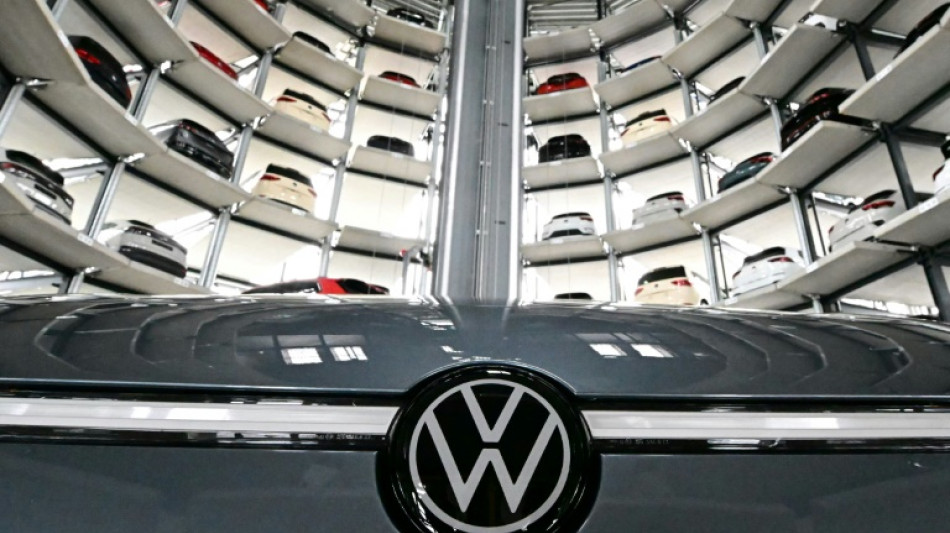
VW's German workers to strike from Monday / Photo: © AFP/File

 German rail regulator backs Italian firm in competition spat
 Ancelotti shows Brazil his worth at World Cup but concerns remain

 Stocks rise, yen at 40-year low against dollar
 Australia hold West Indies to 125-7 in World Cup semi-final

 Defending champ Swiatek survives scare to reach Wimbledon second round
 US Supreme Court upholds state bans on transgender athletes in school

 Tourists soldier on in Rome despite heatwave

 Record number of 'new millionaires' in 2025, says UBS
 UN calls for food, shelter to help Venezuela quake survivors
 Merz faces mockery over praise of Germany's World Cup team
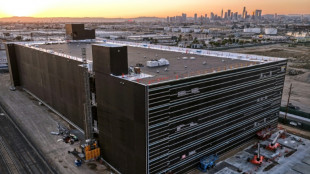
 Ride-share group BlaBlaCar taps AI for 20-country expansion
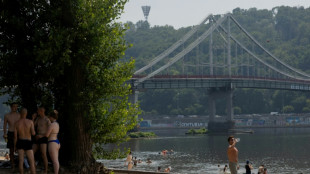 Escaping heat, forgetting war: Kyiv locals hit the beach

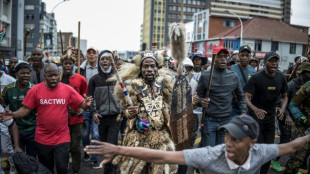 Thousands march to demand illegal migrants leave South Africa

 Serena set for remarkable Wimbledon return
 Outgoing UK PM Starmer announces 'record' defence spending

 Paralluelo joins Barca women's departures
 Police hunt for Monaco bomb suspect after Ukrainian-born businessman wounded

 Sommer, Acerbi, Darmian leave Inter Milan
 'Waiting like torture': Turks despair as Schengen visa delays mount

 Venezuela rescuers in final push to find survivors as families mourn

 Over 1 million migrants apply for Spain's mass regularisation: PM
 Thousands from Philippine sect protest pro-Duterte senator's graft case
 South Africa repatriations top 25,000 ahead of anti-immigrant ultimatum

 Taiwan raids tech firms in China AI chip smuggling probe

 Morocco 'unstoppable' says coach after Netherlands thriller

Workers at German factories for carmaker Volkswagen are to go on strike from Monday over plans to cut thousands of jobs, union IG Metall said Sunday.
"If need be, it will be the toughest collective bargaining battle Volkswagen has ever seen," the union said.
The crisis-wracked auto titan has been locked in bitter talks with unions since announcing in September that it was weighing the unprecedented step of shuttering plants in Germany, where it has around 120,000 employees.
VW has been hit hard by high manufacturing costs at home, a stuttering shift to electric vehicles and tough competition in key market China.
In a statement, VW said it "respects workers' rights" and believes in "constructive dialogue" in a bid to reach "a lasting solution that is collectively supported".
It also said that it had taken "advanced measures to guarantee urgent deliveries" during the strike action.
The crisis at one of Germany's industrial titans comes as the eurozone's top economy is struggling, and amid heightened political uncertainty with early elections looming in February.
After little progress in several rounds of talks between labour representatives and Volkswagen bosses, workers at VW factories across Germany will begin the first stage of planned strike action.
The campaign is starting with "warning strikes", short walkouts that are a common tactic during negotiations in Germany.
But the action could escalate, with powerful union IG Metall warning that VW will face the biggest wave of strikes the country has seen for decades unless management dials back its cost-saving plans.
- 'Extremely regrettable' -
Ahead of talks last month, the union and VW's works councils put forward a series of proposals they said would save 1.5 billion euros ($1.6 billion) in labour costs without the need for site closures.
These included proposals for management and staff to waive bonuses. The union also said it could drop a demand for pay rises in exchange for working shorter hours at some factories.
But Volkswagen said it had concluded that, while the measures could help in the short term, they would not lead "to any long-term financial relief for the company in the coming years".
IG Metall at the time described VW's response as "extremely regrettable", accusing it of "ignoring the constructive proposals of the employee representatives".
Volkswagen's parlous financial position was highlighted in October when it reported a 64 percent plunge in third-quarter profits.
Slowing business in VW's most important market China, where homegrown rivals are zipping past the German carmaker, has been a particularly heavy blow.
VW cited "economic reasons" last week when it announced the sale of its operations in China's Xinjiang, though the company had also been under pressure to exit the region due to human rights concerns.
Further clouding the outlook in the world's number two economy is the EU's move to impose hefty tariffs on Chinese-made electric cars, which VW fears could trigger retaliatory steps.
The manufacturer's woes reflect a broader crisis in the European auto industry, with demand weak and the transition to electric cars slower then expected.
In Germany, VW, BMW and Mercedes-Benz have all downgraded their forecasts recently while key suppliers to the industry have been lining up to announce job cuts.
P.Vogel--VB