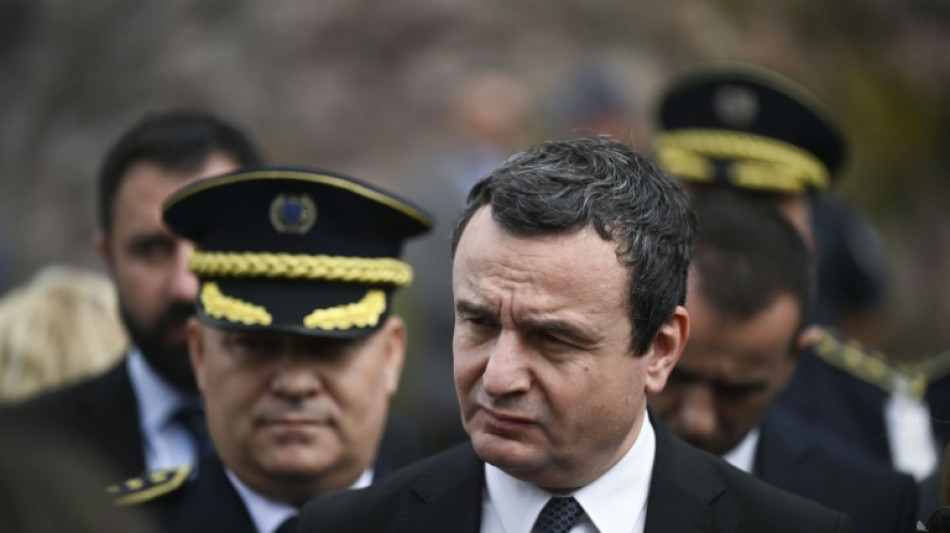
Kosovo raises security after blast, Serbia denies involvement / Photo: © AFP/File

 German rail regulator backs Italian firm in competition spat
 Ancelotti shows Brazil his worth at World Cup but concerns remain
 Stocks rise, yen at 40-year low against dollar
 Australia hold West Indies to 125-7 in World Cup semi-final

 Defending champ Swiatek survives scare to reach Wimbledon second round

 US Supreme Court upholds state bans on transgender athletes in school

 Tourists soldier on in Rome despite heatwave
 Record number of 'new millionaires' in 2025, says UBS
 UN calls for food, shelter to help Venezuela quake survivors
 Merz faces mockery over praise of Germany's World Cup team
 Ride-share group BlaBlaCar taps AI for 20-country expansion
 Escaping heat, forgetting war: Kyiv locals hit the beach
 Thousands march to demand illegal migrants leave South Africa

 Serena set for remarkable Wimbledon return
 Outgoing UK PM Starmer announces 'record' defence spending

 Paralluelo joins Barca women's departures
 Police hunt for Monaco bomb suspect after Ukrainian-born businessman wounded
 Sommer, Acerbi, Darmian leave Inter Milan
 'Waiting like torture': Turks despair as Schengen visa delays mount
 Venezuela rescuers in final push to find survivors as families mourn
 Over 1 million migrants apply for Spain's mass regularisation: PM
 Thousands from Philippine sect protest pro-Duterte senator's graft case
 South Africa repatriations top 25,000 ahead of anti-immigrant ultimatum

 Taiwan raids tech firms in China AI chip smuggling probe
 Morocco 'unstoppable' says coach after Netherlands thriller
Kosovo stepped up security measures around "critical" infrastructure Saturday after an explosion at a key canal feeding two of its main power plants, as neighbouring Serbia rejected accusations it had staged the blast.
The explosion occurred Friday near the town of Zubin Potok in a Serb-dominated area in Kosovo's troubled north, damaging the canal supplying water to cooling systems at two coal-fired power plants that generate most of Kosovo's electricity.
Prime Minister Albin Kurti called a security meeting late Friday, saying: "This is a criminal and terrorist attack aimed at damaging our critical infrastructure".
"The attack was carried out by professionals. We believe it comes from gangs directed by Serbia," he added without providing any evidence.
The government later issued a statement echoing his allegations, saying that "initial indications suggest" the explosion had been "orchestrated by the Serbian state, which has the capacity to carry out such a criminal and terrorist attack".
Kosovo also "approved additional measures to strengthen security around essential infrastructure and services, such as bridges, transformers" and other sites, it said.
Serbia slapped back Saturday condemning the attack, while calling the accusation "premature" and "baseless".
"Such destructive actions are unacceptable and threaten the fragile stability we are striving to maintain," Serbian Foreign Minister Marko Djuric said on X.
"Serbia unequivocally demands responsibility for the perpetrators of this reckless attack," he added, while suggesting the Kosovar "regime" could be behind the blast and calling for an internationally-led investigation.
The main political party representing Serbs in Kosovo, Serb List, also condemned the attack "in the strongest possible terms".
Pictures from the scene published by local media showed water leaking heavily from one side of the reinforced canal, which runs from the Serb-majority north of Kosovo to the capital Pristina and also supplies drinking water.
However, electricity suppplies to consumers were running smoothly on Saturday morning, with authorities having found an alternative method to cooling the plants, Kosovo's Economy Minister Artane Rizvanolli said.
Repair work was ongoing, authorities said.
-'Criminal attack' -
The United States strongly condemned the "attack on critical infrastructure in Kosovo", the US embassy in Pristina said in a statement on Facebook.
"We are monitoring the situation closely... and have offered our full support to the government of Kosovo to ensure that those responsible for this criminal attack are identified and held accountable."
The European Union's ambassador to Kosovo, Aivo Orav, also condemned the attack while calling for an investigation.
"I have already offered EU's help to Kosovo's authorities. The incident needs to be investigated and those responsible brought to justice," he said on X.
Animosity between ethnic Albanian-majority Kosovo and Serbia has persisted since the end of the war between Serbian forces and ethnic Albanian insurgents in the late 1990s.
Kosovo declared independence in 2008, a move that Serbia has refused to acknowledge.
Kurti's government has for months sought to dismantle a parallel system of social services and political offices backed by Belgrade to serve Kosovo's Serbs.
Friday's attack came after a series of violent incidents in northern Kosovo, including the hurling of hand grenades at a municipal building and a police station earlier this week.
A.Ruegg--VB