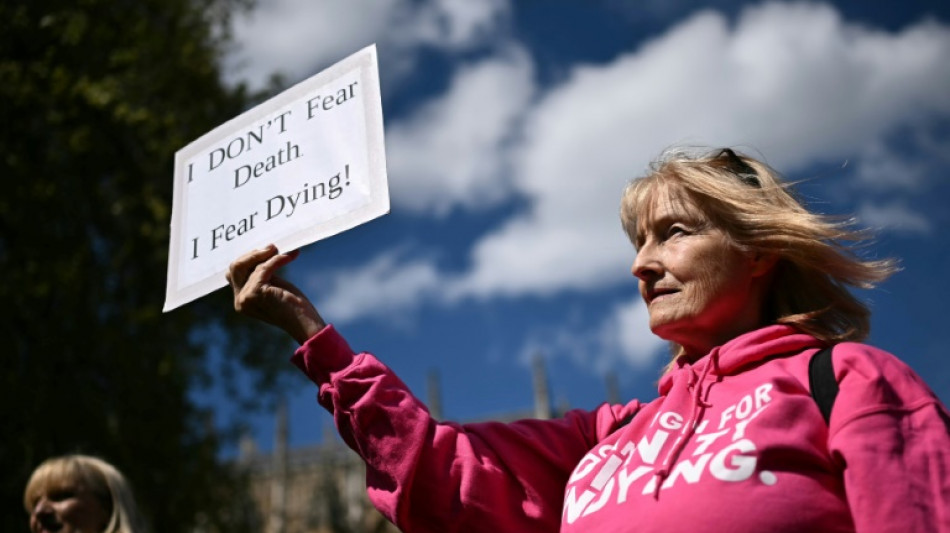
European countries that allow assisted dying / Photo: © AFP/File

 German rail regulator backs Italian firm in competition spat

 Ancelotti shows Brazil his worth at World Cup but concerns remain

 Stocks rise, yen at 40-year low against dollar

 Australia hold West Indies to 125-7 in World Cup semi-final

 Defending champ Swiatek survives scare to reach Wimbledon second round

 US Supreme Court upholds state bans on transgender athletes in school

 Tourists soldier on in Rome despite heatwave

 Record number of 'new millionaires' in 2025, says UBS

 UN calls for food, shelter to help Venezuela quake survivors

 Merz faces mockery over praise of Germany's World Cup team

 Ride-share group BlaBlaCar taps AI for 20-country expansion

 Escaping heat, forgetting war: Kyiv locals hit the beach

 Thousands march to demand illegal migrants leave South Africa

 Serena set for remarkable Wimbledon return

 Outgoing UK PM Starmer announces 'record' defence spending

 Paralluelo joins Barca women's departures

 Police hunt for Monaco bomb suspect after Ukrainian-born businessman wounded

 Sommer, Acerbi, Darmian leave Inter Milan

 'Waiting like torture': Turks despair as Schengen visa delays mount

 Venezuela rescuers in final push to find survivors as families mourn

 Over 1 million migrants apply for Spain's mass regularisation: PM

 Thousands from Philippine sect protest pro-Duterte senator's graft case

 South Africa repatriations top 25,000 ahead of anti-immigrant ultimatum

 Taiwan raids tech firms in China AI chip smuggling probe

 Morocco 'unstoppable' says coach after Netherlands thriller

UK lawmakers will debate on Friday a new bill to legalise assisted dying in England and Wales that has sparked concern among opponents about its implications.
In Europe several countries already allow the terminally ill to receive help to end their lives.
Here is a round-up of the situation on the continent:
- Dutch first -
In 2002, the Netherlands became the first country in the world to legalise active euthanasia, whereby doctors administer lethal doses of drugs to patients suffering from an incurable condition.
It also legalised assisted suicide, where patients can receive help to take their own life voluntarily.
The Dutch law said the patient must have "unbearable suffering with no prospect of improvement" and must have requested to die in a way that is "voluntary, well considered and with full conviction".
In 2012, the Netherlands expanded the law to authorise euthanasia for over-12s in great suffering, provided they have parental consent, and in 2020 to patients with severe dementia, if the patient had requested the procedure while still mentally competent.
The Dutch government in 2023 also approved euthanasia for children under 12 after years of debate, permitting mercy deaths for young minors suffering "unbearably and without hope".
- Belgium, Luxembourg, Spain, Portugal -
Belgium was the second country to adopt euthanasia and assisted suicide in 2002, with similar caveats to the Dutch.
In 2014 it went further by allowing terminally ill children of all ages to also request the procedure, with the consent of their parents.
Luxembourg decriminalised euthanasia and assisted dying in 2009.
Spain in 2021 authorised euthanasia and medically assisted suicide for people with a serious and incurable illness, followed by Portugal in 2023. In the latter case, the law is not yet in force.
- Switzerland -
Switzerland, which prohibits euthanasia, has for decades allowed assisted suicide, making it the go-to destination for patients from around Europe looking for assistance to end their suffering.
The growth of so-called "suicide tourism" has caused much soul-searching in Switzerland but the authorities decided in 2011 against restricting the practice.
Neighbouring Austria, a staunchly Catholic nation, also legalised assisted suicide in 2022 after its constitutional court ruled the country was violating citizens' fundamental rights with the prohibition.
In Italy, where assisted dying is against the law, the constitutional court allowed an exception in 2019.
The court ruled it should not always be punishable to help someone with "intolerable" physical or psychological suffering to commit suicide.
P.Keller--VB