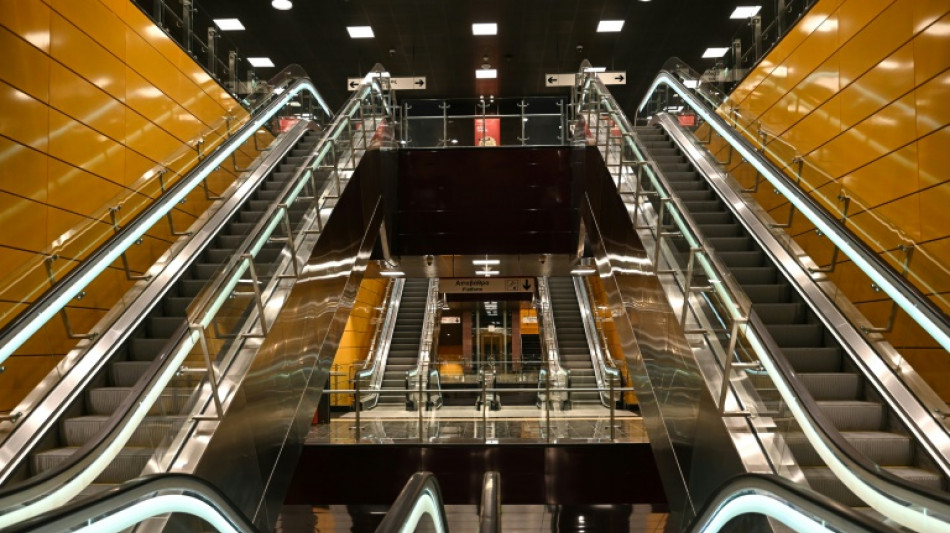
Greeks finally get Thessaloniki metro after two-decade wait / Photo: © AFP

 Devan Ekambaram and Susha’s 'Varuvaaiy' Makes History as First Tamil Song Nominated for a Grammy

 Miranda Lambert Leads North Texans with Seven Grammy Nominations for 2027

 DiDi Advances Robotaxi Operations in China with New R2 Vehicle and Expanded Safety Infrastructure

 Smart Car Seats Tested: Do Sensors and Apps Actually Improve Safety?

 5 Strategies for Fort Worth Households to Reduce Summer Electricity Costs

 Central Bank of Malta Links Energy Subsidies to Middle East Conflict and Price Volatility

 Shomari Figures Defies Redistricting in Alabama Amid Disaster Relief Crisis

 BYD Dolphin G Leasing Deal: Plug-in Hybrid Supermini Available from £174 a Month

 Egypt Opens Registration for 2027 Total Solar Eclipse Viewing Packages

 French Economy Shrinks 0.1% as Consumer Confidence Slumps
 Wall Street Ends Turbulent Week Higher Despite Inflation and AI Jitters
Greece's second city Thessaloniki will unveil its new subway system more than a decade late on Saturday after the project was dogged by archaeological challenges and financial difficulties.
"After many years, we are handing over to the citizens the main metro line in Thessaloniki," Transport Minister Christos Staikouras told AFP during a test run of the trains last week.
The network will handle an estimated 250,000 passengers a day in the northern city of over one million people, he said.
Its stations will also showcase a selection from more than 300,000 archaeological objects discovered during construction, he said.
"It was a project that was long overdue. It is a project that has also had many, many difficulties and obstacles," Staikouras said.
Ordered in 2003, work on the Thessaloniki metro started in 2006 and was originally scheduled to be completed in 2012.
It is only the second metro in the country after that of Athens, which was inaugurated in 2000.
The 9.6-kilometre (six-mile) track both reflects -- and was bedevilled by -- Thessaloniki's rich history.
The line was built along a Roman road that once crossed the 2,300-year-old city, which is named after Alexander the Great's half-sister, Thessalonike of Macedon.
As a result, the project was plagued by long delays and cost overruns.
The new line and a planned extension to the east of the city will cost three billion euros ($3.2 billion).
Some companies involved in its construction also went bankrupt during Greece's near-decade-long debt crisis, officials said.
Over 200 million euros was spent on excavating and removing antiquities dating to the Hellenistic era, some of which were subsequently incorporated into the new stations.
There was also controversy over the cost of the network's logo and that the tender was given to a company in Athens -- a further affront to fiercely independent local sensitivities.
- Archaeological objects -
Among the archaeological objects unearthed were about 50,000 coins, two marble squares, a huge fountain and an early Christian church.
Gold crowns and jewellery were also found in more than 5,000 graves and tombs along the metro route, in what Greece's culture ministry has called the largest salvage excavation ever carried out in the country.
At Agia Sofia station, layers of fragments are displayed by era from Hellenistic to modern.
"The whole period of Thessaloniki's history is imprinted on this wall," said Nikos Denis, deputy director of Elliniko Metro, the state company that developed the subway.
"For the archaeological work that began in 2007 and was completed in 2022, the total cost was about 203 million euros," he said.
Thessaloniki was built in the fourth century BCE by one of Alexander the Great's successors, Cassander, who married one of the famed warrior's half-sisters.
The city grew into an important hub of the Roman Empire and later became the second city of the Byzantine Empire.
It continued to grow under the Ottoman Empire with the arrival in the 15th century of thousands of Sephardic Jews expelled from Spain.
The metro will run 18 fully automated, driverless four-car trains. It is estimated that it will reduce the city's daily road traffic congestion by between 50,000 and 60,000 vehicles.
"This is a very modern metro with a high level of automation and safety," deputy minister for infrastructure Nikos Tachiaos told reporters at the presentation.
He added that another central station, Venizelou, kept under wraps for Saturday's unveiling, will incorporate an "entire archaeological site".
But after two decades of construction and delays, many residents remain sceptical.
"This project was the joke of the town. Every time we heard a new completion date for the project it was never met," said 36-year-old shop worker Anastasia Polychronidou.
Many businesses on the city's central Egnatia Odos also had to shut down because of the construction work, she told AFP.
There are also complaints over the network's limited reach -- additional extensions to reach the city's airport are only planned for 2040.
Thessaloniki's Makedonia airport, Greece's third largest, is 13 kilometres (eight miles) away and handled over seven million passengers last year.
H.Kuenzler--VB