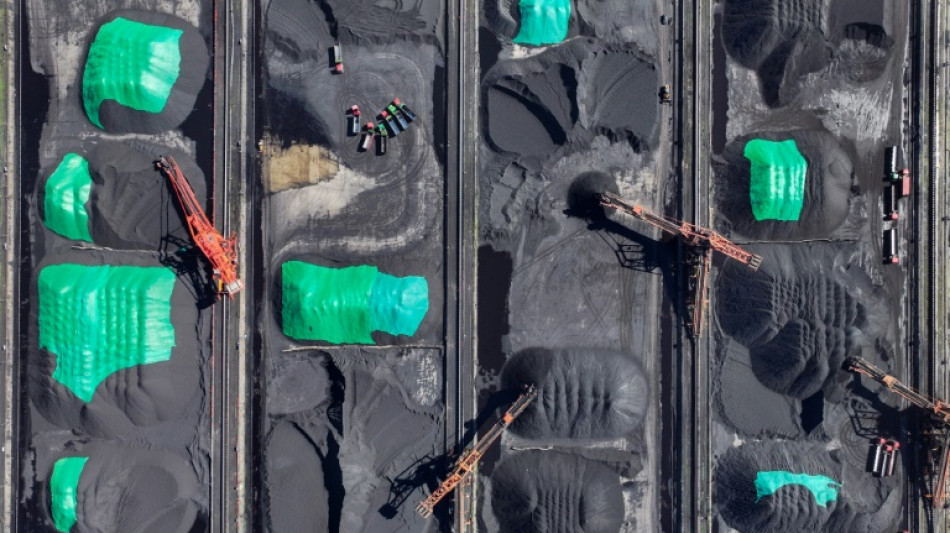
China expected to hit peak coal consumption in 2025: report / Photo: © AFP/File

 Devan Ekambaram and Susha’s 'Varuvaaiy' Makes History as First Tamil Song Nominated for a Grammy

 Miranda Lambert Leads North Texans with Seven Grammy Nominations for 2027

 DiDi Advances Robotaxi Operations in China with New R2 Vehicle and Expanded Safety Infrastructure

 Smart Car Seats Tested: Do Sensors and Apps Actually Improve Safety?

 5 Strategies for Fort Worth Households to Reduce Summer Electricity Costs

 Central Bank of Malta Links Energy Subsidies to Middle East Conflict and Price Volatility

 Shomari Figures Defies Redistricting in Alabama Amid Disaster Relief Crisis

 BYD Dolphin G Leasing Deal: Plug-in Hybrid Supermini Available from £174 a Month

 Egypt Opens Registration for 2027 Total Solar Eclipse Viewing Packages

 French Economy Shrinks 0.1% as Consumer Confidence Slumps

 Wall Street Ends Turbulent Week Higher Despite Inflation and AI Jitters
China's coal consumption could peak by 2025 as the world's top consumer of the fossil fuel ramps up its push for clean energy, a report published on Wednesday said.
The country -- the largest greenhouse gas emitter -- remains heavily reliant on coal despite installing renewable energy capacity at record speed.
But while coal remains king in China's energy mix, there are signs the world's second-biggest economy may be weaning itself off the fossil fuel.
Coal power permits fell 83 percent in the first half of this year, and no new coal-based steelmaking projects were approved in the same period.
And 52 percent of experts surveyed for a report by think tanks Centre for Research on Energy and Clean Air (CREA), based in Finland, and the International Society for Energy Transition Studies (ISETS), based in Australia, expect China's coal consumption to peak next year.
The percentage of experts surveyed this year who believe that China's coal consumption has already hit its maximum have also more than doubled this year from last year.
"Achieving carbon neutrality in a rapidly growing economy like China is no easy feat, but the country's substantial efforts are starting to bear fruit," ISETS' president Xunpeng Shi said.
Significantly more experts also think that carbon dioxide emissions in the country have already peaked or will top out by 2025, according to the study.
- Hitting targets -
Experts have become increasingly optimistic that China will be able to wean itself of polluting greenhouse gases in recent years, with breakneck installation helping Beijing hit its wind and solar energy capacity targets six years ahead of schedule.
Despite this, there is still "little clarity on China's emissions pathway", Lauri Myllyvirta, lead analyst at CREA said.
This leaves open the possibility of emissions increasing until 2030 and "very slow" reductions after that, he added.
China's demand for coal also still jumped last year, driving a global increase.
Coal-fired power generation is projected to grow again this year in China, albeit at the lowest rate in almost a decade, according to the International Energy Agency.
Energy consumption growth is also continuing to outpace GDP growth and is "faster than in the transition pathways aligned with the Paris Agreement", said the CREA report.
"China will need to either speed up renewable energy deployment even further or guide economic development in a less energy-intensive direction," Myllyvirta said.
China aims to peak its planet-warming emissions by 2030 and reach net zero three decades later.
The 2015 Paris Agreement requires countries to submit increasingly deep emission cutting plans every five years, known as Nationally Determined Contributions (NDCs). China is due to submit its updated NDC by February next year.
According to an earlier CREA report, China must set a "strong but achievable target of reducing emissions by at least 30 percent" by 2035.
In November, officials voted to pass an energy law, saying it would "actively and steadily promote carbon peaking and carbon neutrality".
D.Schaer--VB