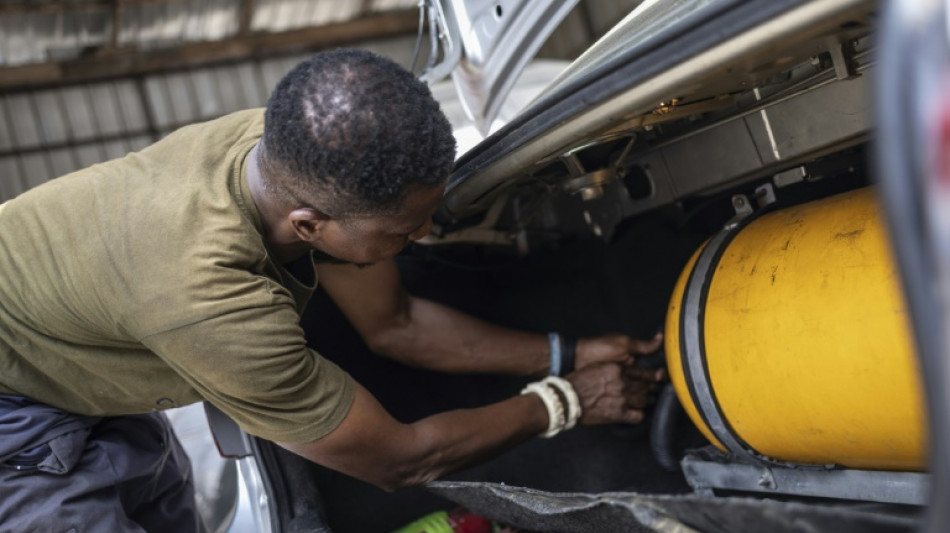
Compressed natural gas vehicles gain slow momentum in Nigeria / Photo: © AFP

 LeBron James to leave Lakers to play 24th NBA season

 Zverev wins in four sets to reach Wimbledon round two

 Grimaldo realises goal of Atletico Madrid move from Leverkusen

 US Supreme Court lifts campaign spending restrictions ahead of midterms

 LeBron James to leave Lakers to play 24th NBA career
 Tens of millions swelter as heat wave blasts US

 US Supreme Court rejects Trump bid to limit birthright citizenship

 Gardner stars as Australia thrash the West Indies in Women's T20 World Cup semi-final

 Former Barca teen star Fati seals permanent Monaco switch

 German rail regulator backs Italian firm in competition spat
 Ancelotti shows Brazil his worth at World Cup but concerns remain

 Stocks rise, yen at 40-year low against dollar

 Australia hold West Indies to 125-7 in World Cup semi-final

 Defending champ Swiatek survives scare to reach Wimbledon second round
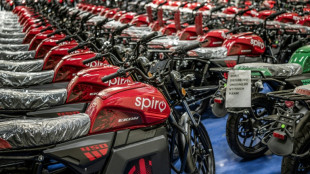
 US Supreme Court upholds state bans on transgender athletes in school

 Tourists soldier on in Rome despite heatwave

 Record number of 'new millionaires' in 2025, says UBS

 UN calls for food, shelter to help Venezuela quake survivors

 Merz faces mockery over praise of Germany's World Cup team
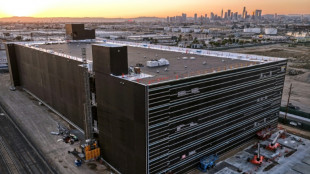
 Ride-share group BlaBlaCar taps AI for 20-country expansion
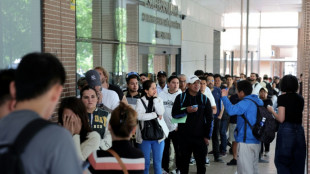
 Escaping heat, forgetting war: Kyiv locals hit the beach

 Thousands march to demand illegal migrants leave South Africa

 Serena set for remarkable Wimbledon return

 Outgoing UK PM Starmer announces 'record' defence spending

 Paralluelo joins Barca women's departures

Car mechanic Adebola Omotosho has to drive eight kilometres across Nigeria's bustling commercial hub Lagos to fill his tank with compressed natural gas.
He is among the few Nigerians who were early adopters of the alternative fuel, which can still be hard to come by.
Nevertheless, Omotosho believes the financial and environmental benefits outweigh the inconvenience of long trips to the gas station.
"Even with that, it is still far cheaper. Before now, I spent 75,000 naira (about $50) on petrol, but now I spend 12,000 on CNG every week," he told AFP.
Authorities are pushing CNG as the silver bullet to end Nigeria's perennial fuel shortages and a five-fold price hike since President Bola Tinubu abolished fuel subsidies in May 2023.
In September 2023, Tinubu established the Presidential Compressed Natural Gas Initiative (PCNGI) to drive CNG adoption and ease Nigeria into a cleaner energy era.
The Nigerian government first supported CNG-powered vehicles in 2007, but only began promoting their widespread use last year.
The African economic powerhouse is looking to join the likes of Argentina, Brazil and Iran, where millions of vehicles are powered by the alternative fuel.
About 100,000 cars have been converted so far, with more than $200 million already invested, the CEO of the PCNGI, Michael Oluwagbemi, said.
With about 12 million vehicles on Nigerian roads, the government is targeting the conversion of one million commercial vehicles by 2026.
Private car owners will have to bear the hefty cost of conversion. It currently costs about 1.3 million naira (about $775) to convert a four-cylinder car with a 2.4-litre engine to CNG.
With some 129 million Nigerians living in poverty, according to the World Bank, and a soaring cost of living, not many in the country can afford to pay the cost out of pocket.
"The upfront cost of making that conversion is prohibitive to most ... drivers," said Chidalu Onyenso, the CEO of Earthbond, a company that helps businesses transition from fossil fuels to cleaner energy.
But Oluwagbemi said salaried workers can access loans to convert their vehicles with a 12-month repayment plan.
To hit its ambitious target, the government has to reckon with the slow speed of conversions and a limited number of CNG fuelling stations.
"In the last six months before the government made it popular, I was able to convert five cars," Jide Fasetire, a trained technician, told AFP at his workshop in Lagos.
He has now converted 20 vehicles since the government began its CNG campaign, with at least 18 more on his waiting lists. It currently takes at least two days to convert one vehicle.
"Our target timing for each conversion is ... three hours but we've not been able to achieve that," he said, explaining that technicians are still learning the skills necessary.
Officials say 75 new stations are being built across the country for ease of access.
In September and October, a spate of posts on the social media platform X claimed that conversion to CNG was unsafe, with one widely-read post calling it a "time bomb".
An explosion of a CNG-powered car in the southern Edo state and the news of Malaysia walking back its CNG ambitions over safety concerns further fuelled public scepticism.
Officials blamed the explosion on the use of "uncertified, and poorly fabricated CNG cylinders" and vowed stricter compliance measures.
"Safety issues from the proliferation of unlicensed conversion centres pose a grave security risk," an energy expert Kelvin Emmanuel told AFP.
Babatunde Odukoya, a freight forwarder who spends 150,000 weekly on fuelling his mid-size crossover SUV, told AFP that talk of the Edo explosion had been "discouraging".
He is, however, open to switching to CNG if he is convinced of its safety.
Several car owners told AFP that they have not had any issues with the gas, and Oluwagbemi insisted that a properly converted vehicle is less risky than one running on diesel or petrol.
Onyenso argues mass adoption of CNG will reduce greenhouse gas emissions, improve air quality and cut maintenance costs.
However, she warned that CNG adoption should be seen as part of Nigeria's journey to sustainable energy and not its destination.
"As Nigeria makes this transition to CNG, it should be seen as something that is not done as just a permanent switchover, but ... in concert with greening the grid," Onyenso said.
T.Egger--VB