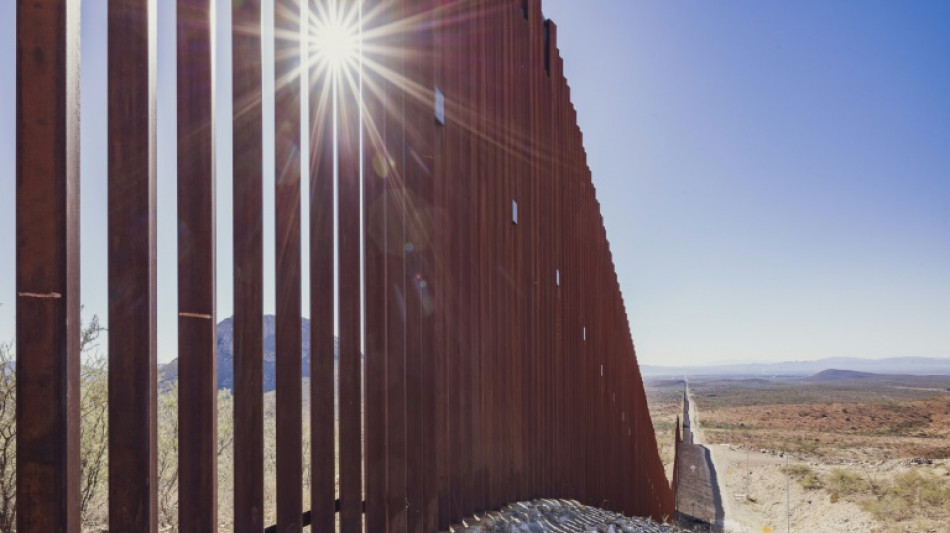
Trump's mass deportation plan could end up hurting economic growth / Photo: © AFP

 Zverev says Wimbledon hopes 'about me' despite open draw

 Lionel Scaloni: Argentina's mastermind marks 100 games in charge

 Mourinho's Real Madrid host Real Sociedad in La Liga opener

 Football brings joy to Venezuelan kids displaced by quakes

 Haaland fires Norway into last 16 as France, Mexico look to advance

 Merkel unveils official portrait for German chancellery

 Canada crews battle northern wildfire after crash kills 3

 Portugal's Silva bides his time after being benched at World Cup

 US stars relish soccer's primetime moment against Bosnia

 Lampard extends Coventry stay after promotion to Premier League

 Djokovic, Sinner aim to step up Wimbledon title chase

 Brook ready for "great honour" of succeeding Stokes as Test skipper

 Taps run dry in Hungarian village as heatwave bites

 Venezuela quake survivors seek food, shelter amid risk of disease outbreaks
 LeBron James to leave Lakers, continue NBA career - media reports

 'Where is she?' The desperate search for Venezuela's missing

 No business as usual after shock World Cup exit, say German FA

 Pope appeals to Catholic traditionalists to avoid schism

 US Supreme Court upholds transgender sports bans

 US Supreme Court rejects Trump bid to restrict birthright citizenship

 Serena set for remarkable Wimbledon return, Swiatek survives scare

 Africa EV firm Spiro accused of torturing Uganda employees

 PSG's Portugal forward Ramos signs five-year AC Milan deal

 Inflation slows in top eurozone economies as ECB ponders next move

 Starmer boosts budget to modernise UK military before exit

President-elect Donald Trump's hardline immigration proposals -- including a controversial mass deportation plan -- could prove economically damaging, analysts say, with US sectors that rely heavily on foreign workers like agriculture and construction especially hard hit.
US authorities estimate that there are around 11 million unauthorized people living in the United States, the vast majority of whom come from Mexico.
Around 8.3 million unauthorized people were in the labor force in 2022, according to a recent estimate from the Pew Research Center. That was equivalent to just under five percent of the overall workforce.
"Today our cities are flooded with illegal aliens," Trump said on the campaign trail earlier this year, adding: "Americans are being squeezed out of the labor force and their jobs are taken."
The reality, however, is more complex; many of the sectors that could be the hardest-hit have long struggled to attract US workers.
"The construction and agriculture industries would lose at least one in eight workers, while in hospitality, about one in 14 workers would be deported due to their undocumented status," the non-profit American Immigration Council (AIC) said in a recent report on Trump's deportation plans.
The deportations would also impact "more than 30 percent" of plasterers, roofers, and painters, along with a quarter of housekeeping cleaners, according to the report.
- Economic impact -
A recent joint study by the American Enterprise Institute (AEI), Brookings Institution, and the Niskanen Center estimated that Trump's immigration plans could curb US GDP growth in 2025 by as much as 0.4 percentage points.
The impact on growth would primarily come from the direct effect of having fewer foreign workers producing goods and services, with an additional, smaller decline in output coming from less consumer spending by those groups.
In such a scenario, the authors said, "legal immigration is slightly below where it was during the pre-pandemic Trump administration, while enforcement and deportation efforts reach levels not seen in recent decades."
A total of 3.2 million people would be deported during Trump's term under this projection, with net migration -- arrivals minus departures -- falling from 3.3 million in 2024 to negative 740,000 in 2025, boosted by a sharp rise in voluntary emigration.
In a more extreme scenario, which analysts say is highly unlikely, the impact on growth could be much more significant.
A recent Peterson Institute for International Economics report modelled the impact of expelling all 8.3 million unauthorized immigrant workers.
It predicted that economic growth by 2028 could be 7.4 percent beneath baseline estimates, "meaning no US net economic growth occurs over the second Trump term because of this policy alone."
At the same time, US inflation would be 3.5 percentage points higher by 2026 than it would otherwise be, as employers raised wages to attract American workers.
But even in a less significant scenario, mass deportations could push up prices, analysts say.
Trump's immigration plans "could lead to big price increases in certain sectors of the economy, but could also lead to inflation," Michael Strain, AEI's director of economic policy studies, told AFP.
But mass deportations' aggregate effect on inflation would likely be small, economists at Pantheon Macroeconomics wrote in an investor note, "with upward pressure in sectors like agriculture and construction partly offset by weaker demand in general and slower inflation in some other areas, such as housing."
- Obstacles -
Most analysts expect legal, logistical and financial challenges will blunt the most extreme proposals -- as they did during the first Trump administration -- with the end result being that net migration eases modestly next year compared to pre-pandemic levels.
"We expect tighter policy to lower net immigration to 750k per year, moderately below the pre-pandemic average of 1 (million) per year," economists at Goldman Sachs wrote in an investor note.
"We're sceptical that the kind of deportations proposed on the campaign could occur," Oxford Economics chief US economist Ryan Sweet wrote in a note to clients.
O.Schlaepfer--VB