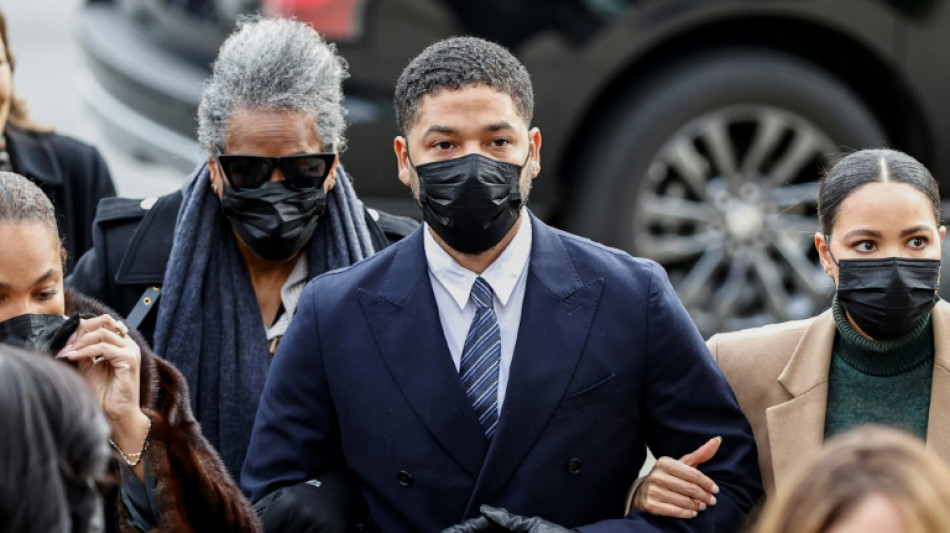
US actor Smollett's conviction for staged attack overturned / Photo: © AFP/File

 Devan Ekambaram and Susha’s 'Varuvaaiy' Makes History as First Tamil Song Nominated for a Grammy

 Miranda Lambert Leads North Texans with Seven Grammy Nominations for 2027

 DiDi Advances Robotaxi Operations in China with New R2 Vehicle and Expanded Safety Infrastructure

 Smart Car Seats Tested: Do Sensors and Apps Actually Improve Safety?

 5 Strategies for Fort Worth Households to Reduce Summer Electricity Costs
 Central Bank of Malta Links Energy Subsidies to Middle East Conflict and Price Volatility

 Shomari Figures Defies Redistricting in Alabama Amid Disaster Relief Crisis

 BYD Dolphin G Leasing Deal: Plug-in Hybrid Supermini Available from £174 a Month

American actor Jussie Smollett's conviction for fabricating a racist and homophobic hate crime in Chicago in 2019 was overturned Thursday on due process grounds.
The Illinois Supreme Court ruled that Smollett, 42, should not have been charged again by prosecutors after a prior agreement saw over a dozen original charges dismissed.
It is the latest twist in Smollett's legal saga, which began with his initial claim in January 2019 that he had been attacked on a Chicago street.
The gay African-American actor, then a cast member of the hit TV series "Empire," said two masked men assaulted him late at night, shouting slurs and placing a noose around his neck.
His claim prompted a major police operation in the Midwest city to find the assailants and an outpouring of public support.
But investigators later came to believe that he had staged the whole thing, based on examination of CCTV images and the cell phone data of Smollett and his two alleged attackers.
Prosecutors charged him with 16 felonies, alleging he had fabricated the hate crime and paid Nigerian brothers Olabinjo and Abimbola Osundairo $3,500 to carry it out, while invoking then-president Donald Trump's "Make America Great Again" slogan.
- Hate mail -
Smollett staged the attack after receiving a legitimate piece of hate mail which he felt was not taken seriously by his employers, prosecutors said.
But those charges were suddenly dropped in March 2019, under an arrangement in which Smollett forfeited his $10,000 bond and agreed to do community service.
The dismissal was met with anger by some city officials, including then-mayor Rahm Emanuel, who argued $10,000 was only a fraction of the actual investigation costs.
A special prosecutor eventually took over the case and several charges were reinstated.
Smollett, who has always maintained his innocence, was found guilty in December 2021.
Though he was sentenced to 150 days in prison with 30 months on probation, he was released pending the outcome of his appeal.
He was also ordered to repay $120,106 to the Chicago Police to cover their investigation costs.
The case had initially sent shock waves through a deeply divided country still plagued by racial and sexual discrimination, and the actor had immediately received support from celebrities in political and cultural circles.
The Illinois Supreme Court ruling said that bringing the charges a second time after "the defendant has performed his part of the bargain" represented "a due process violation."
"We therefore reverse (the) defendant's conviction," the ruling said.
R.Flueckiger--VB