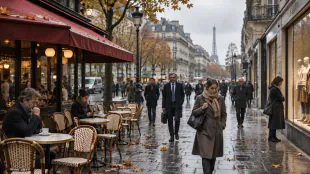
Iraq holds its first census in nearly 40 years / Photo: © AFP

 Devan Ekambaram and Susha’s 'Varuvaaiy' Makes History as First Tamil Song Nominated for a Grammy

 Miranda Lambert Leads North Texans with Seven Grammy Nominations for 2027

 DiDi Advances Robotaxi Operations in China with New R2 Vehicle and Expanded Safety Infrastructure

 Smart Car Seats Tested: Do Sensors and Apps Actually Improve Safety?

 5 Strategies for Fort Worth Households to Reduce Summer Electricity Costs
 Central Bank of Malta Links Energy Subsidies to Middle East Conflict and Price Volatility

 Shomari Figures Defies Redistricting in Alabama Amid Disaster Relief Crisis

 BYD Dolphin G Leasing Deal: Plug-in Hybrid Supermini Available from £174 a Month

Iraq is holding its first nationwide census in nearly four decades this week, a long-awaited count in a nation that has been blighted by sectarian and ethnic divisions.
The census is scheduled for Wednesday and Thursday, and will provide sorely needed up-to-date demographic data for the country which has an estimated population of around 44 million.
It will be the first census to cover all 18 governorates since 1987, when dictator Saddam Hussein was in power, following repeated delays caused by years of war and political tensions between factions.
"More generally across the country, parliamentary representation will change," said Hamzeh Hadad, a visiting fellow at the European Council on Foreign Relations (ECFR).
With one member of parliament allocated by the constitution per 100,000 Iraqis, "having an official census will mean the numbers will have to be adjusted" based on the new demographic breakdown, he said.
A count conducted in 1997 excluded the three northern provinces that make up the autonomous Kurdistan region.
The upcoming census has reignited tensions between Baghdad and Kurdistan over disputed territories in the north.
The census includes religion but does not differentiate between sects, such as Sunni and Shiite Muslims, and, unlike previous counts, it excludes ethnicity.
"There are some crucial details in this census that might be missing to appease all sides to finally allow it to take place," Hadad added.
Iraq has been keen to conduct the census for budgetary reasons.
Prime Minister Mohammed Shia al-Sudani said the census was important for "development and planning steps in all sectors that contribute to the advancement and progress of Iraq", where electricity is scarce and infrastructure largely in disrepair.
- Two-day curfew -
During the census a two-day curfew will operate, with families having to stay at home so 120,000 researchers can collect data directly from households.
A questionnaire seen by AFP records the number of people per household, health status, education level, employment status, number of cars and even an inventory of household appliances, so standards of living can be assessed.
Iraq has spent much of the past few decades devastated by conflict and sanctions, including a sectarian struggle after the US-led invasion 2003 toppled Saddam and the emergence of the Islamic State group in 2014.
Demographics are likely to have shifted with the exile of hundreds of thousands of Christians, and also of tens of thousands of Yazidi families who were displaced from Sinjar by atrocities committed by IS extremists.
Iraq has regained some semblance of stability in recent years, despite sporadic violence and political turmoil.
To organise the count, authorities partnered with the United Nations Population Fund (UNFPA), in an effort to generate "accurate demographic information, facilitating effective policymaking and promoting inclusive growth".
After years of uncertainty, the census will reveal "the reality of Iraq in its smallest details", said planning ministry spokesman Abdel-Zahra al-Hindawi.
"We will be able to diagnose all the problems that paralyse development in the areas of health, education, housing," he added.
- Demographic shift -
Previous censuses were cancelled mainly because of tensions over disputed territories between the Kurdish, Arab, and Turkoman communities in the northern governorates of Kirkuk and Nineveh.
There is still "a lot of sensitivity over disputed territories", said the ECFR's Hadad.
"It's not just the Arabisation policy under Saddam Hussein. But the reversal of it and Kurdification of disputed territories post-2003. So it's not one-sided."
Fahmi Burhane, a Kurdistan region official focused on the disputed territories, voiced long-standing fears among Kurds about a demographic shift in Kirkuk and other areas claimed by both Baghdad and Arbil.
"If we look at past censuses, the number of Kurds has gradually decreased in the Kurdish regions outside autonomous Kurdistan," he said, referring to the movement of Arabs into areas such as Kirkuk under Saddam.
"Arab neighbourhoods have been built in recent years, which absolutely do not correspond to normal population growth," he said.
In the census, Baghdad has agreed to register only the descendants of families who were present in the disputed territories during the 1957 count, in order to prevent subsequent waves of migration from disrupting the demographic balance. Newcomers will be counted in their province of origin.
Burhane said the Iraqi government has been able to "alleviate certain concerns" over the poll.
F.Mueller--VB