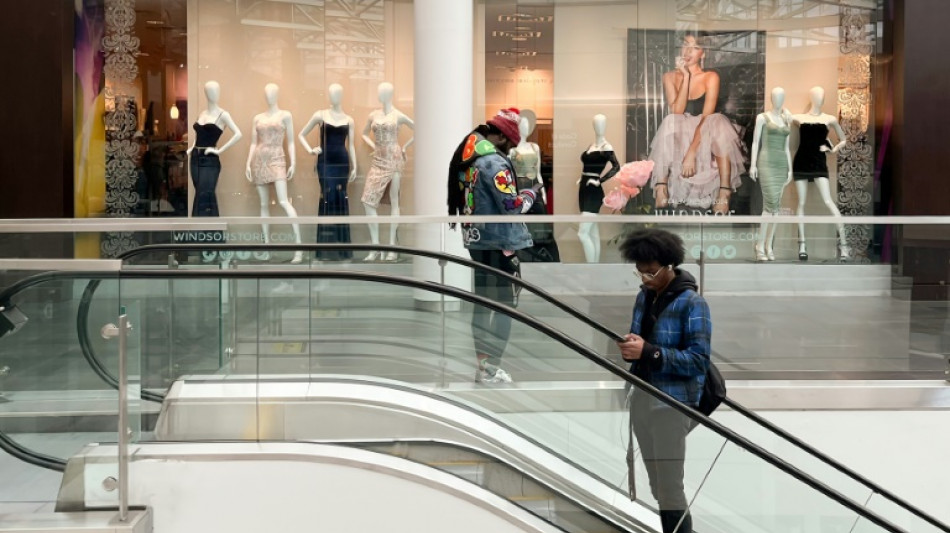
US retail sales lose steam in October after hurricanes / Photo: © AFP/File

 Devan Ekambaram and Susha’s 'Varuvaaiy' Makes History as First Tamil Song Nominated for a Grammy

 Miranda Lambert Leads North Texans with Seven Grammy Nominations for 2027

 DiDi Advances Robotaxi Operations in China with New R2 Vehicle and Expanded Safety Infrastructure

 Smart Car Seats Tested: Do Sensors and Apps Actually Improve Safety?

 5 Strategies for Fort Worth Households to Reduce Summer Electricity Costs

 Central Bank of Malta Links Energy Subsidies to Middle East Conflict and Price Volatility

 Shomari Figures Defies Redistricting in Alabama Amid Disaster Relief Crisis

 BYD Dolphin G Leasing Deal: Plug-in Hybrid Supermini Available from £174 a Month

Retail sales in the United States slowed in October, according to government data released Friday, with analysts noting that devastating hurricanes in recent months likely disrupted consumption.
Sales rose 0.4 percent in October from a month prior to $718.9 billion, according to Department of Commerce data.
This was a smaller uptick than September's revised 0.8 percent increase.
Consumer spending has helped to power the US economy over the past year despite elevated interest rates as the Federal Reserve battled to rein in inflation.
But the cooldown in October, which came after the central bank started lowering the benchmark lending rate, could have been influenced by Hurricanes Helene and Milton, which landed in late September and early October, respectively.
Typically, lower interest rates are expected to support economic activity.
The storms were likely to have forced some businesses to close temporarily, while people grappled with the aftermath, said economists at Pantheon Macroeconomics in a recent note.
"The sectoral breakdown of retail sales also supports the idea that consumers were prevented from shopping," said Samuel Tombs, chief US economist at Pantheon Macroeconomics.
He noted that sales at furniture stores and personal care shops fell, while non-store sales were up.
"More recently, optimism about the economic outlook among consumers might have increased since the election, driven by expectations of tax cuts and surging stock prices," Tombs added.
He was referring to Donald Trump's victory over Kamala Harris in the US presidential election.
In October, retail sales excluding those at auto dealers and gas stations rose just 0.1 percent from the prior month.
Sales at restaurants and bars, as well as grocery stores, slowed from September, Commerce Department data showed.
From a year ago, retail sales were up 2.8 percent in October.
Nationwide chief economist Kathy Bostjancic noted that October's rise in retail sales "comes on the heels of a sharply revised higher spending splurge in September."
This suggests that consumers maintained "upbeat spending momentum" at the start of the fourth quarter, she said.
Her expectation is that GDP growth will remain robust in the final three months of the year, even as the increase cools from the third quarter.
F.Stadler--VB
