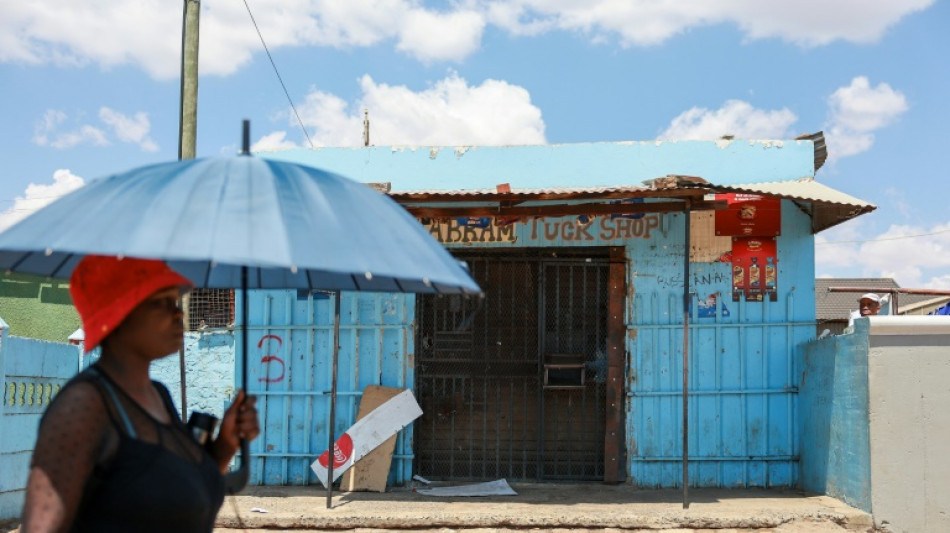
Spate of child poisoning deaths sparks S.Africa xenophobia / Photo: © AFP

 Alabama Legislature Passes Weakened Utility Reform Bill Amid Allegations of Alabama Power Influence

 World Athletics stance on Russia unchanged, says Coe

 Can We Predict Volcanic Eruptions Like Weather? Scientists Seek Unified Physics

 Macron, Carney to visit French islands after Trump's map post

 حمزة قورقماز يناقش العلاقة بين وضوح المبادئ واحترام الاختلاف

 اليورو يستقر في البنوك المصرية وأعلى سعر للبيع 59.85 جنيه

 Myanmar says UN envoy illegitimate ahead of credentials decision

 Philippine rescuers pull more victims from charred ferry

 دول عربية ومنظمات تدين استهداف خط أنابيب في السعودية

 Crash and burn: Pakistan cricket at a new low after England humiliation

 'Second life': Nepal tunnel survivor recalls ordeal

 Hong Kong homes flattened for US$28 bn high-tech hub

 'Be careful what you wish for': 'Obsession' director and star reflect on success

 Messi scores but Miami held by Nashville
 US Open champ Rybakina on top of world after injury scare

 Rybakina reigns serene as new world number one

 South Africa defeat New Zealand 43-28 to complete 3-1 series victory

 Rybakina triumphs in US Open, denies Sabalenka three-peat

 Mini 1998 GT pairs 161-hp engine with John Cooper Works chassis hardware

 GTA VI draws political criticism online as preorder estimates exceed five million

 Steven Strogatz weighs AI mathematics advances and their consequences for researchers

 KFF journalists discuss opioid funds, suicide prevention and gaps in care

 Roadless Rule repeal proposal raises concerns over Midwest forests and fire risk

 Louisiana's developing roster faces USC as Trojans enter as heavy favorites

 Utah hosts Arkansas as both programs begin seasons under new coaches

The deaths of 23 children in Johannesburg this year from suspected food poisoning has ignited anger in South Africa against foreign nationals who run small corner shops known as spazas.
There is still police tape around a now-closed spaza shop in Soweto's Naledi area that allegedly sold snacks to six young children who died from poisoning in October.
The tragedy angered local residents who attacked and looted the spaza and hounded out the shopkeeper, reportedly an Ethiopian national. Even the person who was renting out the premises fled in fear.
While an autopsy revealed that a pesticide had caused the deaths, a link to the shop has not been officially established.
As similar cases were reported in other areas, the outcry mounted, leading authorities to launch raids on foreign-run spazas to check compliance with laws and regulations.
Several have been forced to shut and the shopkeepers -- generally from Ethiopia, India, Pakistan or Somali -- have fled.
Six spazas were closed at Olievenhoutbosch outside the capital Pretoria last week for irregularities, municipal council official Sarah Mabotsa said.
"They're selling expired food, they're selling skin products, they're selling meat, everything is in one shop," she charged.
- 'Operation Dudula' -
As the continent's most industrialised economy, South Africa is a prime destination for people seeking work even though its own unemployment rate is around 32 percent.
The competition has triggered mistrust and even violence.
If authorities don't step in, a xenophobic vigilante group known as Operation Dudula -- which means "push back" in Zulu -- often does.
In Naledi, efforts by Dudula recently saw the foreign shopkeepers at six spazas replaced with South African nationals.
"We have chased the foreigners. Foreigners were running the shop before and we kicked them out," one of the new shopkeepers, Maphoka Mohalanwani, said proudly.
The recent spate of food poisonings is without doubt "related to the foreigners", the 54-year-old said.
"When our kids eat chips from the streets, they do not die... they are dying because of their poison," said Mohalanwani.
The former cashier was selected for the job by Operation Dudula, which awards some finance to South Africans to take over from foreign nationals running spaza shops.
"Some stores were closed down by officials because they don't respect the laws of this country," the head of Operation Dudula, Zandile Dabula, told AFP.
And for those that reopened, "we went back to go and make sure that they closed again," she said.
Even politicians have made outright calls for all spaza shops to be run by South Africans.
- Eliminating competition -
The tragic wave of deaths of the young children has gripped South Africa, with speculation running wild in the absence of proven facts about what really caused their deaths.
Some people believe that foreigners are deliberately setting out to poison South Africans; others say the outcry is a manufactured ploy to get the spazas and their profits back into the hands of locals.
"We don't know what is causing these things (cases)," said Somali national Zachariah Salah at one spaza in White City, Soweto.
It was not even clear if the claims of poisonings were genuine or not, he said. Either way, "it's tragic for us."
Loren Landau, who studies migration at the University of the Witwatersrand in Johannesburg, said attacks against foreign-owned shops were "really about eliminating competition for business.
"If you try to shut down South African businesses, people would protest," he said. But "you can go after a foreigner, no one will protest."
Back in White City, one of the spazas that shut down in the initial flare of anger a few weeks back has reopened, to the relief of locals who rely on their corner shops.
"When it was shut, I had to go to ... malls that are very far," said Nomsa Skosan, 63, who was browsing the aisles of cereal, frozen food and household items.
"If what they sell in these stores is as bad as they say, why loot them?"
L.Wyss--VB