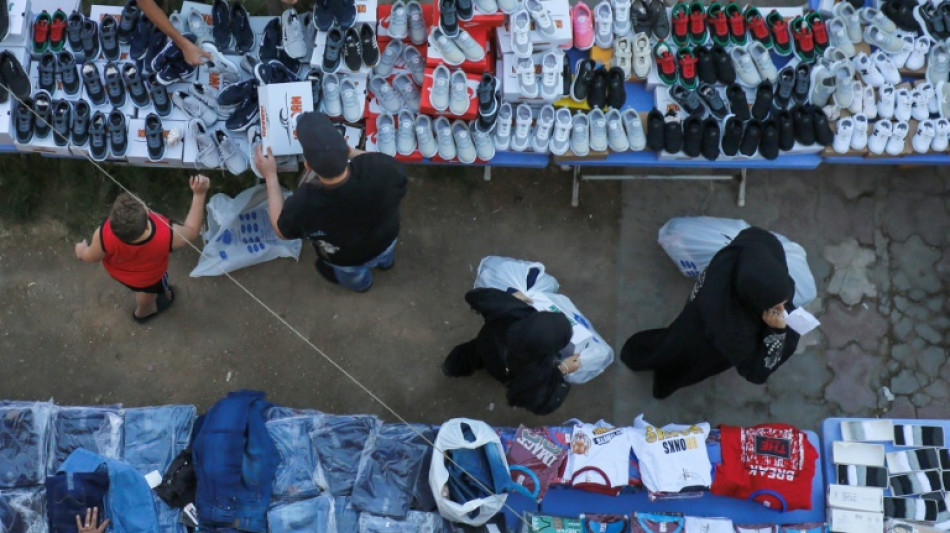
Iraq opens arms to Lebanese fleeing Israeli attacks / Photo: © AFP/File

 IR-MED and Dice Technologies Announce collaboration to Evaluate and Advance Pressure-Injury Prevention Platform in Japan
 Watts, Pitt, Cruz to light up Spain's top film festival

 Sweden expels Iran embassy employee over anti-Jewish threats
 Toogood Gold's Table Mountain Sits in the Shadow of a Nevada Gold Rush

 MEXC July–August Security Report: 38.66M USDT in Risk Funds Intercepted, Futures Insurance Fund Hits 792M USDT

 'Breathing toxin every day': Indonesians choked by haze feel helpless
 Stocks edge higher ahead of US Fed rate call

 Philippines ex-leader Duterte makes first in-person ICC appearance
 2027 Formula One calendar includes Monaco sprint race
 Palestinians are the real victims, Thunberg tells Ed Sheeran
 Hashim Thaci: From 'George Washington of Kosovo' to Hague convict
 Amnesty says Iran committed 'crimes against humanity' in crackdown on 2022 protests

 EU to ban social media for under 13s, curb access until 15
 Philippines ex-leader Duterte makes first appearance at ICC
 EU chief pitches 'associate member' status for Canada
 English village votes to 'secede' from UK over asylum centre plan

 Wildfires push endangered Sumatran elephants to brink: Indonesian NGO

 Stocks head higher as traders prepare for Fed decision
 English village votes to 'secede' from UK over asylum centre
 Hong Kong unveils plan to align economy with China's goals
 Brazilian voters the latest to eye Bukele security model with envy

 EU chief hosts Canada's Carney in push to 'deepen' alliance
 EU chief to unveil social media, gaming curbs for under-15s
 Saudi says Houthis target Mecca, warn of 'red line'

 Asian stocks stutter as traders prepare for Fed decision
Israeli bombardment of Lebanon forced Mohammed Fawaz and his family to flee so often that they finally moved many kilometres (miles) away to find respite in central Iraq.
"Wherever we went, danger followed," the 62-year-old white-haired Lebanese man told AFP in the small town of Al-Qassem, sitting with his wife and daughter.
"That's when I thought of Iraq. It was the only way I could see to escape the danger after we saw death with our own eyes."
Opposite the small house where they now live, beyond a road busy with traffic, tall palm trees emblematic of Iraq's Babylon province stretch as far as the eye can see.
According to the United Nations refugee agency UNHCR, more than 19,200 Lebanese have arrived in Iraq since the escalation of hostilities in Lebanon.
The Baghdad government and Shiite religious authorities mobilised quickly to cope with the influx.
So did the Hashed al-Shaabi, an alliance of pro-Iran former paramilitary groups now integrated into Iraq's security forces.
Everyone turned out to welcome the refugees, helping them get to Iraq and also arranging accommodation.
The solidarity has highlighted the close ties between the Shiite communities of both countries.
Iraq had always welcomed Lebanese pilgrims visiting its famous Shiite shrines at Karbala and Najaf.
But now the Baghdad government, in which pro-Iran parties dominate, is also willing to signal it stands staunchly by Lebanon in the wake of daily Israeli attacks on Hezbollah strongholds there.
Fawaz is originally from south Lebanon, and moved to the southern suburbs of Beirut before later moving again to the outskirts of the capital.
- 'Invited guests' -
"We fled from place to place," the father of four said, bursting into tears when he spoke of relatives back in Lebanon.
"My displaced brothers now live in schools in different areas."
His journey to Iraq included a coach trip across Syria.
After a stopover in the Sayyida Zeinab area south of Damascus, home to a Shiite shrine protected by pro-Iran groups, their entry to Iraq was coordinated by the Hashed al-Shaabi.
Fawaz hailed what he called "the best welcome" and Iraqi generosity, especially from his host, one of many Al-Qassem residents who have opened their doors to Lebanese refugees.
He praised Iraq's government for "treating us like invited guests, not refugees".
The war in Lebanon has displaced at least 1.3 million people, according to the UN migration agency, and more than half a million have fled into neighbouring Syria.
Those who opted to stay often find themselves in makeshift and under-equipped shelters set up in schools.
In other areas, their presence can sometimes provoke unease or mistrust.
Iraq has made things easier for the new arrivals by extending visas. Those with no passports are helped out with new travel documents, in coordination with the Lebanese embassy.
The UNHCR says that some 62 percent of the Lebanese arrivals are women and children, and that the children will be able to attend Iraqi schools.
Nearly half of the arrivals are being housed in Najaf and also Karbala, which is home to the gold-domed mausoleums of the Imam Hussein and his brother Abbas.
The religious authorities have taken over hotels previously reserved for pilgrims.
- 'No alternative' -
Jalal Assi, who is in his forties, is now in Karbala.
"We had no alternative, and decided to come to Iraq," he told AFP, citing the "facilities offered to Lebanese".
"We hope the situation will get better and security will be restored so we can go home," he added.
Neemat Mussa, 44, originally from the south Lebanese village of Hariss, is now living in the Babylon provincial capital Hilla.
She and her husband, their two daughters and an aunt are staying in a house owned by an Iraqi police officer.
When she does the family shopping she is driven there accompanied by a local benefactor who also foots the bill.
"We chose Iraq because it's a safe place where we are not afraid," she said in a tired voice. It is her first time in the country, although her husband came previously on pilgrimage.
The warmth of Iraq's welcome cannot mask the bitterness of exile.
Mussa has lost her cousin and sister-in-law in the war, and she follows the news intently on her phone.
She weeps when she talks of their loss and of the country to which she longs to return.
"I'm in a comfortable home, and the Iraqis make sure we lack for nothing," she said, adding: "When I got sick, they took me to hospital."
"But I miss my house and my own country, my neighbours and my family. That's my real home."
K.Hofmann--VB