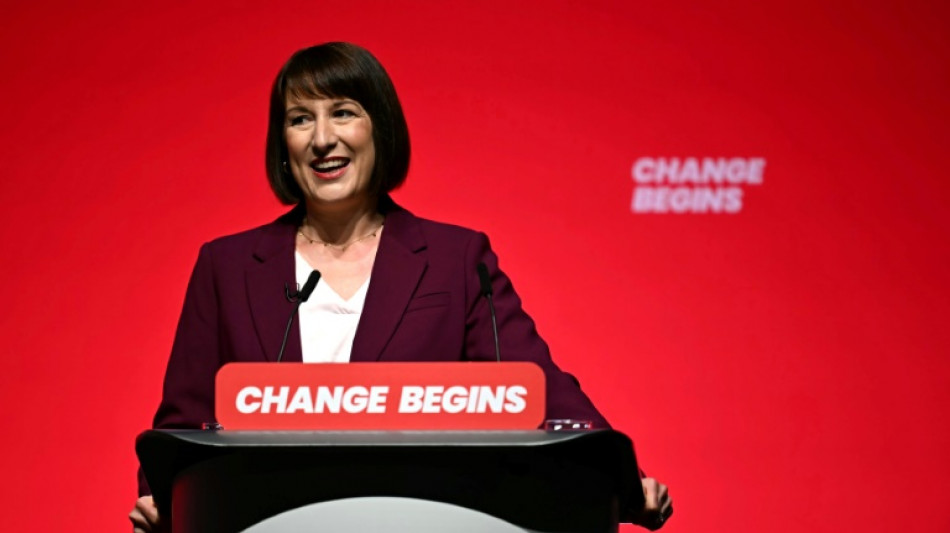
UK's Labour govt prepares to unveil its first budget / Photo: © AFP

 Barcelona hit seven in Racing Santander rout
 Amorim's Milan beaten by Benfica, Sunderland make dream European return

 US stocks fall, dollar gains after Fed lifts interest rates

 Seahawks rule out Darnold for Sunday game at Arizona
 Mbappe explains Ceuta shirt stance after criticism
 Improving Atletico cruise to comfortable win over Osasuna

 Candidate for UN chief calls for AI regulation akin to nuclear weapons

 O'Neill expects Celtic recovery after Old Firm misery
 Man City midfield trio backed to emulate Rodri and Silva

 'We're losing control,' AI pioneer Yoshua Bengio tells AFP

 WHO eyes 'encouraging' signs in DRCongo fight against Ebola

 Liga boss criticises Real Madrid trio for Ceuta shirt incident
 WTA Finals moved to Charlotte from 2027

 Almost 8,000 excess deaths in France's scorched summer: statistics

 Ex-president's lengthy war crimes sentence shocks Kosovo

 US House faces test on sweeping Russia sanctions bill

 British PM says to make 'difficult decisions' as inflation rises

 TotalEnergies pumps up controversy in France with cut-price gas
 Global fuel price demos: a round-up

 Leverate Launches MCP for Traders to Connect AI Assistants With Trading Platforms

 MEXC Launches $1M "Discover Your Wall Street DNA" Campaign to Help Traders Find Their Market Fit

 Emporio Armani names Dario Vitale new creative director
 Maresca defends VAR officials after Man City benefit from error

 Courts jails LGBTQ activists as Turkey crackdown widens

 French court to hear Depardieu's appeal against rape trial order: sources

Britain’s new Labour government unveils its maiden budget Wednesday, with Prime Minister Keir Starmer warning of "painful" decisions over taxes and public spending.
The highly-anticipated fiscal update -- the first under the centre-left government after 14 years of Conservative rule -- is crucial to Starmer's mission of firing up Britain's sluggish economy.
The fresh government has promised a "decade of national renewal" as it pledges to protect living standards, fix public services and spur investment.
But it will have to square such promises with the reality of public finances strained by surging debt over recent years caused largely by the Covid pandemic, according to analysts.
Finance minister Rachel Reeves, who will present the budget to parliament, has promised "iron discipline" over public finances.
Below AFP looks in more detail at what to expect from her tax and spend plans.
- Fiscal rule changes -
Reeves on Thursday announced a shakeup of Britain's fiscal rules, giving the government room to borrow billions more to fund investment in publicly-funded projects.
"We need to invest more to grow our economy... but we'll only be able to do that if we change the way that we measure debt," she told the BBC.
It is expected that she will use a wider measure of debt that takes into account the future returns on investment.
Analysts estimate that the change could free up to £50 billion ($65 billion) in extra fiscal headroom.
- Tax rises -
The government has pledged to claw back what it says is a £22-billion black hole in public finances inherited from the previous Tory government.
"Alongside tough decisions on spending and welfare... taxes will need to rise," Reeves wrote in the Financial Times on Thursday.
She added that her new fiscal rules would ensure day-to-day spending is matched by revenues.
Labour has pledged not to hike taxes on "working people", which would appear to rule out raising income tax.
"The tax rises that are most likely at this budget include an increase to capital gains tax," said Kathleen Brooks, research director at trader group XTB, adding that the government may hike inheritance levies.
There are reports also that banks could face a windfall tax.
- Growth forecasts -
Alongside the budget, government fiscal watchdog the Office for Budget Responsibility (OBR) will provide revised forecasts on Britain's economic growth.
The International Monetary Fund (IMF) recently forecast that the UK economy would grow 1.1 percent this year, up from 0.7 percent.
The OBR will also update 2025 economic growth forecasts and assess future UK debt levels.
The UK faces the highest levels of state debt since the 1960s, with the figure nearing 100 percent of British gross domestic product, according to official data.
In a positive sign for the UK economy, inflation has fallen below the Bank of England's two-percent target, triggering cuts to interest rates.
- Pre-budget policies -
Labour has already announced several key economic policies since winning the election by a landslide at the start of July, including moves to improve relations with the European Union following Brexit.
Starmer has attended international summits and travelled to European capitals seeking to repair relations with allies that were damaged by Britain's EU departure.
The government has also launched a flagship green-energy plan, with the creation of a publicly-owned body to invest in offshore wind, tidal power and nuclear power.
Plans to fully nationalise Britain's railways and create a new national wealth fund to boost private investment for new infrastructure projects have also been unveiled.
While the government has faced widespread criticism over scrapping a winter fuel-benefit scheme for millions of pensioners, it has won plaudits from unions for agreeing new pay deals for public and private-sector staff, notably junior doctors, that have ended crippling strikes.
R.Buehler--VB