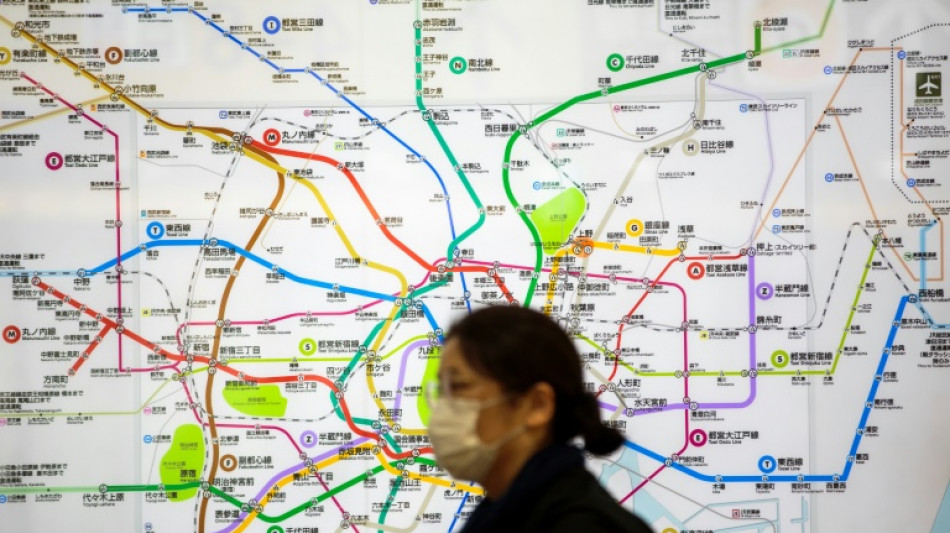
Tokyo Metro: Asia's oldest subway goes public / Photo: © AFP

 STARPRIME Responds to Diverging Gold Market Demand with AM/PM Fixing and XAU24/7
 Ukrainian fashion designer debuts art between air raids

 Gambian businesses struggle under prolonged blackouts
 Fiji declares national HIV crisis
 Australia to cut migration to fix housing crisis: minister

 NASA scan discovers new, 'once in a century' Moon crater
 Most stocks rise as Fed hikes and indicates drive to curb inflation
 US again denies Palestinian leader Abbas visa to attend UN assembly
 Lula says he will go to UN to tell Trump to 'stay out' of Brazil's elections
 Messi heads Inter Miami to Campeones Cup triumph
 AI looms large ahead of Xi, Trump summit

 Smith still haunted by 'Sandpapergate' as he prepares for South Africa Tests
 UK-Sudanese author pens book to give children 'African history of Africa'

 Boehly and Walter sell Chelsea stake to Clearlake Capital
 US House backs data center power cost bill amid midterm backlash
 US Congress passes sweeping Russia sanctions bill

 Barca hit Racing for seven as Atletico crush Osasuna

 US Fed raises rates to tackle 'too high' inflation, irking Trump
 Man Utd misery mounts after League Cup collapse against Brighton
 Turkey releases 106 protesters, jails more LGBTQ activists

 US Fed raises rates to tackle 'too high' inflation in move sure to rile Trump

 England were 'waiting for death' in World Cup semi-final defeat: Tuchel

 NFL star fined for displaying name of slain Palestinian girl
 Witsel retires from internationals after 18-year Belgium career
 US Fed raises rates to battle inflation in move likely to rile Trump

Every day six and a half million people ride Tokyo Metro's nine lines, part of a dizzyingly complex transport network serving the Japanese megacity and its sprawling suburbs.
Tokyo Metro shares rocketed more than 40 percent on their stock market debut Wednesday, raising $2.3 billion in Japan's biggest initial public offering (IPO) in six years.
Here are some facts about the company and its listing:
- Asia's first subway -
London built the first public underground railway, but in 1927 Tokyo became the first Asian city with a subway thanks to a 2.2-kilometre (1.4-mile) track from Ueno to Asakusa.
The trains ran every three minutes on what is now part of Tokyo Metro's modern-day Ginza Line but were crowded with passengers who previously overran the city's trams.
Having slowed during and after World War II, construction of public transport picked up pace as Japan rebuilt itself into a major economic power.
The company Tokyo Metro was incorporated in 2004, adopting its heart-shaped "M" logo in place of the network's previous one: a spiky, space-age "S" for subway.
- Complex map -
Tokyo Metro's nine lines -- named Ginza, Marunouchi, Hibiya, Tozai, Chiyoda, Yurakucho, Hanzomon, Namboku and Fukutoshin -- stretch for a total of 195 kilometres.
The spotless and punctual air-conditioned trains form only one part of a vast underground and overground rail system serving Greater Tokyo, often cited as the world's biggest urban area.
All but two of the nine Tokyo Metro routes connect to other train lines, allowing direct access to the capital for commuters in farther flung areas.
Four other subway lines are run separately by the Tokyo government, alongside private services and East Japan Railway's overground routes like the Yamanote Line, whose green trains carry millions in a loop around the city.
Unique jingles are played at each Tokyo Metro station when a train is at the platform.
For example, at Ginza Station, the Marunouchi line's tunes are called "Tomorrow's Door" and "The March of a Little Bird".
- IPO -
The IPO is Japan's largest since 2018 when tech and telecoms conglomerate SoftBank Group raised a national record of $23.5 billion by listing its mobile unit.
On Wednesday morning, Tokyo Metro shares traded at 1,745 yen, up 45 percent from their issue price of 1,200 yen, with reports saying the issue was 15 times oversubscribed among investors.
Before the IPO, the national government owned just over half of Tokyo Metro shares and the Tokyo city government owned the rest. The listing reduces total state ownership to around 50 percent.
The funds raised will be used to repay bonds issued to finance the reconstruction of northeastern Japan after the 2011 earthquake, tsunami and nuclear disaster that killed 18,000 people.
- Free tickets -
Tokyo Metro says investors who buy 200 shares or more will receive some free tickets to its museum and golf range, as well as free tempura toppings at its noodle stands.
The "low volatility" of a firm like Tokyo Metro makes their shares a safe investment prospect for Japanese households, said Hideaki Miyajima, a professor of commerce at Waseda University.
"And for institutional investors, the Japanese market is very favourable given the very low exchange rate" of the yen and recent corporate governance reforms, he told AFP.
- Going underground -
In earthquake-prone Japan, Tokyo Metro trains are set up to stop just before a powerful jolt hits, using real-time seismic data from monitoring stations.
Climate change is also bringing more frequent and intense flooding to the capital, with some Tokyo subway stations inundated in August by torrential rain.
Also buried beneath the Greater Tokyo area is the world's largest flood tank, a cavernous subterranean reservoir built to protect the metropolis from storms and typhoons.
L.Stucki--VB