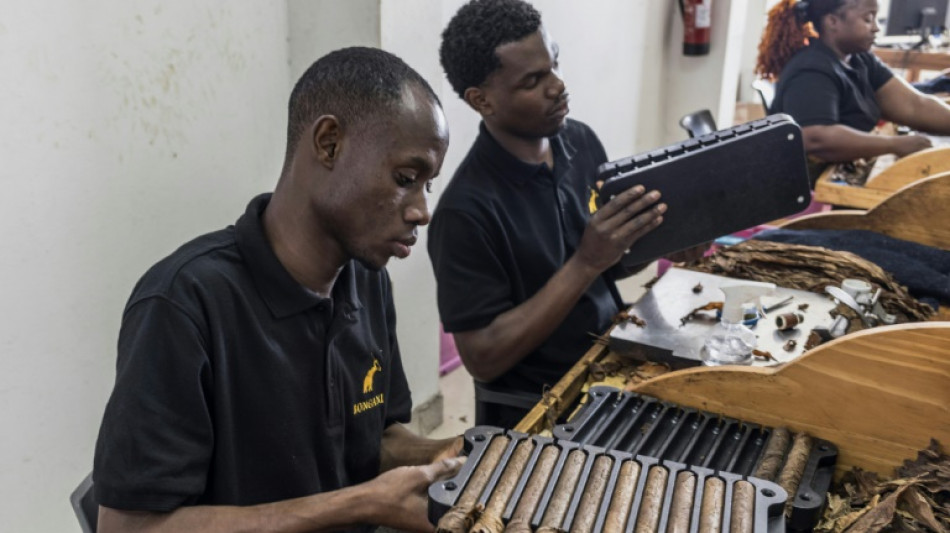
In Mozambique, cigars 100% made in Africa / Photo: © AFP

 Ninth woman found dead in South Africa killing spree

 Smog scuppers Japan force helping fight Indonesia wildfires

 King Charles to call on tech giants for 'reassurances' over AI

 Lebanon security talks in Paris focus on replacing UN mission

 Most stocks rise as Fed hikes and oil prices drop

 'Vande Mataram': Why is India's freedom song in spotlight?
 Counterculture pop artist Peter Max dies at 88: US media
 Asian Games chief defends 'functional' rooms after backlash

 Leader's sister says only 'idiots' think N. Korea to give up nukes

 World's water cycle becoming more unpredictable, UN warns

 Where the US-China tariff row stands ahead of White House summit

 Croc-habitat gets green light for 2032 Olympic rowing

 Indonesia cash-for-photos scheme turns animal hunters into protectors

 'Left-field' life: Briton becomes Thailand's top foreign monk

 India's transgender amendment leaves many in limbo

 Trump to host Xi amid pomp, low expectations

 Harry set for UK public outings with security, royal status hazy

 NFL Chiefs' Kelce among investors bilked in Ponzi scheme

 Trump threatens EU over 'hostile' Canada association plan

 Argentine judge orders suspension of Falklands oil project

 Carrick takes the blame as troubled Man Utd suffer League Cup misery

 Barcelona hit seven in Racing Santander rout

 Amorim's Milan beaten by Benfica, Sunderland make dream European return

 US stocks fall, dollar gains after Fed lifts interest rates

 Seahawks rule out Darnold for Sunday game at Arizona

In a small neon-lit factory in Maputo, a dozen workers are hand-rolling premium cigars intended for the global market, seemingly undisturbed by the pungent tobacco smell.
Sitting at wooden benches, men and women stack tobacco leaves in one hand –- the components must be dry but soft, like the velvety texture of leather.
A large wrapper leaf made in Cameroon and recognisable by its delicate finish is torn in half before being rolled around the cigar, its last layer.
"Not many people know about African cigars" and that some are produced in Mozambique, said Eugenia Mauaie, with a proud smile. The 38-year-old has been working at Bongani Cigars since the company was founded eight years ago.
The tobacco is mainly made in Mozambique, but for some products it comes from the Dominican Republic, a key producer for cigar aficionados.
Anthony Padilla Perez, who runs the workshope, grew up in the Caribbean nation in a family of tobacco producers.
"Each leaf has a function: its burning quality, its strength and its smell," said the 38-year-old, sporting a shaved head and trimmed goatee.
Once the tobacco is rolled and a wrapper applied, a worker cuts each end of the cigar to the required size and places it in a mold for at least 24 hours to get the desired shape.
The last step is finishing the tip, which is made round with small pieces of tobacco cut and stuck together with a drop of vegetable gum.
- Adventurous bet -
"There was a gap to fill here in Mozambique, where the climate and soil are great for quality tobacco production," said Perez.
An African cigar, "surprises consumers" he said, and "makes people curious" about the brand, which translates to "be grateful" in Zulu.
The founder, Kamal Moukheiber, got the idea "probably one drunken night", he joked, in a cafe ion Maputo where he was on a business visit.
"I was with some friends and I saw people smoking cigars. And I wondered: why are there no African cigars?"
"Often, raw materials are produced in Africa and shipped elsewhere to be repackaged and rebranded," said Moukheiber, like coffee or chocolate, depriving the continent of much needed resources.
The 55-year-old Lebanese who used to work in finance in London and had "never produced anything", launched the company after thorough research, to try something new.
His first Bongani cigars were sold in a shop in Mozambique in 2016. He now employs a dozen people and manufactures 10,000 to 12,000 cigars per month.
About a third of the cigars are shipped across Africa, with Mozambique and South Africa its largest markets, but they are also available online.
Another third is sold in the United States and the last third in Europe, where they are popular among black consumers, Moukheiber said.
Priced at 13 dollars a piece, each model has to be perfectly crafted, "otherwise you don't have a business", said the entrepreneur, who travels the world to market his brand in a competitive industry.
L.Stucki--VB