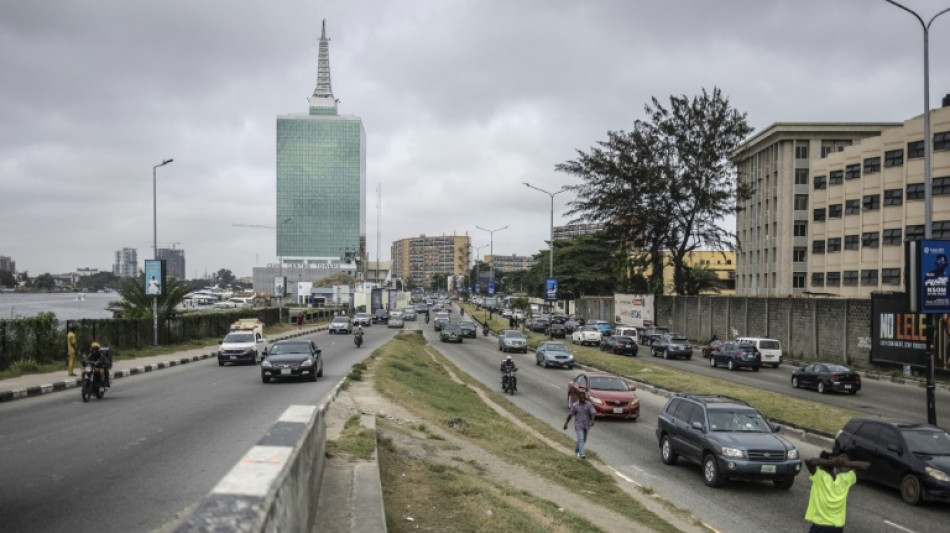
Nigerians sacrifice cars as cost of living crisis worsens / Photo: © AFP

 Princess Diana's brother makes new explosive claims against Charles

 Ovechkin on Russian political video: 'I support my country'
 Can we shut down AI?
 Teenager Sullivan named in new-look US squad

 Travis Scott and Keith Richards feature on GTA VI soundtrack

 AFP photo shows Trump examining image of apparent Kennedy Center razing
 Pochettino rings changes for USA friendlies

 Alonso says Chelsea ambition 'very clear' after end of Boehly era

 Mbappe draws political fire over Ceuta t-shirt controversy
 Third malaria death in Germany from outbreak tied to Frankfurt airport
 AtlasClear Holdings Reports Preliminary Fiscal 2026 Revenue of Approximately $20.1 Million, Up 85%; Revenue Plus Interest Income of Approximately $21.9 Million

 Alonso says Chelsea ambition clear after end of Boehly era
 Micron's Taiwan workers say 68 months' bonus not enough
 'Another arrow to the quiver': World Bank posts record private capital mobilization
 Macron hosts Lebanon security talks as UN mission nears end
 From land to race laws: what's driving the US-South Africa rift?

 Beyond Investment Returns: Families Are Measuring Wealth by Freedom, Continuity, and Legacy, According to Nour Private Wealth
 King Charles disputes claims in book by Princess Diana's brother
 Real Madrid fan group wants Mbappe apology over Ceuta shirt snub

 Nepal floods among 'most challenging' disasters: WFP

 Doubts as Italy eyes electric future for steel plant
 'One of the kindest people': Taraneh, 21, facing execution in Iran

 Japan eyes changing prostitution law to punish sex buyers

 After record rain, typhoon threatens new challenge to Asian Games
 Kids and social media: what would change under new EU law
Nigeria's economic crisis and soaring petrol prices forced Bolaji Emmanuel to give up his driver and his Honda Pilot utility vehicle, as he struggles with spiking living costs.
Emmanuel is not alone. Many in Africa's most populous country are abandoning their cars as the costs strain disposable income.
The price of petrol has risen more than fivefold since President Bola Tinubu took office in May 2023.
"I parked it at my son's house. I use public transport now," Emmanuel, a 72-year-old retired health worker, told AFP. "It is not convenient, but it is what the economy demands."
Since coming to power, Tinubu has ended a costly fuel subsidy and freed up the naira currency, in reforms that government officials and analysts say will revive the economy and attract investors.
But in the short term, Nigeria has seen one of its worst crises in decades with inflation at a three-decade high.
A litre of petrol sold for around 195 naira just before Tinubu took office. The price rose to at least 998 naira ($0.61) per litre in Lagos and 1,030 naira in the capital, Abuja, at the beginning of October. It can go for as much as 1,300 naira elsewhere.
Inflation reached an almost three-decade high of 34.19 percent in June. It has since slowed to 32.7 percent in September.
The slump in purchasing power is piling more hardship on locals, with more than 40 percent of the population living in poverty, according to the World Bank. That figure is expected to rise in 2024 and 2025, before it stabilises in 2026.
The Nigerian middle class, which made up about 20 percent of the population in 2020, now readily sacrifices the comfort of private cars for survival.
Car dealers in Lagos and Abuja told AFP that they had seen more and more people trading their fuel-guzzling cars and sports utility vehicles (SUVs) for more efficient vehicles to cut costs.
"People are actually selling their big cars these days," Maji Abubakar, a car dealer in Abuja, told AFP. "The problem is that even if you put them on the market, there isn't much demand for them."
"It has been more than a year since I sold a car with an eight-cylinder engine, and the major reason is the price of petrol," he added.
With fewer cars on the road, even the notorious Lagos traffic, known as "go-slow", has thinned out.
- Used or Chinese cars, bicycles -
Elijah Bello, a tech entrepreneur in the southern state of Ogun, has looked for a buyer for his Lexus RX 350 SUV for months.
He has since bought a smaller, energy-saving Toyota Corolla to replace it.
The trend, which began last year, "will intensify" and "we will see fewer cars on the roads", said Bunmi Bailey, head of research at SBM Intelligence risk consultancy.
Bailey can fill his small car for 55,000 naira. "I can use it for two weeks for my normal home-to-work movement," he told AFP, while his larger car consumes 110,000 naira worth of petrol in just eight days.
The market for new cars has dropped by 10 to 14 percent in the last year, said Kunle Jaiyesinmi, deputy director at the Lagos-based CFAO Group, which specialises in automobile distribution.
"An SUV that sold for 40 to 45 million naira ($24,000 to $27,000) about two years ago, for now, if you want to negotiate the price, you see that it is within the range of 95 or 100 million ($57,000 to $60,000)," Jaiyesinmi told AFP.
But unyielding inflation and high exchange rates are steering more middle-class people away from used Japanese- and American-brand cars, toward increasingly popular Chinese-made ones.
Some are turning to bicycles, despite the lack of appropriate infrastructure in cities like Lagos, where car crashes are common.
"Sure, we notice (a rise in) cycling... for months since the fuel hike," said Femi Thomas, head of FT Cycle Care, a Lagos-based organisation that promotes cycle use.
Food delivery platform Glovo said it had recorded a growing interest in bicycle deliveries among its riders.
About 20 percent of orders are delivered by bike, Chidera Akwuba, the group's public relations manager in Nigeria, told AFP.
O.Schlaepfer--VB