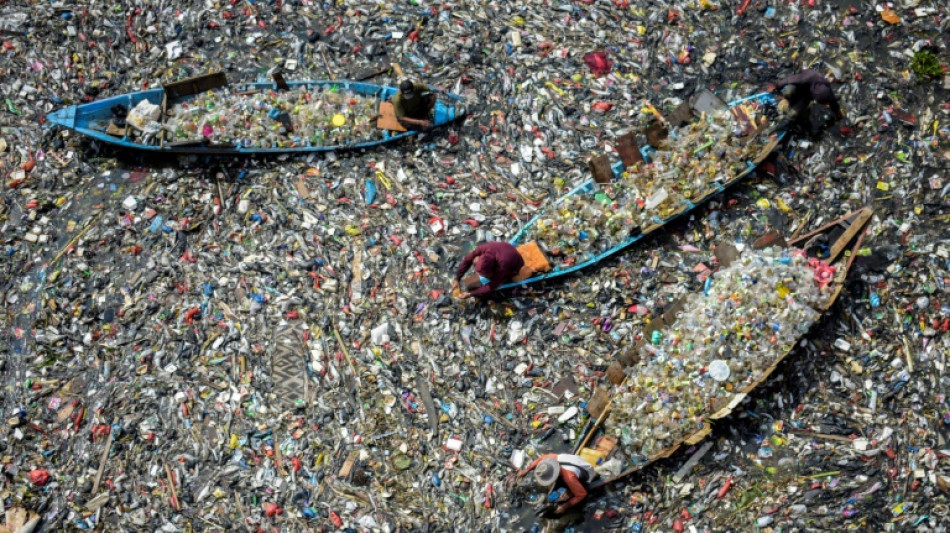
Experts meet as final global plastic treaty talks near / Photo: © AFP/File

 Bacteria suspected in deaths of hundreds of baby whales off Argentina

 US 'must choose' whether to end war: Iran president to Fox News

 UN approves resolution on dealing with rising sea levels

 Yalcouye makes dream debut as Ivory Coast beat Ghana in AFCON qualifier
 Chicago's White Sox and Cubs book MLB playoff berths

 Last-gasp Gakpo strike snatches Dutch draw to sour Klopp debut

 Global stocks mostly fall as oil prices and bond yields rise

 Israel's Netanyahu denounces enemies, allies in fiery UN speech
 Hollywood stars among arrests in NY anti-Netanyahu protest

 Losing start in AFCON qualifying for 78-year-old coach Le Roy
 Italy bans burqas in schools, caps numbers of foreign students per class

 Israel policies threaten 'life and existence' of Palestinians, Abbas says

 Paolini steers Italy past China in BJK

 Zidane admits emotion on eve of first game as France coach
 Breetzke and Maharaj sink Australia in first one-day international

 Zelensky broke confidentiality with North Korea POWs disclosure: South's president

 Former Liverpool star Carroll reveals he was sexually assaulted
 Dominican Republic calls for Haiti force to be strengthened
 Dolly Parton's nephew ordered to stay away from estate staff, properties

 Early exit for Philippine darling Eala at Singapore Open

 Hurricane Polo triggers huge waves in coastal Mexican city
 What happens if the US bans diesel exports

 Macklemore hits back with 'Free Palestine Tour' after Sheeran split

 Met Opera to give New Yorkers free tickets in affordability push

 Top ECB official to resign to take up IMF role

With months until crunch talks on the world's first binding treaty on plastic pollution, experts are meeting in Bangkok to discuss financing options and problematic plastics.
The four-day gathering is a largely technical waypoint on the road to final negotiations in late November in South Korea's Busan.
There, countries are hoping to seal a potentially groundbreaking deal to tackle the gargantuan problem of plastic pollution.
The scale of the issue is almost unprecedented -- microplastics have been found in the deepest ocean trenches, highest mountain peaks, in clouds and even breastmilk.
Plastic production has doubled in 20 years and at current rates it could triple by 2060, according to the Organisation for Economic Cooperation and Development (OECD).
Yet over 90 percent of plastic is not recycled, with much of it dumped in nature or buried in landfills.
Negotiators have already met four times to discuss a deal that could include production caps, unified rules on recyclability, and even bans on certain plastics or chemical components.
But significant gaps remain, including on whether the treaty will be adopted by consensus or a majority vote.
Other flashpoints include whether plastic production will be addressed, Eirik Lindebjerg, global plastics policy lead at WWF, told AFP.
"Is it within the scope to talk about production, or does the value chain start after plastic products are made? And then if we can regulate production... is it with a cap, is it with a reduction target, what are the measures?" he said.
"That's been a very contentious issue."
Environmental groups have long argued that the treaty must include curbs on new plastic, a position backed by dozens of countries who call themselves the "high ambition coalition".
They may now have a powerful ally in the form of the United States, which has reportedly thrown its backing behind some production limits.
That shift has been welcomed by environmental groups, though Lindebjerg warned it was not yet clear if Washington would back mandatory caps or weaker voluntary limits.
- 'Unresolved matters' -
Just how binding the deal will be is another source of contention.
Some countries want measures like a unified timeline for phasing out certain plastics, while others back vaguer language that would let nations decide how and when to regulate.
And, as with climate negotiations, finance for implementing whatever is agreed remains hugely controversial.
"Some countries want money, and some countries don't want to give money, very simply put," said Lindebjerg.
Two expert groups are meeting in Bangkok, with one focused on financing, including technical details on waste management systems and how to implement "polluter pays" principles.
The second group will focus on a framework and criteria for chemicals, plastic materials and plastic products that could be targeted for bans or reductions in the treaty.
The meetings are advisory and are being held behind closed doors, to the dismay of some environmental groups and industry.
"There are still a lot of unresolved matters," warned Chris Jahn, council secretary of the International Council of Chemical Associations, which represents the global chemical industry.
The group opposes language that would regulate chemicals or cap plastic production.
"Plastics are essential in order for the world to achieve its sustainable development and climate change goals," Jahn said, pointing to uses from solar energy to food preservation.
The American Chemistry Council last week warned US backing for production caps would "betray" US manufacturing and risk jobs.
The industry does back efforts to promote the reuse of plastics and new designs to make recycling easier, Jahn said, as well as rules to make producers pay for plastic pollution.
And despite the remaining gaps, there is cautious optimism that a robust deal is possible.
"I think that we're really at a historic opportunity here," said Lindebjerg.
F.Stadler--VB